
There are questions that seem trivial until you tug on them a little, and then the whole sweater of history begins to unravel in your hands. “Mary Ann or Ginger?” is one of those questions. It sounds like barstool nostalgia, the kind of thing settled sometime around the third cup of coffee. But buried inside that choice is something the Founders would have understood instantly, and most of us, if we are honest, no longer do.
Mary Ann was not just the wholesome one. She was coded. Her unseen relatives, George and Martha, were not random names tossed into a script. They were a quiet signal to an audience that still carried a shared historical memory. In the 1960s, you did not need that explained. You simply knew. The reference landed, the meaning followed, and the culture held together just a little tighter.
Today, that connection slips past unnoticed, like a ship in fog.
And that is where this episode begins.
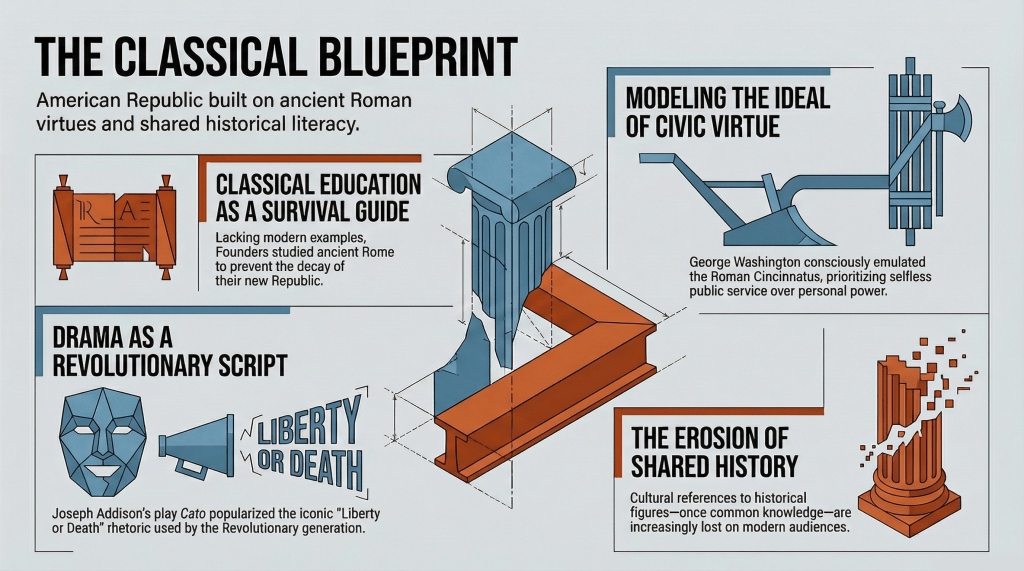
Because if you want to understand the American Founders, you have to step into a world where history was not optional. It was the air they breathed. These were men who read Livy and Tacitus the way we scroll headlines, searching not for amusement but for survival. They had no modern republic to imitate, no friendly guidebook waiting on a shelf. So they turned to Rome, not as tourists, but as investigators at the scene of a very old crime.
What killed the Roman Republic?
That question haunted them.
And the answers did not stay confined to dusty books. They came alive on stage through Joseph Addison’s play Cato. A story of defiance, of principle, of a man who would rather die than bend the knee to tyranny. This was not mere entertainment. It was a shared script. Washington had it performed at Valley Forge while his army froze. Let that sink in. When things were at their worst, he reached not for comfort, but for history.
The Founders did not just admire the past. They tried, in their imperfect and very human way, to live up to it. They built a system that assumed virtue would falter and power would tempt. Checks and balances were not acts of optimism. They were acts of caution, carved from hard lessons learned two thousand years earlier.
Which leaves us with a question that lingers long after the music fades out.
If they built a republic on a shared understanding of history… what happens when that understanding disappears?
It is not a loud collapse. It is quieter than that.
It starts when we stop getting the reference.


 DAVE DOES HISTORY
Leave a comment