
The winter wind coming off the Chesapeake in late 1775 carried more than salt air. It carried rumor, fear, and the strange hollow feeling that comes when ordinary people realize the government no longer trusts them. Virginia was not yet fully revolutionary in spirit, at least not the way Massachusetts had become after Lexington and Concord. The colony still had deep cultural ties to Britain. The Anglican Church remained established by law. Wealthy planters still sent their sons to England for schooling and their tobacco to English markets. If any colony should have remained loyal to the Crown, it probably should have been Virginia.
Instead, Virginia became one of the places where the illusion finally shattered.
By the close of 1775, the colony existed in a strange suspended state, neither fully governed nor fully independent. Commerce, the bloodstream of Tidewater Virginia, had begun to clot. British naval patrols prowled the Chesapeake like watchmen who had stopped pretending they were there for protection. Ships were halted and searched. Cargoes disappeared into royal custody. Cannon vanished from public magazines. Ports found themselves under constant observation. Men who had spent their entire lives thinking of the Atlantic as a highway suddenly understood it could also become a wall.
Jefferson would later write in the Declaration of Independence that the King had “plundered our seas.” Modern readers sometimes glide past that phrase because it sounds abstract, almost poetic. It was not abstract to Virginians watching British patrol ships inspect merchant vessels at gunpoint. It was not poetic to captains whose livelihoods disappeared into imperial confiscation. The empire was not behaving like a parent government trying to restore calm. It was behaving like an occupying force that had begun treating its own subjects as suspects.
That shift mattered more than people often realize. Governments survive all kinds of disagreements. Taxes can be negotiated. Parliamentary acts can be repealed. Politicians can insult each other for generations and still somehow stagger forward together. But once trade routes become militarized and daily life starts moving at cannon range, trust evaporates quickly. The Atlantic itself became hostile territory.
No man embodied that transformation more dramatically than John Murray, the Earl of Dunmore, royal governor of Virginia. Dunmore had once governed from Williamsburg with all the expected rituals of imperial authority. There were assemblies, receptions, polite political maneuvering, carefully written letters carried by servants through candlelit corridors. That world collapsed astonishingly fast. Hostility toward the governor intensified throughout 1775, especially after the gunpowder incident and the growing confrontations with the House of Burgesses. Eventually Dunmore reached a blunt conclusion. He could no longer trust the ground beneath his own feet.
So he fled.
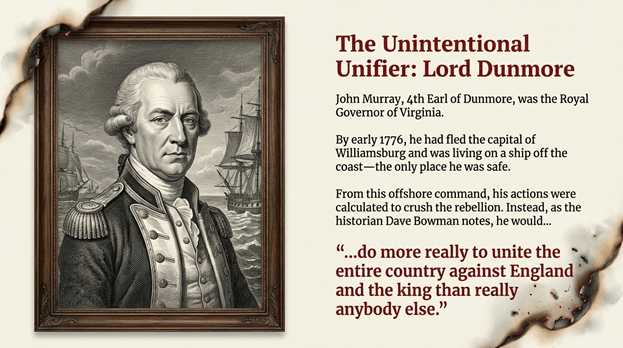
That single act carried enormous symbolic weight. Dunmore abandoned Williamsburg and retreated to the safety of the Royal Navy anchored offshore. The governor of Virginia now ruled from the deck of a warship.
It is difficult to overstate how ominous that looked to ordinary colonists. A governor in a capitol governs through institutions. A governor aboard a frigate governs through intimidation. One speaks through assemblies and proclamations. The other speaks through broadsides. The physical relocation of British authority from land to sea sent a message far louder than any speech Parliament could have delivered.
The King’s power now floated offshore behind rows of naval guns.
For Virginians, this confirmed something they had begun to suspect but had not fully admitted aloud. Britain no longer trusted the constitutional relationship that had once bound colony and Crown together. Imperial authority had ceased relying on consent and begun relying on force. The empire now communicated through cannon ports.
There is an old tendency in modern discussions to imagine tyranny arriving dramatically, perhaps accompanied by martial music and obvious villains dressed like something from central casting. History is usually less theatrical. Most tyranny arrives wearing administrative language. It insists it is temporary. Necessary. Procedural. The British naval patrols stopping ships in the Chesapeake were not pirates. They wore uniforms. They carried commissions. They operated under legal authority. Yet the practical effect on colonial life felt increasingly indistinguishable from organized coercion.
This was what “plundered our seas” looked like in real time.
The irony was that British officials believed these actions would restore obedience. Like many governments confronting unrest, they mistook fear for stability. The logic seemed straightforward enough from London. Demonstrate overwhelming force, isolate the radicals, pressure the economy, and the colonies would settle down. The difficulty was that Americans did not experience these measures as discipline from a lawful parent state. They experienced them as humiliation.
Every confiscated cargo, every intercepted merchant vessel, every warship looming offshore pushed moderate colonists closer toward resistance.
Norfolk stood directly in the center of this growing storm. In early 1776 it was Virginia’s largest port and its commercial lifeline, crowded with warehouses, taverns, ropewalks, and docks thick with Atlantic trade. Norfolk was not uniformly revolutionary. Loyalists and Patriots lived side by side there, often uneasily. Merchants worried about preserving commerce more than ideology. Some still hoped reconciliation remained possible. Others already believed war had become unavoidable.
What everybody understood, however, was that whoever controlled Norfolk controlled Virginia’s coastline.
Patriot forces moved into the town largely for defensive reasons. They feared Dunmore would transform Norfolk into a permanent British naval base capable of projecting power deep into Virginia. From the Patriot perspective, occupying the city was preventative. From Dunmore’s perspective aboard his ships offshore, it looked like outright rebellion.
Distance has a way of hardening men. So does humiliation. Dunmore had already watched royal authority crumble across much of Virginia. He had retreated from the colonial capital to floating exile. His Ethiopian Regiment, formed after his proclamation offering freedom to enslaved people who joined British forces, had suffered defeat at Great Bridge in December 1775. The rebellion was spreading, not shrinking.
And so, sitting offshore amid the guns of the Royal Navy, Dunmore increasingly saw force as the only remaining language available to him.
This is the dangerous thing about governments that begin ruling through fear. Eventually every act of resistance starts looking like provocation. Every disagreement becomes defiance. Every compromise appears weak. Once that psychology takes hold, escalation becomes almost inevitable.
For Virginians watching these events unfold, the transformation was impossible to miss. British authority no longer resembled constitutional government. It resembled siege warfare.
A strange reversal had taken place. The Patriots ashore increasingly spoke the language of rights, assemblies, and inherited liberties. The representatives of the Crown increasingly spoke through naval patrols and military pressure. The side claiming to preserve order looked progressively dependent on coercion to maintain it.
That contradiction gnawed at people who had not yet fully embraced independence. Many colonists still considered themselves loyal British subjects in some emotional sense. They did not necessarily want revolution. What they wanted was the restoration of what they believed had once existed, a constitutional balance between colony and empire.
But history rarely pauses politely for moderation to catch its breath.
The atmosphere along the Virginia coast by the opening days of 1776 felt less like political disagreement and more like approaching catastrophe. Refugees drifted inland carrying stories of British ships and military raids. Merchants watched trade collapse. Local militias hardened into something more serious. Families quietly buried valuables or hid supplies. Every rumor traveled fast because everybody sensed events were moving toward some irreversible conclusion.
And looming offshore through it all sat Dunmore’s fleet.
There is something haunting about the image even now. A governor without a colony, clinging to imperial authority from the deck of a warship while the society beneath him slips beyond his grasp. He had not merely left Virginia. He had carried British sovereignty out onto the water and wrapped it in naval artillery.
For many Virginians, that became the final revelation.
If the King could only rule them through ships and guns, then perhaps he no longer ruled them at all.
The Declaration of Independence would later condense all of this into a single sharp accusation, that the King had “plundered our seas, ravaged our coasts, burnt our towns.” Those words did not emerge from abstraction or philosophical theory. They came from men remembering what it felt like to watch imperial power drift offshore and point its cannons back toward home.
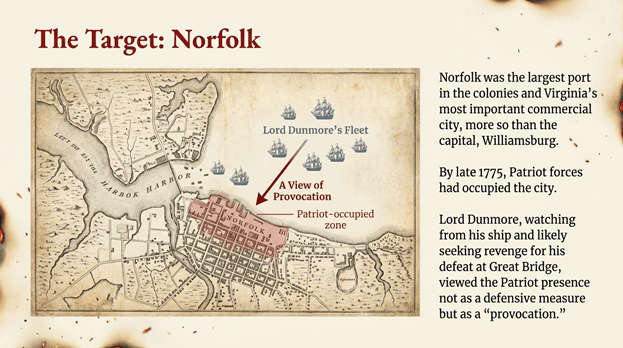
Norfolk sat on the edge of revolution long before the first British shell screamed across its harbor. By the winter of 1775, the city had become the most important port in Virginia and one of the most strategically valuable towns in the colonies. Tobacco moved through its docks. Merchant ships crowded its waterfront. Warehouses stacked with rope, tar, flour, rum, naval supplies, and imported goods stood shoulder to shoulder along narrow streets that smelled of saltwater and smoke even on ordinary days. If Williamsburg was Virginia’s political heart, Norfolk was its economic pulse.
And like many important port cities in history, it was divided against itself.
Some citizens leaned toward the Patriot cause, convinced Britain had already crossed too many constitutional lines to retreat peacefully. Others remained loyal to the Crown, or at least loyal to commerce, which often amounted to the same thing in practical terms. Merchants worried about what independence might do to trade. Families with British ties feared mob rule more than imperial authority. Dockworkers and sailors tended to think less ideologically and more immediately. They wanted ships moving and wages paid.
The city balanced uneasily between rebellion and loyalty, right up until the moment balance became impossible.
That uncertainty mattered because Norfolk occupied a dangerous position in the geography of the war. Whoever controlled the city controlled access to Virginia’s coastline and much of the Chesapeake region. Patriot leaders understood immediately that allowing the British Navy to establish a permanent operational base there would be catastrophic. Royal ships could raid inland communities, seize supplies, disrupt commerce, and project military force deep into Virginia whenever they pleased.
So Patriot militia forces moved into Norfolk not because they wanted destruction, but because they feared occupation.
That distinction would disappear quickly once the shooting started.
Lord Dunmore watched these developments from offshore aboard the British fleet. His position had become increasingly desperate by the closing days of 1775. The governor who had once presided ceremonially over Virginia’s government now lived effectively as a floating exile. His authority rested not on colonial institutions anymore, but on the guns of the Royal Navy and whatever troops he could still command.
Humiliation has a way of narrowing political imagination. Men who feel cornered begin mistaking escalation for decisiveness. Dunmore already believed the rebellion in Virginia had to be crushed through force. The Patriot occupation of Norfolk confirmed his fears that the colony was slipping permanently from British control.
He chose violence.
On January 1, 1776, while many Virginians probably still hoped the new year might somehow bring stability, British warships opened fire on Norfolk.
There was no real ambiguity about what happened. No ceremonial warning shots drifting harmlessly overhead. No careful demonstration meant merely to intimidate. This was bombardment. Heated shot tore into the waterfront district where buildings stood tightly packed together, built largely from wood seasoned by years of Atlantic weather. Tar stores, warehouses, ropewalks, and shipyards turned the city into a tinderbox waiting for a spark.
Dunmore provided the spark.
The first explosions shattered more than structures. They shattered whatever fragile belief remained that Britain intended reconciliation on honorable terms. Families fled carrying whatever possessions they could gather in panic. Horses broke loose through smoke-filled streets. Merchants watched entire livelihoods erupt into flame. Sailors stumbled through chaos trying to salvage cargo before warehouses collapsed around them.
And once the fires started, Norfolk never really had a chance.
Eighteenth-century cities were extraordinarily vulnerable to urban fire even under ordinary circumstances. Add naval bombardment, winter winds, and densely packed commercial buildings, and the result became almost inevitable. Flames leapt from rooftop to rooftop. Smoke swallowed entire blocks. The waterfront transformed into an inferno visible for miles across the harbor.
Historians still argue about the exact sequence of destruction afterward. Patriot forces, recognizing that the city might fall fully into British hands if portions remained intact, made the grim decision to continue burning what survived the initial bombardment. Buildings that had escaped the first wave of fire were deliberately destroyed to deny shelter and infrastructure to the enemy.
This has led generations of historians into endless debates about culpability. Who burned more of the city? Which structures fell first? Which side bears ultimate responsibility?
But those arguments tend to sound strangely bloodless compared to the experience of the people actually standing there watching Norfolk vanish.
To the families fleeing inland with smoke rolling behind them, the distinctions hardly mattered. The British had fired first. Everything else followed from that fact.
That reality settled into the colonial imagination with tremendous force. The destruction of Norfolk was not experienced as a complicated military controversy. It was experienced as proof. Proof that the empire would burn colonial cities to preserve authority. Proof that military intimidation had replaced constitutional government. Proof that moderation no longer had anywhere solid to stand.
This is one of those moments where the emotional temperature of the Revolution changed permanently.
Up to this point, many colonists still spoke hopefully about reconciliation. Even after Lexington and Concord, even after Bunker Hill, there remained people who believed some negotiated settlement might restore the old constitutional relationship. The Continental Congress itself spent much of 1775 performing a strange balancing act, preparing for war while simultaneously petitioning for peace.
Norfolk burned straight through that illusion.
Compromise does not rise naturally from ashes. Bombardment has a way of clarifying political questions very quickly. Men who might argue endlessly about taxation or parliamentary sovereignty become less patient when their cities are collapsing into firestorms.
The destruction also exposed something deeply unsettling about British strategy. The attack achieved little meaningful military advantage. Norfolk was damaged beyond immediate usefulness to either side. Commerce collapsed. Civilians suffered enormously. Refugees scattered through the countryside. The practical result looked less like disciplined warfare and more like punishment.
That mattered because Americans had begun drawing a dangerous conclusion about imperial behavior. Britain increasingly appeared willing to destroy colonial society in order to save imperial authority.
Once people start believing that about a government, legitimacy dies quickly.
Jefferson’s grievance in the Declaration of Independence later captured this shift with startling precision: “He has plundered our seas, ravaged our coasts, burnt our towns, and destroyed the lives of our people.”
Modern readers sometimes treat those lines as exaggerated revolutionary rhetoric, the sort of heated language common in political disputes. Norfolk changes the meaning entirely. After January 1776, those words were no longer abstractions. They were eyewitness testimony.
“Ravaged our coasts” was no longer metaphorical. Virginians had watched British warships dominate their coastline through force and intimidation.
“Burnt our towns” was no longer political theater. Norfolk still smoldered.
And perhaps most importantly, the destruction killed moderation itself.
That sounds dramatic, but revolutions often turn not on ideology alone, but on moments where ordinary people decide the existing system can no longer protect them. Norfolk became one of those moments. Men who might have tolerated taxes could not tolerate bombardment. Merchants who feared rebellion began fearing British power more. Neutrality started looking impossible.
The center collapsed.
There is a tendency in modern discussions to imagine revolutions emerging from fiery radicals dragging hesitant populations toward extremism. History is usually more complicated. Often revolutions succeed because governments radicalize moderates faster than revolutionaries do.
Dunmore accomplished exactly that.
The irony is difficult to miss. Britain intended these displays of force to restore obedience. Instead they accelerated separation. The burning of Norfolk did more to convince Virginians that coexistence had become impossible than countless pamphlets ever could.
Ash has a strange honesty to it. Political speeches can be denied. Parliamentary debates can be reframed. Royal proclamations can be softened with careful language. Burned cities speak more plainly.
Norfolk spoke plainly.
By the time Jefferson sat down months later to draft the Declaration, he did not need to invent accusations against the Crown. He only needed to remember Virginia in flames.
Dunmore crossed a line in November 1775 that transformed the Virginia crisis from political rebellion into something far more primal and terrifying. Up to that point, many colonists still believed the conflict might remain limited, perhaps even reversible. There had been violence already, certainly. Blood had spilled in Massachusetts. Norfolk smoldered. Trade collapsed under naval pressure. Yet many moderate Virginians still imagined the struggle largely in constitutional terms. Parliament versus colonial assemblies. Taxation versus representation. Rights versus authority.
Dunmore changed the argument completely.
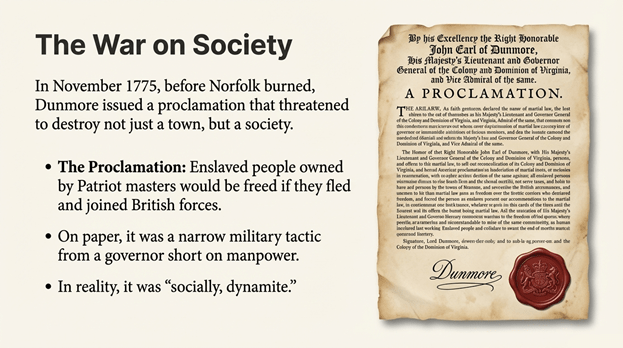
On November 7, 1775, aboard the British warship William, the royal governor issued a proclamation declaring martial law in Virginia and offering freedom to enslaved people belonging to Patriot masters if they fled and joined British forces.
The military significance of the proclamation was limited. The psychological impact was enormous.
To understand why, one has to remember what Virginia actually was in 1775. This was not merely a colony arguing about taxes. Virginia was a slave society balanced atop profound demographic fear. In many regions, enslaved Africans and African Americans constituted enormous portions of the population. Wealth, agriculture, political power, and social hierarchy all rested upon slavery. White Virginians disagreed bitterly about Parliament, trade policy, and constitutional theory, but underneath those disagreements lay one shared anxiety stronger than almost anything else.
Fear of slave insurrection.
Dunmore understood that fear perfectly.
Whether he grasped the full moral implications of what he unleashed is another question entirely. Like many imperial officials throughout history, he saw social divisions primarily through the lens of strategic utility. If the rebellion depended upon slaveholding planters, then threatening slavery itself might destabilize resistance. Militarily, the idea made sense on paper. Britain needed manpower. The Crown could present itself as liberator while simultaneously punishing rebellious elites.
But paper logic and social reality are often very different things.
For enslaved people across Virginia, the proclamation carried explosive emotional power. Here, at last, was an opening, however narrow and dangerous, toward freedom. One should not romanticize British motives too heavily. The empire itself remained deeply entangled in slavery and the Atlantic slave trade. Dunmore was not launching an abolitionist crusade. He was weaponizing emancipation selectively for military purposes.
Yet history often moves through contradictions exactly like this.
An empire defending monarchy and hierarchy suddenly became the source of liberation for thousands of enslaved people trapped within colonial society. Many fled immediately toward British lines despite the terrifying risks involved. Families vanished into the night. Plantations awoke to discover enslaved laborers gone. Rumors spread faster than facts, and rumors alone were enough to terrify Virginia’s countryside.
That terror radicalized the middle faster than any pamphlet ever printed.
This is the crucial point modern discussions sometimes miss. Dunmore’s proclamation did not simply anger committed Patriots who already wanted independence. It frightened moderates who had spent years hoping for compromise. Many Virginians who disliked Parliamentary overreach still dreaded revolution because revolution threatened social collapse. Dunmore now appeared willing to produce that collapse himself.
And once people believe a government will deliberately tear apart society to preserve authority, loyalty erodes rapidly.
That was the true political catastrophe for Britain.
The proclamation transformed the imperial conflict from a dispute over governance into a struggle over survival itself. Men who had once hoped reconciliation remained possible began concluding that British victory might prove more dangerous than rebellion. Dunmore had effectively convinced large portions of Virginia that the empire would burn the social order to save imperial control.
Again, one should not sanitize the colonial response morally. Many Virginians reacted not out of enlightened constitutional principle, but out of panic over slavery itself. The proclamation exposed the ugly contradictions already embedded deeply inside the Revolution. Colonists demanding liberty for themselves recoiled in horror at the prospect of liberty extended suddenly toward enslaved people.
History rarely offers clean moral geometry.
Jefferson himself embodied this contradiction painfully. He would later write soaring language about natural rights while remaining entangled in slavery throughout his life. Yet even within that contradiction, Dunmore’s proclamation carried enormous political consequence because it shattered lingering illusions about British restraint.
The governor now appeared willing to unleash social chaos strategically.
And chaos followed quickly.
Hundreds, eventually thousands, of enslaved people fled toward British positions seeking protection and freedom. Some joined what became known as Dunmore’s Ethiopian Regiment, whose uniforms reportedly bore the chilling words “Liberty to Slaves.” Imagine the psychological impact of that sight moving through Virginia’s countryside. The empire itself now marched beneath the language of emancipation while many Patriot leaders struggled desperately to explain the contradiction.
But reality aboard the British ships and camps proved brutal.
Disease spread rapidly through overcrowded refugee encampments surrounding Dunmore’s fleet. Smallpox, dysentery, exposure, and malnutrition tore through both soldiers and escaped slaves alike. British logistical systems were already strained badly. Now thousands of desperate refugees flooded into unstable military camps where sanitation barely existed and medical treatment remained primitive even by eighteenth-century standards.
Hope and catastrophe arrived together.
This is another place where history resists simplification. Some enslaved people genuinely gained freedom through flight to British lines. Others died horribly from disease before ever reaching safety. Families fractured permanently. Parents disappeared from plantations while children remained behind. Husbands fled while wives stayed trapped under the old system. Some refugees were later evacuated by British forces after the war. Others were abandoned, captured, or driven into desperate wandering through wartime chaos.
War rarely liberates cleanly.
Meanwhile, Virginia itself began unraveling socially under the pressure. Refugees flooded inland carrying stories of raids, naval attacks, runaway slaves, burned property, and spreading violence. Coastal communities emptied partially. Trade collapsed further. Plantation economies staggered under uncertainty. Fear moved through the colony faster than armies did.
And fear became policy.
That is ultimately what made Dunmore so politically disastrous for the British cause. He governed increasingly through intimidation rather than legitimacy. Naval bombardments. Raids along the coast. Martial law. Armed patrols. Threats of slave uprisings. Every action reinforced the same conclusion among wavering colonists. Britain no longer intended to restore constitutional harmony. It intended to force obedience through terror.
The irony is brutal.
Dunmore probably believed he was saving the empire.
Instead, he accelerated the destruction of British authority in Virginia more effectively than many Patriot propagandists ever could have managed alone. Moderates who once distrusted radicalism began concluding that neutrality itself had become impossible. If imperial policy now involved burning towns, disrupting trade, militarizing the coastline, and destabilizing slavery simultaneously, then compromise no longer looked realistic.
Dunmore had made independence emotionally plausible.
That may be the single most important political shift of the entire period.
Revolutions do not succeed merely because radicals exist. Radicals always exist somewhere. Revolutions succeed when ordinary moderates lose faith that existing institutions can preserve normal life safely anymore. Dunmore pushed thousands of Virginians across that threshold.
And the consequences reached all the way to Philadelphia.
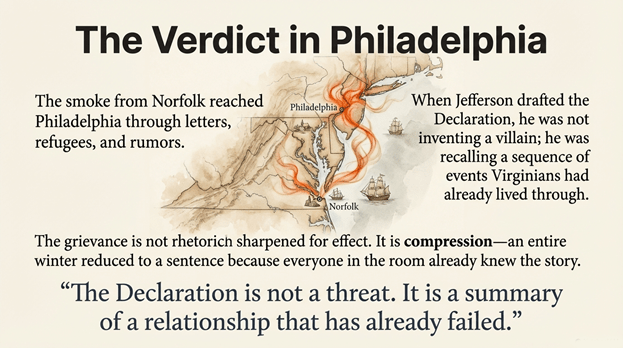
By the time Jefferson sat down in 1776 to draft the Declaration of Independence, Virginia’s experiences were already burned into memory. The grievances against George III did not emerge from philosophical abstraction floating politely through Enlightenment salons. They emerged from lived experience. Burned ports. Naval intimidation. Refugee crises. Broken commerce. Families scattered by war.
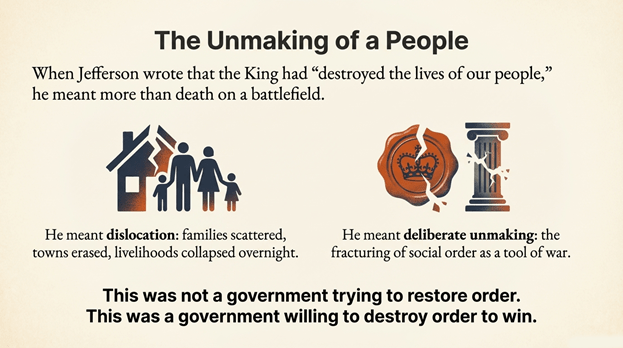
When Jefferson wrote that the King had “destroyed the lives of our people,” he meant something broader than battlefield casualties alone.
Death mattered, certainly. But so did displacement. Terror. Disease. Economic collapse. The slow unmaking of communities that had once assumed stability would continue indefinitely. Dunmore’s policies shattered ordinary life across wide portions of Virginia long before independence formally existed.
And perhaps that is the darkest reality of all.
Empires often convince themselves they are preserving order while their actual methods systematically destroy the social fabric holding ordinary life together. Britain believed force would restore obedience. Instead force dissolved legitimacy faster than rebellion alone ever could have accomplished.
Norfolk’s smoke drifted northward into the Declaration itself.
Jefferson did not need imagination to write those grievances. He needed memory. He remembered warships offshore. He remembered panic spreading through Virginia plantations. He remembered refugees clogging roads and rumors traveling faster than facts. He remembered an empire that increasingly spoke through cannon fire and coercion instead of constitutional trust.
Dunmore never intended to become a revolutionary accelerant.
History rarely cares about intent.
It measures consequences instead.
Breen, T. H. American Insurgents, American Patriots: The Revolution of the People. New York: Hill and Wang, 2010.
Declaration of Independence. July 4, 1776.
Dunmore, John Murray, Earl of. “Lord Dunmore’s Proclamation,” November 7, 1775. In American Archives, 4th ser., vol. 3, edited by Peter Force. Washington, DC: M. St. Clair Clarke and Peter Force, 1840.
Ellis, Joseph J. American Creation: Triumphs and Tragedies at the Founding of the Republic. New York: Alfred A. Knopf, 2007.
Ferling, John. Almost a Miracle: The American Victory in the War of Independence. Oxford: Oxford University Press, 2007.
Force, Peter, ed. American Archives. 4th ser. 6 vols. Washington, DC: M. St. Clair Clarke and Peter Force, 1837–1846.
Isaac, Rhys. The Transformation of Virginia, 1740–1790. Chapel Hill: University of North Carolina Press, 1982.
Jefferson, Thomas. The Papers of Thomas Jefferson. Edited by Julian P. Boyd. Princeton, NJ: Princeton University Press, 1950–.
Ketchum, Richard M. Saratoga: Turning Point of America’s Revolutionary War. New York: Henry Holt, 1997.
Locke, John. Two Treatises of Government. Edited by Peter Laslett. Cambridge: Cambridge University Press, 1988.
Maier, Pauline. American Scripture: Making the Declaration of Independence. New York: Vintage Books, 1998.
Middlekauff, Robert. The Glorious Cause: The American Revolution, 1763–1789. Rev. ed. Oxford: Oxford University Press, 2005.
Morrissey, Brendan. Yorktown 1781: The World Turned Upside Down. Oxford: Osprey Publishing, 1997.
Nelson, Paul David. William Tryon and the Course of Empire: A Life in British Imperial Service. Chapel Hill: University of North Carolina Press, 1990.
Norton, Mary Beth. 1774: The Long Year of Revolution. New York: Alfred A. Knopf, 2020.
Rakove, Jack N. Revolutionaries: A New History of the Invention of America. Boston: Houghton Mifflin Harcourt, 2010.
Selby, John E. The Revolution in Virginia, 1775–1783. Williamsburg, VA: Colonial Williamsburg Foundation, 1988.
Shy, John. A People Numerous and Armed: Reflections on the Military Struggle for American Independence. Rev. ed. Ann Arbor: University of Michigan Press, 1990.
Tuchman, Barbara W. The March of Folly: From Troy to Vietnam. New York: Alfred A. Knopf, 1984.
Wood, Gordon S. The Radicalism of the American Revolution. New York: Vintage Books, 1993.
Wood, W. J. Battles of the Revolutionary War, 1775–1781. Chapel Hill: Algonquin Books, 1990.



Leave a comment