
As the sun rises on October 18th, we’re taken back to 1926, when a legend named Chuck Berry was born. In the pantheon of American music, few figures loom as large or have had as indelible an impact as Berry. His life, from humble beginnings in St. Louis to world stages, speaks of a journey studded with iconic riffs, groundbreaking songs, and a passion for music that transcended racial barriers.
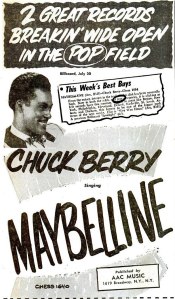
Born Charles Edward Anderson Berry in St. Louis, Missouri, young Chuck showed an early love for music. By the age of six, he began singing in the church choir. By his teenage years, he’d dabbled in the blues and was influenced by the likes of Muddy Waters and T-Bone Walker. But Berry’s destiny wasn’t immediately apparent. After a brief stint in prison as a youth, it was a chance meeting with Muddy Waters in 1955 that set him on the path to greatness. Waters introduced Berry to Leonard Chess of Chess Records, which led to the recording of Berry’s first hit, “Maybellene.”
Public Domain
What made Chuck Berry an immortal figure in music history wasn’t just his adept guitar playing or his catchy melodies; it was his innate ability to tell a story. His songs captured the spirit and energy of youth, the joy of freedom, and the dreams of an entire generation. Songs like “Roll Over Beethoven,” “Johnny B. Goode,” and “Rock and Roll Music” didn’t just define the soundscape of the 1950s—they became enduring anthems for all subsequent rock musicians.
Berry’s guitar riffs, characterized by their double-string bends and ringing solos, became the backbone for rock ‘n’ roll’s sonic texture. His showmanship, including his iconic “duck walk,” set the stage for the flamboyant performances of future rock stars.
It’s not an exaggeration to say that without Chuck Berry, the landscape of modern music would be vastly different. His influence permeated the works of The Beatles, The Rolling Stones, Bruce Springsteen, and countless other musicians. Both John Lennon and Keith Richards famously stated how Berry’s music was foundational to their own careers.
His impact wasn’t confined to rock ‘n’ roll alone. Berry’s fusion of R&B rhythms with country twangs and narrative-driven lyrics created a template that artists in pop, rock, and even hip-hop have emulated.
Like many artists of his time, Berry faced racial discrimination. Despite this, he helped break down racial barriers in music, making rock ‘n’ roll a universal language for all. His legal troubles and personal challenges never dimmed his star. In fact, they added layers of complexity to the man and his music.
Chuck Berry left us in 2017, but his music remains timeless. As we mark the anniversary of his birth, it’s essential to remember not just the music but the man behind it—a visionary who reshaped the American musical narrative.
Let’s celebrate October 18th not just as the birth date of a musician, but as the day when a force of nature, an architect of rock ‘n’ roll, was introduced to the world. Here’s to Chuck Berry—the father of rock ‘n’ roll, the master of the riff, and the eternal poet of youth and freedom.




 DAVE DOES HISTORY
Leave a comment