
Edgar Ætheling was born circa 1051, a member of the House of Wessex. His name ‘Ætheling’ was not a surname, but rather an Old English term used to denote a prince or a person of royal lineage eligible for the throne. Edgar was the last male member of the ancient royal house of the English, which is why he was named Ætheling. His father was Edward the Exile, and his grandfather was King Edmund Ironside of England.
The Norman conquest of England, initiated by Duke William of Normandy, was a pivotal moment in English history. The English throne was claimed by several individuals after the death of Edward the Confessor in 1066. Harold Godwinson was crowned as Harold II, but his claim was contested by both William of Normandy and Harald Hardrada of Norway. The disputes eventually led to military confrontations.
On October 14, 1066, the English faced the Normans in the Battle of Hastings. Despite a valiant defense, the English forces under King Harold II were defeated by William’s army. Harold himself was killed in battle, creating a power vacuum.
Following the battle, on October 15, 1066, the Witenagemot (a council of nobles) proclaimed Edgar Ætheling as king, though he was never crowned. His brief proclamation was largely symbolic, as England was in chaos, and the Normans were advancing rapidly.
The young Edgar, with support from other English nobles, led a series of resistances against the Normans. However, faced with overwhelming Norman forces and the cunning strategies of William, Edgar’s efforts were unsuccessful. By 1067, realizing the odds stacked against them, Edgar and his supporters sought peace with William.
Despite his submission, William was suspicious of Edgar. For a time, Edgar was treated well and was even taken to Normandy. However, fearing potential uprisings, William later decided to imprison him. After his release, Edgar went into exile in Scotland, where he joined forces with King Malcolm III, taking part in several raids against Norman positions in England.
The reasons for Edgar’s journey to Italy are a matter of some historical debate. What is known is that, around 1086, Edgar traveled to Italy, possibly seeking support from the Norman rulers there or perhaps on a pilgrimage. By this time, Norman influence had spread beyond England and into parts of Italy.
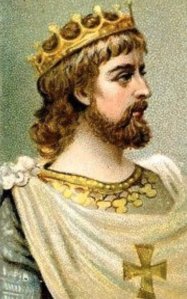
Public Domain
By the end of the 11th century, Edgar became involved in the First Crusade, a series of campaigns initiated to recapture the Holy Land from Muslim control. Historical records indicate that Edgar was part of the crusading forces, showcasing his continued commitment to martial causes even outside of England.
After the crusades, Edgar returned to England, where he lived under the favor of King Henry I. He largely faded from the political scene and lived a relatively quiet life. Edgar Ætheling passed away around 1126, though the exact date and location of his death remain uncertain.
Though Edgar never ruled as a crowned king, his life story is an emblematic reflection of the tumultuous times that marked the Norman Conquest. He symbolizes the last vestiges of the Anglo-Saxon era, representing the resistance, submission, and adaptation of the English nobility under Norman rule. His life, filled with aspirations, resistances, and wanderings, offers a glimpse into the complexities of medieval politics and the enduring spirit of a prince without a crown.


 DAVE DOES HISTORY
Leave a comment