
William Penn was born on October 14, 1644, in London, England, to Admiral Sir William Penn and Margaret Jasper. He came from a prominent Anglican family, with his father having served in the navy and his mother hailing from a line of Irish nobility. Young Penn grew up amid the tumult of the English Civil War and the establishment of the Cromwellian Commonwealth, events that would deeply influence his worldviews.
Penn was educated first at Chigwell School, where he was introduced to religious ideas that would guide much of his life’s work. Later, he attended Christ Church, Oxford. However, Penn found himself at odds with the strict Anglican orthodoxy of the university. His rebellious spirit against what he perceived as empty religious rituals led to his expulsion from Oxford.
Penn’s spiritual journey took a significant turn when he encountered the teachings of George Fox, the founder of the Religious Society of Friends or Quakers. Embracing Quaker beliefs, which emphasized an individual’s direct relationship with God and disavowed formal liturgy and clergy, Penn became a staunch defender of religious freedom and tolerance.
After his conversion, Penn managed his family’s properties in Ireland. During this time, he further solidified his Quaker beliefs and began advocating for religious freedoms. His travels also took him to Germany, where he engaged with Pietist communities, an experience that enriched his religious perspectives.
Penn’s religious convictions led to multiple imprisonments. Quakers were viewed with suspicion in England for their refusal to pay tithes, take oaths, or participate in military service. Penn, in particular, was imprisoned in the Tower of London after writing a tract that criticized the Church of England. Despite facing persecution, he remained unwavering in his faith.
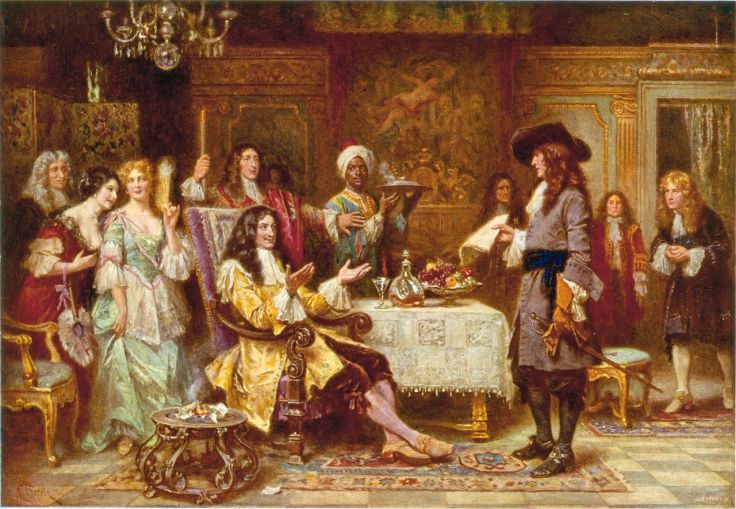
Public Domain
In 1681, King Charles II granted Penn a large tract of land in the New World as repayment for a debt owed to Penn’s father. This territory became Pennsylvania, derived from Penn’s surname and the Latin word for “forest,” symbolizing the wooded landscape of the region. Penn envisioned Pennsylvania as a “Holy Experiment,” a refuge for Quakers and other persecuted religious groups. Under his guidance, the colony adopted the Frame of Government, one of the most progressive constitutions of its time, emphasizing religious tolerance, democratic principles, and peaceful relations with Native American tribes.
Penn returned to England in 1684 to address some financial and political concerns. In 1699, he made a second trip to Pennsylvania with his family. They stayed until 1701, setting the groundwork for the future development of the colony. Despite the success of his colony, Penn faced significant financial challenges, many of which were caused by mismanagement by his agents in Pennsylvania.
Penn’s later years were marked by personal and financial troubles. His health deteriorated, and he suffered multiple strokes. The financial strains also took a toll on him, and in 1712, he was forced to mortgage Pennsylvania. William Penn died on July 30, 1718, in Ruscombe, Berkshire.
William Penn’s legacy is vast and multifaceted. His commitment to religious freedom, individual rights, and democratic governance became foundational principles for both Pennsylvania and the emerging United States. The city of Philadelphia, which Penn founded as the capital of his colony, embodied his vision of a “City of Brotherly Love.” Furthermore, Penn’s treaties with Native Americans, especially the symbolic “Treaty with the Lenape,” were remarkable for their emphasis on mutual respect and peace, though subsequent generations did not always honor these principles.
Today, William Penn’s contributions are memorialized in various ways: from the state of Pennsylvania itself to numerous schools, streets, and monuments. His ideals, particularly those of religious tolerance and democracy, continue to influence and inspire.




 DAVE DOES HISTORY
Leave a comment