
On October 14, 1912, the United States witnessed an event that could have changed its history dramatically: the attempted assassination of former President Theodore Roosevelt. Although the event is not as well-known as the assassinations of Presidents Lincoln or Kennedy, it remains a significant chapter in the annals of American political history.
Theodore Roosevelt, the 26th president of the United States, had already served two terms (1901-1909) and was no longer the sitting president in 1912. However, he was vying for a third term as a candidate for the Progressive Party, also known as the Bull Moose Party. On that fateful day in Milwaukee, Wisconsin, he was scheduled to deliver a speech, championing his party’s policies and making a case for his re-election.
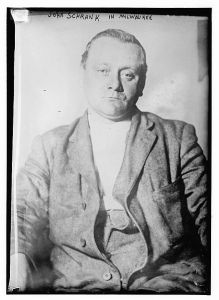
Public Domain
The would-be assassin, John Schrank, was a Bavarian-born saloon-keeper. He claimed to have had a dream in which the late President McKinley, whose assassination had inadvertently elevated Roosevelt to the presidency, pointed at Roosevelt and said, “This is my murderer—avenge my death.” This vision, along with Schrank’s belief that no man should have a third term as president, drove him to attempt to take Roosevelt’s life.
As Roosevelt was entering his car outside the Hotel Gilpatrick in Milwaukee, Schrank approached and fired a .38-caliber revolver. The bullet, rather than finding its mark directly, first passed through Roosevelt’s steel eyeglass case and the folded 50-page speech he had in his breast pocket, ultimately lodging in his chest.
Despite being shot, Roosevelt’s wound was not immediately fatal. The bullet had lodged in his chest muscle but did not penetrate the lung. The thick manuscript and eyeglass case had undeniably slowed the bullet, potentially saving his life.
In an astounding display of fortitude, Roosevelt chose to proceed with his speech. Declaring, “I don’t know whether you fully understand that I have just been shot,” he showcased his wound and continued, “It takes more than that to kill a Bull Moose.”
For a staggering 90 minutes, Roosevelt addressed the audience, speaking on his policies, his vision for America, and his commitment to the Progressive cause. The gravity of his gunshot wound only seemed to galvanize him further.
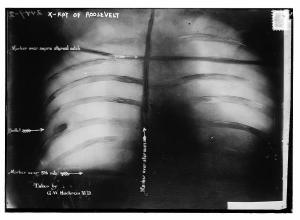
Public Domain
Upon concluding his speech, Roosevelt was rushed to the hospital. Doctors assessed the wound and determined that it would be more dangerous to remove the bullet, which had lodged near his ribs, than to leave it. The bullet remained in Roosevelt’s chest for the rest of his life.
Schrank was quickly apprehended. After being examined by psychiatrists, he was deemed insane and was institutionalized for the remainder of his life. He passed away in 1943 in a mental hospital.
The event showcased Roosevelt’s tenacity and sheer willpower. The attempted assassination amplified his image as a rugged, indomitable figure. The “Bull Moose” speech he gave, even with a bullet in his chest, became a testament to his dedication and resilience. However, the political momentum from this event did not propel him to victory; he lost the 1912 election to Woodrow Wilson.
In retrospect, the attempted assassination of Theodore Roosevelt serves as a reminder of the unpredictability of American politics and the extraordinary resilience of some of its leaders.


 DAVE DOES HISTORY
Leave a comment