
Christopher Columbus, a Genoan navigator, was born in 1451 in the Republic of Genoa (present-day Italy). His early life was characterized by extensive sea voyages, which took him as far north as the British Isles and as far south as the Gold Coast of Africa. These voyages not only honed his navigational skills but also instilled in him the idea that the East could be reached by sailing westward. His passion was fueled by both religious zeal and the promise of untold riches.
After years of self-education and careful study, Columbus was convinced that the Atlantic Ocean was not as vast as it was believed to be. He approached several European monarchs with his plan, only to be repeatedly rejected. However, Spain, newly united under the Catholic Monarchs Ferdinand and Isabella, showed some interest. After many persistent visits, negotiations, and delays, Columbus finally convinced the monarchs. In April 1492, the Alhambra Decree was issued, and Columbus was granted the means to go forth and find the western route to Asia.
For the ambitious voyage, three ships were readied: the Santa Maria, the largest and Columbus’s flagship; and two smaller caravels, the Pinta and the Niña. The crew, largely comprised of Spaniards from the Andalusian region, was hesitant but hopeful about the journey ahead.
The journey west was challenging. Days turned into weeks, and the vast, empty expanse of the Atlantic started to wear on the crew’s nerves. The first signs of potential mutiny on the Santa Maria emerged as the distance from home grew and no sign of the Indies appeared. Columbus, with a mix of guile and leadership, managed to quell the brewing dissent. Promises of rewards and an adjusted (some might say manipulated) log kept the men in check.
Then, at 2 a.m. on October 12, 1492, the lookout on the Pinta sighted land, an island in what we now call the Bahamas. Columbus named it San Salvador. The New World had been reached, though Columbus believed he had arrived in the East Indies. The expedition went on to explore more islands in the Caribbean, including Cuba and Hispaniola.
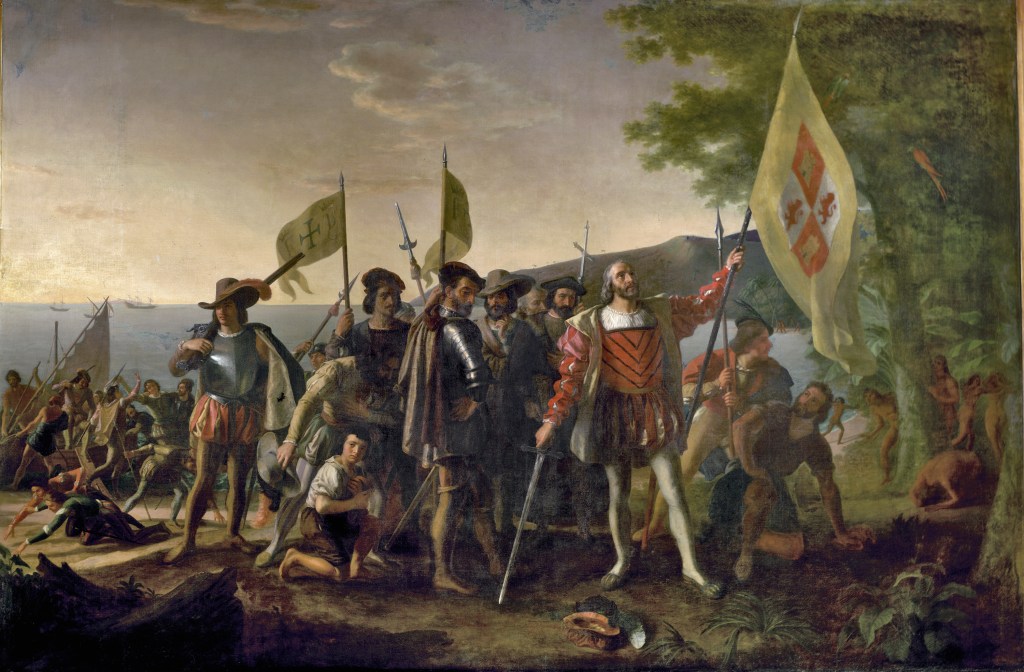
Public Domain
Columbus’s first voyage is arguably one of the most significant events in world history. While he was not the first European to reach the Americas (Vikings had been there centuries earlier), his voyages opened the door for widespread European exploration and eventual colonization.
However, the legacy of Columbus is not without its controversies. The ensuing centuries saw the large-scale devastation of indigenous cultures, the horrors of the transatlantic slave trade, and the ecological upheaval of two worlds colliding.
Yet, Columbus’s journey embodies the spirit of exploration, of challenging established beliefs, and of the unyielding drive of the human spirit to discover and explore new horizons. Whether viewed as a heroic explorer or a symbol of imperialist expansion, Christopher Columbus and his first voyage to the New World will forever remain pivotal in the annals of history.



 DAVE DOES HISTORY
Leave a comment