
In 1777, the Revolutionary War was in full swing. The British had devised a plan to seize the American capital at Philadelphia, hoping that capturing the city would demoralize the rebellion and lead to a quicker end to the war.
In September 1777, British General Sir William Howe had successfully moved his troops to Philadelphia after defeating the American forces led by General George Washington at the Battle of Brandywine. After the British occupied Philadelphia, Washington and his troops regrouped and tried to counter the British advancement. They set up camp at Pennypacker’s Mill in the outskirts of Philadelphia. Eager to strike a blow against the British and to boost American morale, Washington began devising a plan to attack the British at Germantown, where Howe had placed a portion of his army.
On the night of October 3, Washington decided to launch a four-pronged attack against the British. He intended to catch them off guard, with different columns of his troops approaching Germantown from multiple directions.
Public Domain
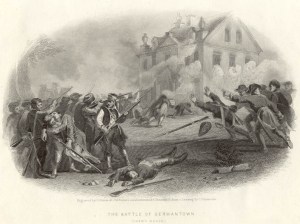
As the battle commenced in the early morning hours of October 4, 1777, American forces initially saw some successes. The column led by General John Sullivan, which was one of the main American attacking forces, managed to drive back the British soldiers. However, a thick fog that had settled over the battlefield began to create confusion among the American troops. Unable to differentiate between friend and foe, some units of the American forces inadvertently began firing on each other.
The turning point in the battle occurred around the Chew House, a stone mansion that was used as a fortified position by the British. Instead of bypassing this stronghold, American forces wasted valuable time and resources trying to capture it.
British reinforcements soon arrived, and the combined effect of the fog, the miscommunication, and the focus on the Chew House caused the American offensive to falter. Recognizing the deteriorating situation, Washington ordered a retreat.
Though the Battle of Germantown was a tactical loss for the Continental Army, it had a few significant ramifications:
1. Boosted Morale: Despite the loss, the fact that Washington’s troops had initiated an aggressive attack shortly after their defeat at Brandywine raised spirits in the American camp. It demonstrated that the Continental Army was capable of taking the initiative and posed a significant threat to the British.
2. Foreign Perception: The bravery and resilience showcased by the American forces during the battle made an impression abroad, particularly in France. Though France had been providing covert aid to the rebels, the battle, along with the American victory at Saratoga, played a role in convincing the French to enter the war as an American ally in 1778.
3. Tactical Lessons: Mistakes made during the battle, like the mismanagement of the situation at the Chew House and the issues of communication in the fog, provided valuable tactical lessons for the Continental Army.
In conclusion, while the Battle of Germantown did not result in an American victory, its implications extended beyond the immediate outcome. It showcased the tenacity and resilience of the American forces and played a role in shaping the course of the Revolutionary War.




 DAVE DOES HISTORY
Leave a comment