
To me personally, Al Smith is one of the most interesting “what if’s” in Presidential history. I actually have a book of his speeches, and I find that he is well spoken and tracked often with the things that I support. The 1928 campaign was one that brought out some of the worst things in America, and at the same time, I often wonder if it would have mattered who was President after 1929?
Smith’s position on prohibition was quite refreshing, as was his position on religion, in which we hear an echo in 1960, when JFK spoke on the matter as well. Smith died on October 4, 1944.
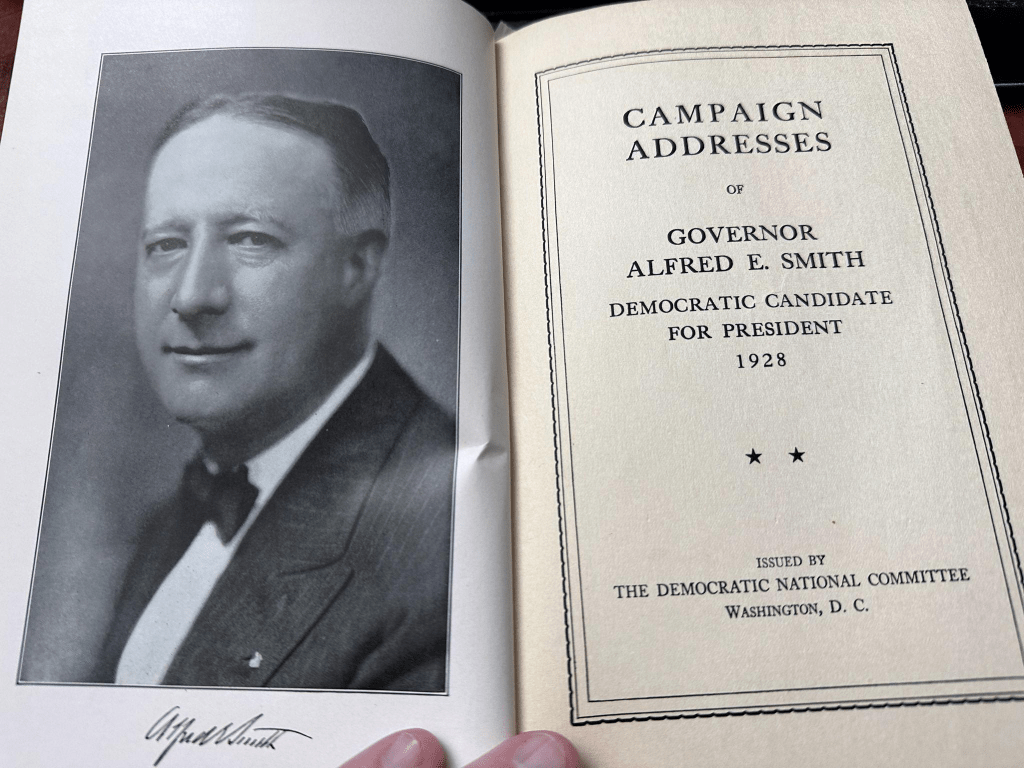
NEW YORK CITY — Alfred E. Smith, the four-time governor of New York and a towering figure in the early 20th-century Democratic Party, passed away on October 4, 1944, at the age of 71. His leadership, charisma, and commitment to urban reforms made him a transformative figure not only in the state of New York but also on the national stage.
Born on December 30, 1873, in the Lower East Side of Manhattan, Smith grew up in the heart of the immigrant experience. He left school at the age of 14 following the untimely death of his father, and worked various jobs to support his family. This early experience with the challenges faced by working-class New Yorkers would shape his political career and his commitment to progressive reforms.
After serving in the New York State Assembly, where he became known for his thorough investigation into factory conditions following the tragic Triangle Shirtwaist Factory fire, Smith ascended the ranks of New York politics. He was elected governor of New York in 1918 and would serve four non-consecutive terms. During his tenure, he pursued an ambitious progressive agenda, modernizing state government, improving infrastructure, and enacting labor reforms.
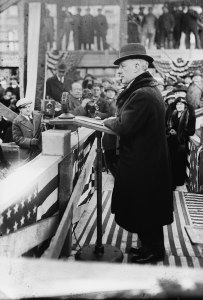
Public Domain
Beyond the Empire State, Smith’s national prominence grew. In 1928, he became the first Catholic to be nominated by a major party for the presidency of the United States. While he did not win the election, his candidacy marked a significant moment in American political history, breaking religious barriers and challenging the prejudices of the time.
Governor Smith’s Catholic faith was central to his identity, and his career embodied the broader story of Catholic integration into the fabric of American public life. His commitment to the needs of the urban working class and his defense of immigrants and minority rights placed him in stark contrast to the nativist sentiments of his era.
Smith’s legacy is intricately tied to the development of modern New York. His championing of the construction of the Empire State Building during the onset of the Great Depression was symbolic of his unyielding belief in the promise and potential of the city and its people.
He is survived by his children and a legacy that stretches beyond the political realm. His impact on New York and the nation is a testament to the power of progressive leadership, the importance of standing up against bigotry, and the enduring spirit of the American Dream.
Alfred E. Smith will be remembered not only as a political giant but also as a symbol of the rich tapestry of American society, embodying the hopes and struggles of the generations that shaped the early 20th century. His commitment to justice, equity, and progress will continue to inspire future generations.


 DAVE DOES HISTORY
Leave a comment