
In 52 B.C., the formidable Roman general Julius Caesar faced one of his greatest challenges during his campaign in Gaul. Vercingetorix, a chieftain of the Arverni, was not merely a leader of his tribe; he was a symbol of Gallic unity, resistance, and resilience against the expansionist objectives of Rome.
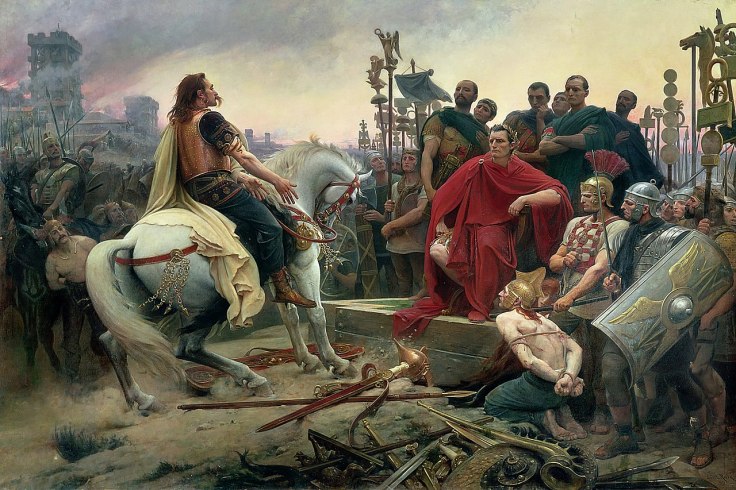
The climax of this contest of wills came at the Battle of Alesia. Caesar, with his tactical genius, managed to lay siege to the Gallic forces, constructing formidable fortifications and trenches around the city. Despite a valiant attempt by Gallic reinforcements to break the Roman stranglehold, the Gauls faced shortages of food and resources. Vercingetorix, understanding the dire circumstances and perhaps hoping to spare further Gallic suffering, made the fateful decision to surrender. The image of Vercingetorix, descending from his stronghold and laying his arms at Caesar’s feet, remains an emblematic moment in the history of Rome’s conquests.
Public Domain
The immediate aftermath of the Battle of Alesia led to a consolidation of Roman control over Gaul. With Vercingetorix’s surrender, organized, large-scale resistance against Roman dominion substantially diminished. The ensuing years saw the full integration of Gaul into the Roman state, transforming it from a tumultuous frontier to a peaceful and productive province, albeit at the cost of Gaulish autonomy and identity.
The fate of Vercingetorix is both tragic and emblematic of Rome’s approach to conquered leaders. After his surrender, he was transported to Rome and held in captivity for roughly six years. In a typical display of Roman pageantry, he was paraded in Caesar’s Triumph in 46 B.C., a spectacle that celebrated Caesar’s military victories. The defeated chieftain was then executed, his life ending in the dark shadows of a Roman prison.
While Vercingetorix’s immediate aftermath is marked by Roman dominance, his enduring legacy is much more complex. In many ways, he came to symbolize the spirit of resistance against oppression. The story of Alesia and Vercingetorix’s stand against Caesar was not forgotten. Instead, it was resurrected, especially during the 19th and 20th centuries, as a symbol of French nationalism and the indomitable spirit of the Gallic people.
In modern times, Vercingetorix has been celebrated as a national hero in France. Statues, like the one in Clermont-Ferrand, stand testament to his enduring legacy. He represents a paradoxical figure – a symbol of both defeat and resilience.
In conclusion, the surrender of Vercingetorix at Alesia marks a poignant moment in the annals of history. It was not just the end of a battle, but a transformation of an entire region’s identity. Yet, through the vicissitudes of time, Vercingetorix’s legacy remains robust, reminding us of the complexities of conquest, resistance, and memory.




 DAVE DOES HISTORY
Leave a comment