
The Civil War, a brutal and formative chapter in America’s history, bore witness to countless skirmishes, campaigns, and major battles. Amidst the better-known engagements, the Corinth Campaign and the subsequent Battle of Corinth in October 1862 present a tale of tactics, tenacity, and the ever-constant toil for strategic advantage.
As spring blossomed in 1862, Union forces had achieved a critical victory at Shiloh, a battle known for its savage fighting and heavy casualties. Following Shiloh, the Union Army, led by Maj. Gen. Henry Halleck, moved slowly to besiege Corinth, Mississippi. This town held significant strategic value because of the convergence of two major railroads, the Memphis and Charleston and the Mobile and Ohio. Possession of Corinth would allow either side the ability to move troops and supplies with greater ease and potentially tip the balance of power in the Western Theater.
Throughout May, Halleck cautiously approached and ultimately forced a Confederate withdrawal from Corinth, led by Gen. P.G.T. Beauregard. Although it was a Union victory, the cautious nature of the campaign left many feeling that a more aggressive approach might have yielded more fruitful results.
The late summer and early fall saw Confederate forces, now under the command of Maj. Gen. Earl Van Dorn and Maj. Gen. Sterling Price, attempt to retake Corinth and shift the momentum in their favor. The duo planned a swift offensive to reclaim the town before Union reinforcements could arrive.
On October 3, 1862, Confederate forces launched an assault on Union defensive positions around Corinth. Despite initial progress, they were unable to break through. The day’s fighting showcased the Confederacy’s persistence, but the Union’s defenses, orchestrated by Maj. Gen. William S. Rosecrans, held firm.
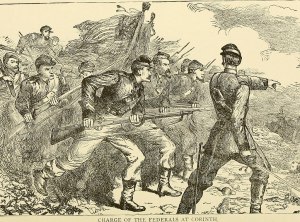
Public Domain
The following day, October 4, saw the climax of the battle. Confederate troops launched multiple assaults against strong Union positions, particularly focusing on Battery Powell and Battery Robinett. Despite courageous efforts, notably during a fierce charge led by Col. William P. Rogers, the Confederate attacks broke down under relentless Union artillery and infantry fire.
By the end of the day, the Confederate forces were in retreat, having suffered significant casualties and failing to retake the pivotal town.
In the aftermath of the October battle, it was clear that the Confederacy’s hope to reverse its fortunes in Mississippi had been dashed. The Union retained control of Corinth and its crucial railroads, ensuring a continuous line of communication and movement for Union forces in the Western Theater.
The failure at Corinth was a blow to Confederate morale and leadership. Van Dorn’s and Price’s reputations suffered, and their capacity to wage offensives in the region was significantly hampered.
The Corinth Campaign and the subsequent battle underscored a few critical aspects of the Civil War:
1. Strategic Geography: The emphasis both sides placed on Corinth highlighted the importance of strategic geography, particularly railroads, in the conduct of the war.
2. Union Resilience: Despite the criticism of Halleck’s cautiousness, the Union showcased its ability to defend key positions effectively, a trait that would be reflected in later battles.
3. Confederate Limitations: The failure to retake Corinth after significant effort illustrated some of the challenges the Confederacy faced in terms of leadership, resources, and strategic planning.
In the tapestry of Civil War history, the Corinth Campaign stands as a testament to the strategic maneuvers and desperate gambles of a nation divided. It reminds us of the importance of places not just for their inherent value, but for the symbolic hope they offer to weary soldiers and anxious leaders.




 DAVE DOES HISTORY
Leave a comment