
Cordell Hull was born on October 2, 1871, in Olympus, Tennessee, to Elizabeth and William Hull. Growing up in a rural setting, Hull’s early life was shaped by the modest and rugged environment of the Cumberland Mountains. He pursued his education at the National Normal University in Ohio and later earned a law degree from the Cumberland School of Law at Cumberland University in Tennessee in 1891. This legal education would set the stage for Hull’s long-standing career in public service.
Hull embarked on his political journey as a member of the Tennessee House of Representatives in the 1890s. In 1907, he was elected to the U.S. House of Representatives, where he championed a variety of progressive causes. Notably, he advocated for an income tax, which would later become an integral part of the U.S. tax system with the 16th Amendment in 1913.
By the 1930s, Hull had garnered significant respect in the Democratic Party. Recognizing Hull’s abilities and commitment, President Franklin D. Roosevelt appointed him Secretary of State in 1933, a position he held for 11 years, making him the longest-serving Secretary of State in U.S. history.
Under Roosevelt, Hull played a crucial role in shaping American foreign policy, particularly as the world moved towards World War II. He was a strong advocate for collective security and believed in the power of international law and diplomacy to maintain peace.
In the years leading up to the Pacific War, Hull was deeply involved in negotiations with Japan. With Japan’s increasing militarism and expansionist policies in Asia, tensions between the U.S. and Japan were escalating. Hull advocated for diplomatic solutions, pushing for Japan to withdraw from China and respect the territorial integrity of its neighbors.
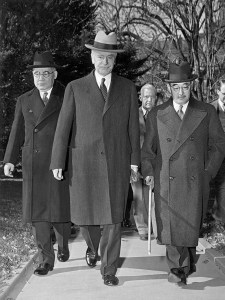
Despite his commitment to diplomacy, Hull also supported economic sanctions against Japan, including oil embargoes, when it became clear that Japan was not going to cease its aggressive actions in Asia. These sanctions played a part in precipitating the conflict with Japan.
December 7, 1941, was a pivotal day in American history, as the Japanese launched a surprise attack on Pearl Harbor. On that day, Hull was expecting a diplomatic delegation from Japan and was prepared to discuss further negotiations. Instead, he received the shocking news of the attack. Later that day, he met with the Japanese envoys and famously exclaimed that he had never seen a document that was more “crowded with infamous falsehoods and distortions.”
Throughout the Pacific War, Hull continued to play a pivotal role in shaping U.S. foreign policy. He was instrumental in establishing the United Nations, believing that a post-war international organization was essential to maintain global peace. Hull also maintained his commitment to diplomacy, working with allies to strategize and plan for the post-war order.
In 1944, due to health reasons, Hull resigned from his position as Secretary of State, but his contributions didn’t end there. He was a recipient of the Nobel Peace Prize in 1945 for his efforts in establishing the United Nations.
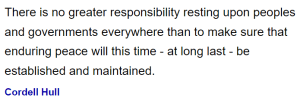 Cordell Hull’s legacy is defined by his unwavering belief in diplomacy, international cooperation, and the rule of law. His tenure as Secretary of State was marked by significant challenges, but through it all, Hull remained a beacon of hope for peaceful solutions. His work in helping to establish the United Nations speaks to his vision of a world where nations resolve their differences through dialogue rather than war.
Hull’s impact on American foreign policy was profound, setting the tone for future administrations. His life serves as a testament to the power of diplomacy and the importance of international cooperation in an ever-changing global landscape.




 DAVE DOES HISTORY
Leave a comment