
In the annals of world history, few events hold as much significance as the Battle of Gaugamela. It was not merely a clash of two military powers but rather a defining moment in the rise and fall of empires.
By 331 BC, Alexander the Great of Macedonia had spent several years campaigning against the mighty Persian Empire. Earlier confrontations, including the Siege of Tyre and the Battle of Issus, had seen the Macedonians gaining significant ground against King Darius III. With the western territories of his empire already lost, Darius prepared for one last grand confrontation in the hopes of halting Alexander’s relentless advance.
Public Domain
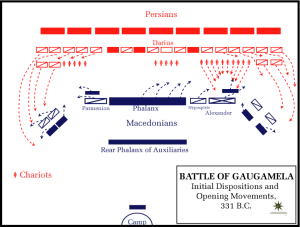
The two armies met on October 1, 331bce, near the town of Gaugamela in modern-day northern Iraq. Darius had chosen the location carefully, ensuring a vast open plain which he hoped would allow the full deployment of his numerically superior forces and chariots.
Alexander, ever the tactician, responded to this challenge ingeniously. Despite being outnumbered, he employed the oblique order strategy. The Macedonian left was held back, while the right wing, under Alexander’s personal command, advanced. This caused the Persian line to stretch out as they tried to envelope the Macedonian left, creating gaps in their own line.
The climax of the battle came when Alexander led a bold cavalry charge through one such gap, aiming directly for Darius. The Persian king, sensing the tide turning and the imminent threat to his person, fled the battlefield. With their king in flight, the morale of the Persian troops waned, and Alexander’s forces pressed the advantage.
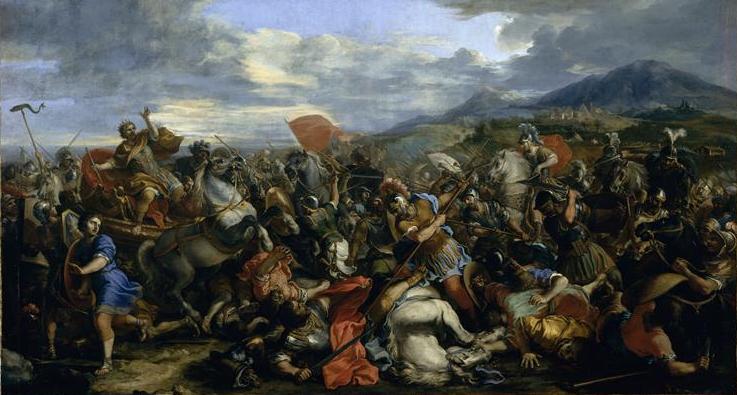
Gaugamela was not merely a military victory for Alexander; it was the crowning achievement of his campaign against Persia. Following this decisive battle, the Persian capital cities of Babylon, Susa, and, later, Persepolis opened their gates to the Macedonian king. Darius III, once the ruler of the largest empire the world had seen, was reduced to a fugitive and would be assassinated by one of his satraps the following year.
The Persian Empire, which had lasted for over two centuries and had seen the likes of Cyrus the Great and Xerxes, was effectively brought to an end. In its place rose the Hellenistic era, where Greek culture, language, and influence spread from Egypt to India.
Gaugamela, like few other battles in antiquity, reshaped the known world. The Hellenistic cultures that emerged after the fall of the Persian Empire played a pivotal role in the development of arts, sciences, and philosophy. Cities like Alexandria in Egypt became melting pots of various traditions and saw advancements in various fields from astronomy to literature.
Moreover, Gaugamela stands as a testament to Alexander’s military genius. Despite being faced with overwhelming odds, his innovative tactics and bold leadership turned a potential disaster into one of history’s most legendary victories.
Even today, the Battle of Gaugamela is studied in military academies around the world, a shining example of strategy, leadership, and the ever-present reality that in the theatre of war, it is not just numbers but tactics, morale, and leadership that often decide the outcome. The legacy of Gaugamela, thus, continues to echo through the corridors of time, reminding us of a world forever changed by the clash of empires on a vast Mesopotamian plain.




 DAVE DOES HISTORY
Leave a comment