
In the annals of naval history, few vessels possess the transformative impact of the USS Nautilus (SSN-571). As the world’s first operational nuclear-powered submarine, she represented a quantum leap in marine engineering and strategic

Navsource
naval warfare. The story of the Nautilus not only speaks to the height of Cold War innovation but also to humanity’s quest to harness atomic energy for peaceful and powerful purposes.
By the early 1950s, submarines had been a part of naval warfare for several decades. However, conventional diesel-electric submarines were restricted in endurance, speed, and submerged operational capabilities. They were forced to surface frequently to recharge batteries and renew the air supply, making them vulnerable to detection and attack.
It was this reality that drove the United States Navy to seek a means to transcend these limitations. The idea of a nuclear-powered submarine was not new, but it took the combined vision and tenacity of individuals such as Admiral Hyman G. Rickover and his team to bring it to fruition.
The foundation for the Nautilus was laid in 1946 when Congress authorized the development of a nuclear propulsion plant for naval use. After years of intense research and development, Westinghouse Electric Corporation was chosen to build the reactor. Concurrently, the Electric Boat Division of General Dynamics Corporation in Groton, Connecticut, was selected to design and construct the vessel that would house this groundbreaking propulsion system.
On January 21, 1954, under the watchful eyes of thousands, First Lady Mamie Eisenhower christened the Nautilus with a bottle of champagne, uttering the iconic words, “May God bless her and all who sail in her.” The submarine was launched into the Thames River.
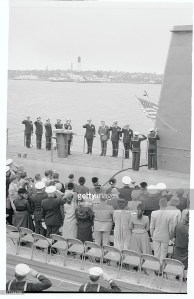
However, it was on September 30, 1954, a date etched in naval history, that the USS Nautilus officially became a commissioned vessel of the United States Navy. With Commander Eugene P. Wilkinson at the helm, she signaled the dawning of a new age of undersea warfare.
The Nautilus shattered previous submarine records. In 1958, she made history by being the first submarine to transit under the North Pole. This journey, codenamed Operation Sunshine, demonstrated the capability of nuclear-powered submarines to operate in areas previously thought inaccessible.
Throughout her operational career, the Nautilus participated in numerous exercises, operations, and tests, helping the U.S. Navy refine and expand its understanding of nuclear propulsion’s tactical and strategic advantages.
The USS Nautilus was decommissioned in 1980, but her legacy lives on. Today, she rests as a museum in Groton, Connecticut, a testament to the pioneering spirit of the Cold War era. Her successful operational history paved the way for successive generations of nuclear submarines, transforming the naval strategic landscape and affirming the United States’ position as a dominant maritime power.
In remembering the Nautilus, we don’t just recount the history of a submarine; we reflect on a revolutionary period in naval warfare, marked by vision, innovation, and unparalleled technological advancement.




 DAVE DOES HISTORY
Leave a comment