
Throughout the 1930s, Adolf Hitler’s Nazi regime in Germany pursued an aggressive foreign policy that sought to revise the post-World War I settlement, as established by the Treaty of Versailles. Among Hitler’s many objectives was the annexation of the Sudetenland, a region in Czechoslovakia with a significant ethnic German population. In 1938, the situation escalated rapidly, with Germany demanding the immediate cession of the Sudetenland.
Many Western leaders believed in a policy of appeasement, thinking they could prevent a larger conflict by making concessions to Germany. They hoped that by allowing Germany to annex the Sudetenland, Hitler’s territorial ambitions would be satisfied.
Principle People Involved
1. Neville Chamberlain – The British Prime Minister, the key proponent of the appeasement policy. He played a central role in the Munich negotiations.
2. Adolf Hitler – The German Chancellor and Führer. He had been pushing for the annexation of the Sudetenland.
3. Édouard Daladier – The French Premier. France had a mutual assistance pact with Czechoslovakia, but was reluctant to go to war with Germany.
4. Benito Mussolini – The Italian dictator. He proposed a four-power conference and was instrumental in bringing the parties together, although Italy was more of a mediator than a principal actor.
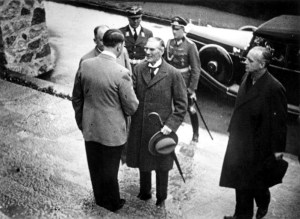
16.9.1938
Premierminister Chamberlain bei Hitler 1938
Am 13.9.1938 schlug Chamberlain Hitler eine Aussprache über die Abtennung des Sudetengebietes vor. Das Ergebnis der Münchener Konferenz zeigte auch Chamberlains Verrat am Weltfrieden und der Unabhängigkeit der Völker.
UBz: [Neville] Chamberlain stattet [Adolf] Hitler auf dem Obersalzberg am 15.9.1938 einen Besuch ab.
1. von rechts: der Reichsminister des Auswärtigen [Joachim] von Ribbentrop.
12279-38
[Scherl Bilderdienst]
The agreement saw differing receptions around the world.
– Germany: The annexation of the Sudetenland was presented as a great victory. Hitler was initially reluctant to agree to a conference, preferring to take the land by force, but he accepted the peaceful acquisition.
– England: Neville Chamberlain returned from Munich proclaiming “peace for our time”. While he was initially celebrated for preventing war, criticism soon arose, particularly after Germany’s subsequent aggressions.
– United States: The US, still deeply isolationist during this period, was generally supportive of any agreement that could prevent another European war. But there were voices of concern, believing that appeasement would not stop Hitler.
– France: Like Britain, France was initially relieved. War had been averted, and a potentially costly conflict with Germany was postponed. But the French, too, would soon see the flaws in appeasement.
– Czechoslovakia: The Czechs felt deeply betrayed. They had been ready to defend the Sudetenland but were not even invited to the Munich conference. Their fortifications in the Sudetenland, which might have been a significant defensive asset in a war against Germany, were handed over without a fight.
The Munich Agreement permitted the German annexation of the Sudetenland, starting on October 1, 1938. Czechoslovakia was significantly weakened without its frontier defenses and substantial military resources that were located in the Sudetenland. Germany would later occupy the entirety of Czechoslovakia by March 1939, in clear violation of the Munich Agreement.
The Munich Agreement is often cited as a classic example of the failures of appeasement. Hitler’s subsequent aggressions proved that he was not to be placated with concessions. The phrase “Munich” became synonymous with betrayal and misguided diplomacy.
The agreement demonstrated to the world that appeasement could embolden dictators rather than pacify them. It’s a lesson that has been invoked many times in international relations when statesmen are confronted with aggression by authoritarian regimes.
The Munich Agreement also played a role in the run-up to World War II by emboldening Germany and weakening the Western allies’ position. After the war, it served as a reminder of the costs of compromising with aggressors, influencing foreign policies during the early Cold War and beyond.


 DAVE DOES HISTORY
Leave a comment