
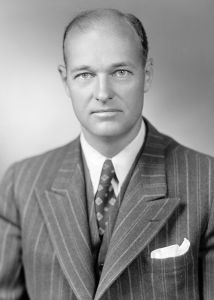
The “X Article” stands as a pivotal document in the history of the Cold War, shaping the United States’ approach to the Soviet Union and the broader world. Authored by George F. Kennan under the pseudonym “X,” this influential article laid the groundwork for the policy of containment and became a touchstone for U.S. foreign policy throughout the Cold War era.
In the years following World War II, tensions between the United States and the Soviet Union escalated rapidly. A key moment that heightened concerns in the U.S. government was a speech delivered by Soviet Premier Joseph Stalin on February 9, 1946. In this speech, known as the “Two Camps” speech, Stalin asserted that the world was divided into two opposing camps: one led by the capitalist Western powers, and the other by the communist Soviet Union. Stalin’s rhetoric solidified the perception of an irreconcilable ideological conflict and fueled American anxieties about Soviet expansionism.
Public Domain
George F. Kennan, a seasoned diplomat and expert on Soviet affairs, penned the X Article, officially titled “The Sources of Soviet Conduct,” which was published in the journal Foreign Affairs in July 1947. In it, Kennan articulated a comprehensive analysis of Soviet behavior and outlined a policy prescription that would become known as “containment.”
Key points of the X Article:
– Kennan argued that the Soviet Union’s expansionist ambitions were driven by a combination of Marxist-Leninist ideology, historical insecurity, and a desire for strategic advantage.
– He advocated for the United States to adopt a strategy of “containment,” which entailed preventing the spread of Soviet influence through diplomatic, economic, and, if necessary, military means.
– Kennan stressed that containment did not necessarily require military conflict but rather a firm and patient diplomatic stance backed by credible military deterrence.
The X Article received considerable attention and played a significant role in shaping U.S. foreign policy. It resonated with policymakers who were grappling with how to respond to Soviet expansionism. President Harry S. Truman and key advisors found Kennan’s analysis compelling, and containment became the cornerstone of American Cold War strategy.
Containment was a strategy aimed at preventing the spread of communism without resorting to all-out war. It guided U.S. policies such as the Marshall Plan (which provided economic aid to Western Europe), the Truman Doctrine (offering support to nations threatened by communism), and the formation of military alliances like NATO (North Atlantic Treaty Organization). It shaped American interventions in Korea and later in Vietnam.
The X Article’s legacy is profound. It marked the formal articulation of containment as a policy doctrine that guided U.S. foreign relations for decades. It laid the groundwork for the broader Cold War struggle between the United States and the Soviet Union, shaping the course of international politics and global security during the 20th century. Kennan’s insights and recommendations continue to be studied and debated, underscoring the enduring significance of the X Article in Cold War history.



 DAVE DOES HISTORY
Leave a comment