
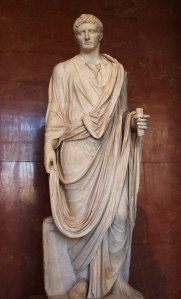
Born on September 23, 63 BCE, as Gaius Octavius Thurinus, the man history remembers as Augustus would go on to become one of the most influential figures in the history of Rome. His life and legacy are intertwined with the transformation of the Roman Republic into the Roman Empire. This article explores the remarkable life and enduring legacy of Augustus, the first Roman Emperor.
CC0
Augustus came from a prestigious Roman family with a lineage connected to Julius Caesar. His father, Gaius Octavius, was a senator, and his mother, Atia, was the niece of Julius Caesar. Young Octavius grew up in an environment of political ambition and power, and his life took a decisive turn when Julius Caesar adopted him as his heir.
Following Julius Caesar’s assassination in 44 BCE, Octavius, at the tender age of 18, entered the complex world of Roman politics. He formed the Second Triumvirate with Mark Antony and Marcus Lepidus in 43 BCE, a political alliance aimed at avenging Caesar’s death. Octavius, now known as Octavian, proved to be a masterful strategist, and the Triumvirs defeated their rivals at the Battle of Philippi in 42 BCE.
The triumvirate’s victory brought temporary stability to Rome, but internal conflicts soon resurfaced. Octavian’s relationship with Mark Antony soured, leading to the famous showdown between the two at the Battle of Actium in 31 BCE. Octavian emerged victorious, and in 27 BCE, he officially returned power to the Senate, effectively ending the Roman Republic.
In the wake of his victory, Octavian received the honorific title “Augustus,” meaning “revered” or “majestic.” He became the sole ruler of Rome but was careful to maintain the façade of republican institutions. Augustus implemented a series of political, social, and economic reforms, bringing an era of stability and prosperity known as the Pax Romana, or Roman Peace. He also initiated major construction projects that transformed Rome into a magnificent capital.
Augustus’ rule laid the foundation for the Roman Empire, which would endure for centuries. His governance set a precedent for future emperors, and he left a profound mark on Roman culture and society. He was responsible for the establishment of a professional civil service, the standardization of the Roman currency, and the development of a network of roads, fostering communication and trade.
In terms of literature and art, the Augustan Age was a period of remarkable creativity. The poet Virgil, the historian Livy, and the architect Vitruvius were among the luminaries of this era.
Augustus also promoted a cult of personality, emphasizing traditional Roman virtues and family values. His reign saw the beginnings of imperial cult worship, with temples dedicated to the divine Augustus.
Augustus, born Gaius Octavius Thurinus on September 23, 63 BCE, transformed Rome from a Republic into an Empire. His life and reign marked a pivotal moment in Roman history, bringing stability, prosperity, and the Pax Romana to a world previously marred by internal strife and political turmoil. Augustus’ enduring legacy is felt not only in the monumental structures of ancient Rome but also in the very idea of the Roman Empire, which would shape the course of history for centuries to come.



 DAVE DOES HISTORY
Leave a comment