
On September 14, 1914, in the early days of World War I, the Royal Australian Navy’s HMAS AE-1, an E-class submarine, mysteriously disappeared off the coast of Papua New Guinea. For over a century, her fate remained one of the great unsolved mysteries of maritime history. In this blog post, we will delve into the design and construction of the submarine, her service history, the circumstances surrounding her loss, and the recent discovery of her wreck in 2017.
HMAS AE-1 was one of two submarines ordered by the Royal Australian Navy (RAN) in 1910 and was constructed in the United Kingdom. She was an E-class submarine, measuring 181 feet in length with a displacement of 810 tons. Her design incorporated cutting-edge technology for the time, featuring two 18-inch torpedo tubes in the bow and an additional 12-pounder deck gun. Powered by two diesel engines and electric motors, AE-1 could reach a maximum speed of 15 knots submerged.
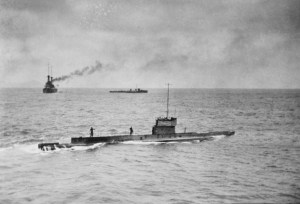
Public Domain
HMAS AE-1 was commissioned on May 28, 1914, and became the first submarine to serve in the RAN. She was assigned to the Australian Naval and Military Expeditionary Force (ANMEF) and played a significant role in capturing the German-controlled territory of German New Guinea during the early stages of World War I.
On September 14, 1914, HMAS AE-1, along with her crew of 35 officers and men, departed the harbor of Rabaul, now part of Papua New Guinea, to patrol waters near the Duke of York Islands. However, she failed to return as scheduled, and frantic searches proved fruitless. It was as if the submarine had vanished without a trace. The circumstances of her loss baffled naval experts and fueled speculation and conspiracy theories for decades.
For 103 years, HMAS AE-1 remained one of the greatest maritime mysteries. Numerous search expeditions were launched over the years, but the submarine’s whereabouts remained unknown. Theories abounded, ranging from mechanical failure to enemy action and even tales of a sea monster.
In December 2017, a joint Australian and Papua New Guinean search expedition, led by Microsoft co-founder Paul Allen’s research vessel R/V Petrel, finally located the wreckage of HMAS AE-1. The submarine was found resting on the seafloor at a depth of approximately 300 meters near the Duke of York Islands. The discovery brought closure to the families of the 35 sailors who had perished on board.
The exact cause of the submarine’s loss remains uncertain, but evidence suggests that it may have been due to a combination of factors, including rough seas and a valve malfunction, which caused her to dive uncontrollably.
The tragic loss of HMAS AE-1 on September 14, 1914, and its subsequent discovery in 2017 serves as a poignant reminder of the sacrifices made by naval personnel during times of conflict. While the mystery of her disappearance has been unraveled, her story continues to be a testament to the bravery of those who served and the enduring power of exploration and discovery.




 DAVE DOES HISTORY
Leave a comment