
The final days and death of the Roman Emperor Titus remain shrouded in some mystery, with debates persisting over the exact cause of his death. Titus, whose full name was Titus Flavius Vespasianus, ruled as Roman Emperor from 79 to 81 CE. He is most famous for his role in the capture and destruction of Jerusalem in 70 CE during the First Jewish-Roman War.
Titus was an able and popular emperor who undertook several public works projects, including the completion of the Flavian Amphitheatre, which is now known as the Colosseum. However, his reign was relatively short, and he died on September 13, 81 CE, at the age of 41.
Historians have debated the cause of Titus’s death for centuries. Several ancient sources suggest different possibilities. Some accounts claim he died of a fever, while others mention an illness, possibly malaria or an intestinal infection.
One intriguing and somewhat controversial account of Titus’s death is found in the Talmud, a collection of Jewish texts and teachings. According to the Talmudic narrative, Titus died as a result of a divine punishment for his actions during the siege of Jerusalem. It is said that Titus, after the successful Roman siege of Jerusalem, entered the Holy of Holies in the Jewish Temple, an act considered blasphemous by Jewish tradition.
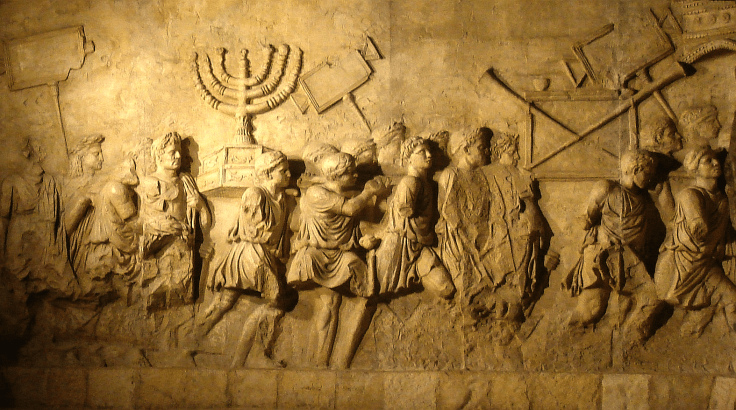
Titus’s triumph after the First Jewish-Roman War was celebrated with the Arch of Titus in Rome, which shows the treasures taken from the Temple, including the Menorah and the trumpets of Jericho.
By derivative work: Steerpike (talk)Arc_de_Triumph_copy.jpg: user: בית השלום – Arc_de_Triumph_copy.jpg, CC BY 3.0, https://commons.wikimedia.org/w/index.php?curid=4303855
In this Talmudic story, it is told that Titus, upon leaving the Holy of Holies, stabbed the curtain separating it from the Holy Place with his sword. The curtain miraculously bled, and Titus, not understanding the significance of this event, mocked it. He later boiled a calf in its mother’s milk, a ritual prohibition in Jewish dietary laws, and distributed the meat among his soldiers.
As a result of these perceived desecrations, the Talmud recounts that Titus was afflicted with an illness that caused him excruciating pain. Worms are said to have infested his body, and his flesh rotted while he was still alive. This illness eventually led to his death.
Titus’s death is often associated with his final statement, which was recorded by Roman historians. He is said to have remarked, “I have made but one mistake.” Unfortunately, the nature of this mistake was not elaborated upon in historical accounts, leaving it open to interpretation.
Some have suggested that Titus may have been reflecting on the harshness of his actions during the Jewish-Roman War, particularly the destruction of Jerusalem and the suffering of its inhabitants. Others speculate that he may have been referring to political or administrative decisions made during his short reign. The true meaning of this enigmatic statement remains a subject of debate among historians.
Titus is remembered as a competent and relatively benevolent emperor during his brief rule. His reign was marked by rebuilding efforts after the disastrous eruption of Mount Vesuvius in 79 CE, which buried the cities of Pompeii and Herculaneum. He is also celebrated for the completion of the Colosseum, an iconic symbol of Roman engineering and entertainment.
Despite his achievements, Titus’s legacy is also associated with the destruction of Jerusalem, which had a profound impact on Jewish history and identity. The Talmudic story of his death serves as a cautionary tale in Jewish tradition, emphasizing the consequences of desecrating sacred places.
In the broader context of Roman history, Titus is remembered as one of the Flavian emperors, and his reign contributed to the stability of the Roman Empire during a time of transition. His death, shrouded in mystery and interpretation, continues to capture the imagination of historians and scholars to this day.




 DAVE DOES HISTORY
Leave a comment