
Michelangelo’s David – a paragon of Renaissance artistry and an icon of humanistic values that arose during that period. As a professor with a passion for medieval and Renaissance art, it’s my pleasure to guide you through the intricate details and historical significance of this masterpiece.
The block of marble that would become David had been worked on by two other sculptors before it reached the hands of Michelangelo in 1501. Commissioned by the Arte della Lana and the Opera del Duomo, the statue was intended to adorn the Florence Cathedral’s buttresses. However, once the young Michelangelo completed it in 1504, the enormity and magnificence of David made it clear that this statue deserved a more prominent location.
David is depicted before his battle with Goliath, not after his victory, as was traditional. This choice captures the tension and resolution in David’s form.
1. Posture & Expression: The contrapposto stance, where one part of the body turns or twists away from another, gives a dynamic quality to the figure. David’s expression is one of deep concentration, perhaps even contemplation of the upcoming challenge.
2. Veins & Musculature: Michelangelo’s acute understanding of human anatomy is evident. The detailed rendering of veins and muscles, especially in David’s hands, displays tension, suggesting the latent power within him.
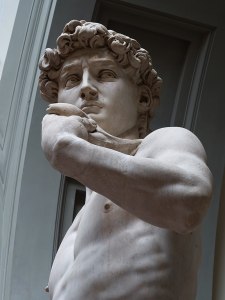
By Jörg Bittner Unna – Own work, CC BY-SA 4.0, https://commons.wikimedia.org/w/index.php?curid=109727457
The oversized features are a subject of much scholarly debate. A prevailing theory suggests that because the statue was originally intended to be placed on a cathedral buttress high above the ground, these proportions would have made the statue appear more regular from that distance. The enlarged right hand might symbolize the hand of God or the impending act of slaying Goliath.
Once completed, the statue’s sheer beauty and nudity sparked debate among the city’s officials and clergy.
1. The Decency Debate: A committee, which included artists like Sandro Botticelli and Leonardo da Vinci, was formed to decide on the statue’s placement and whether to add a gilded loin garland to ensure modesty. Initially placed in the Piazza della Signoria, a replica now stands there, while the original was moved to the Galleria dell’Accademia in 1873 for preservation.
2. Political Symbolism: Beyond the religious implications, David became a political symbol for the Florentine Republic, representing the defense of civil liberties against tyranny.
David isn’t just a statue; it’s a symbol of the Renaissance spirit.
1. Artistic Mastery: The statue stands as a testament to Michelangelo’s genius, showcasing his profound understanding of human anatomy, emotion, and form.
2. Symbol of Human Potential: More than biblical heroism, David represents human potential and intellect. It champions the idea that knowledge, determination, and faith can overcome overwhelming odds.
3. Cultural Impact: Today, David is not just an attraction but an emblem of Florence’s rich history and its contribution to art and thought during the Renaissance.
In summation, Michelangelo’s David transcends marble and time. It’s not just a depiction of a biblical hero but a reflection of an era’s soul, values, and beliefs, beautifully encapsulated in stone.




 DAVE DOES HISTORY
Leave a comment