
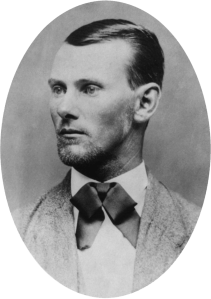
Library of Congress
Born on September 5, 1847, in Clay County, Missouri, Jesse Woodson James was the son of a Baptist minister, Robert James, and his wife, Zerelda. Raised in a household that included a mixture of prosperous farming and fervent Southern sympathy, Jesse grew up in an environment that cultivated a sense of strong regional identity. He had an elder brother, Frank James, with whom he later formed the notorious James-Younger gang.
Jesse’s entrance into the world of guerilla warfare and outlawry can be traced back to the Civil War. Missouri, a border state, was torn between Union and Confederate loyalties. Young Jesse, influenced by his family’s Confederate leanings, joined pro-Southern guerillas known as “bushwhackers.” Under leaders like William Quantrill and “Bloody Bill” Anderson, Jesse honed his skills in guerilla tactics, sabotage, and violence.
After the war, the Reconstruction era presented challenges for many Southerners. For Jesse and Frank James, however, their wartime activities morphed into a life of crime. Unable to reintegrate into society and branded as outlaws, they transitioned from wartime guerillas to peacetime bandits.
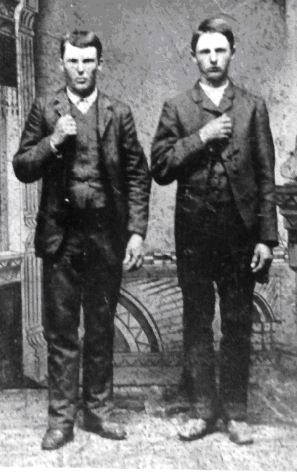
Public Domain
Jesse James, alongside his brother Frank and their gang, was responsible for a series of notorious robberies across the Midwest. Their targets included banks, stagecoaches, and later, trains. One of the earliest and most significant was the Liberty Bank robbery in 1866, which is often considered the first daylight bank robbery during peacetime. Their exploits earned them infamy and were often sensationalized by the press. Some of their most significant heists include the Gallatin, Missouri bank robbery, where Jesse allegedly killed the cashier, and the Glendale train robbery in 1879.
Jesse James’s criminal career came to an end on April 3, 1882. Living under the alias “Thomas Howard” in Saint Joseph, Missouri, and with the gang dwindling, he was shot in the back of the head by Robert Ford, a new recruit seeking the reward on James’s head. Ford’s action, while earning him a brief moment of fame, also garnered him widespread contempt for the cowardly manner in which he killed Jesse.
The legend of Jesse James grew larger than the man himself. Sensationalized by dime novels and newspapers, he was often portrayed as a Robin Hood-like figure, stealing from the rich and, ostensibly, helping the poor, though evidence of such altruism is scant. His image was that of a Southern rebel, defiantly standing against the changing tides of America during Reconstruction. Over the years, the line between fact and fiction blurred.
In the 20th and 21st centuries, Jesse James’s life has been adapted into numerous films, books, and songs. They range from historically accurate depictions to wildly fictionalized accounts, further cementing his place as a legendary figure in the annals of American history. Some view him as a symbol of resistance, others as a ruthless outlaw. But regardless of one’s opinion, the name Jesse James remains synonymous with the Wild West, rebellion, and the blurred lines between hero and villain in the American narrative.



 DAVE DOES HISTORY
Leave a comment