
As you know, the Roman Republic is one of my passions when it comes to history. The intrigue, the machinations, the beauty and ingenuity of the era all combine to make it fascinating. When you combine that with the impact that the Roman republic had n the creation of the American Republic, it become enthralling to me.
At the end of the republic, the masterful orator Cicero, took on Caesar’s right hand man, Marc Anthony, in a series of Phillipcs, or denunciations before the Senate. It was an example of the age old idea that in politics, you can be correct, but some things probably just shouldn’t be said. Especially if you aren’t one hundred percent sure that your side is going to win…
In the late Roman Republic, few names shine as brightly as that of Marcus Tullius Cicero, the eloquent orator, and Mark Antony, the audacious military leader. The two had a relationship characterized by deep political rifts, personal animosities, and public confrontations. But what fueled this animosity, and what role did Cicero’s invective speeches, the Philippics, the first of which was delivered on September 2, 44bce, play in this drama?
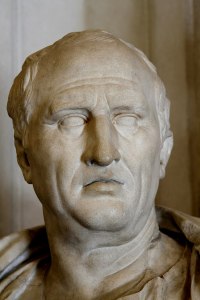
Public Domaim
Initially, the relationship between Cicero and Mark Antony was not one of enmity. Both had mutual acquaintances and occasionally aligned interests. However, as the Roman political climate became more tumultuous following Julius Caesar’s assassination in 44 BCE, their paths diverged, with Cicero advocating for the restoration of the traditional republic and Antony pursuing personal power and vying for Caesar’s mantle.
There are several reasons contributed to Cicero’s opposition to Antony:
1. Pursuit of Power: Cicero was deeply wary of individuals who sought unchecked power, having earlier opposed Julius Caesar and Catiline for similar reasons. Antony’s attempts to consolidate power after Caesar’s death, particularly through controlling the distribution of Caesar’s bequests and manipulating the Senate, were deeply concerning to Cicero.
2. Disregard for the Senate and the Law: Antony’s political maneuvers, which often bypassed traditional Republican norms, further drove a wedge between him and Cicero. Antony’s use of Caesar’s papers to enact measures in Caesar’s name, without consultation, was particularly egregious in Cicero’s eyes.
3. Personal Disdain: Cicero disapproved of Antony’s personal behavior, viewing him as licentious and lacking the moral fortitude befitting a Roman leader.
Named in emulation of the orations delivered by Demosthenes against Philip II of Macedon, Cicero’s Philippics were a series of speeches (14 in total) that attacked Antony both politically and personally. They criticized Antony’s power grabs, his disrespect for the Senate, his personal vices, and painted him as a tyrant in the making.
The Philippics were potent propaganda tools and had a significant impact:
1. Reputation Damage: Cicero’s eloquence and rhetoric meant that Antony’s image suffered in the eyes of many Romans. The speeches portrayed him as a drunk, a debauchee, and an enemy of Republican ideals.
2. Political Isolation: The Philippics successfully rallied many senators against Antony, isolating him politically. They were a significant factor in the Senate’s decision to support Octavian (the future Augustus) against Antony.
Long-term Impact of the Philippics:
1. Cicero’s Death: The immediate consequence for Cicero was dire. When Antony, Octavian, and Lepidus formed the Second Triumvirate and began proscribing their enemies, Cicero was high on the list, largely because of the Philippics. He was hunted down and executed in 43 BCE.
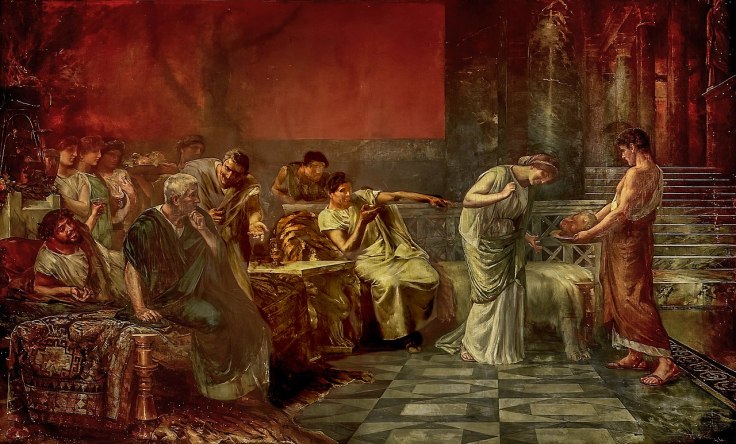
Public Domain
2. Literary Legacy: Despite the personal cost to Cicero, the Philippics became legendary in the annals of rhetorical literature. They were studied for centuries as masterpieces of oratory, influencing later generations of speakers.
3. The Fall of Antony: While the Philippics were not the sole reason for Antony’s eventual downfall (his conflict with Octavian played a substantial role), they played a part in diminishing his standing in Rome and making him more reliant on alliances outside the traditional power structures, most notably with Cleopatra.
In conclusion, the drama between Cicero and Mark Antony encapsulates the turbulence of the Late Roman Republic. The Philippics stand testament to the power of words in shaping the course of history, illustrating how eloquence, when wielded by a master like Cicero, can change the fate of empires.




 DAVE DOES HISTORY
Leave a comment