
Born on August 29, 1632, in Wrington, Somerset, John Locke stands as one of the most influential thinkers in the annals of British intellectual history. His philosophical contributions laid the groundwork for Enlightenment thought and modern political theory, especially liberal democracy.
Locke’s formative years were marked by the turbulent events of the English Civil Wars. He began his education at the prestigious Westminster School in London, later attending Christ Church, Oxford. Though initially drawn to medicine – and indeed, he would retain a lifelong interest in it – Locke’s intellectual trajectory led him to the broader fields of philosophy and political theory.
The politics of Locke’s day were tumultuous, to say the least. England’s Glorious Revolution, the restoration of the monarchy with Charles II, and later, the ascension of James II – these events and the political machinations surrounding them undoubtedly influenced Locke’s political thought.
Public Domain
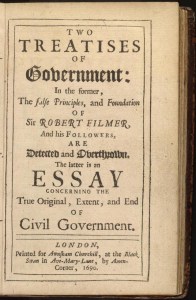
Among Locke’s works is his “Two Treatises of Government” (1689). Written as a refutation of the divine rights of kings, this work, particularly the second treatise, laid out a revolutionary proposition: the idea that government rests on the consent of the governed. Locke championed the idea of natural rights, specifically life, liberty, and property, and argued that should a government violate these rights, the people have the right to revolt.
The First Treatise is primarily a refutation of Sir Robert Filmer’s “Patriarcha,” which argued in favor of the divine right of kings. The Second Treatise, however, is where Locke’s more influential ideas are fleshed out. It establishes his theories on the social contract, natural rights, and the appropriate functions and limitations of government.
**Key Concepts of the Second Treatise:**
1. **State of Nature:** Locke imagines a pre-social and pre-political state where individuals live together in perfect freedom without any overarching authority. In this state, individuals are guided by reason and have natural rights.
2. **Natural Rights:** Central to Locke’s theory is the concept of natural rights. Every individual has the right to life, liberty, and property. These rights are inherent and cannot be surrendered or transferred, even with the individual’s consent.
3. **Property:** Locke had a broad conception of property. While it does include material possessions, he also believed that individuals own their bodies and the labor they produce. When individuals mix their labor with nature, they create property.
4. **The Social Contract:** To protect their rights and resolve disputes in the state of nature, individuals agree to form a social contract, giving up some freedoms to enjoy the benefits of a communal existence. This agreement leads to the establishment of civil society and government.
5. **Consent of the Governed:** Government legitimacy rests on the consent of the governed. This means that authority is not derived from divine mandate or hereditary rights but from the will and agreement of the people.
6. **Right of Revolution:** Should a government fail in its duty to protect the rights of its citizens or breach the social contract, the people have the right to revolt and institute a new government.
Influence on the American Founders:
1. **Declaration of Independence:** Thomas Jefferson’s phrasing in the Declaration of Independence—“life, liberty, and the pursuit of happiness”—echoes Locke’s trinity of “life, liberty, and property.” Jefferson’s assertion that governments derive “their just powers from the consent of the governed” is directly Lockeian.
2. **Constitutional Design:** Locke’s emphasis on the separation of powers and checks and balances informed the framing of the U.S. Constitution. The Founders were keenly aware of the dangers of concentrated power, a sentiment that can be traced back to Locke’s treatises.
3. **Property Rights:** Locke’s ideas on property rights influenced the Founders’ belief in individual rights and the sanctity of private property. These ideals were enshrined in the Constitution, particularly in the protections against the unjust seizure of property.
4. **Revolutionary Zeal:** Locke’s justification for the right of revolution gave the American colonists a philosophical grounding for their revolt against British rule. His arguments were used as a basis for the colonies’ assertion of their rights and the decision to ultimately declare independence.
“Two Treatises of Government” provided the intellectual fuel for America’s founding documents and the nation’s underlying principles. The Founders did not simply parrot Locke but adapted his ideas, blending them with their own insights and the wisdom of other Enlightenment thinkers. Nevertheless, Locke’s position as an essential figure in the intellectual origins of the United States is undeniable. His vision of limited government, predicated on individual rights and the consent of the governed, remains foundational to American political thought.
3. **”A Letter Concerning Toleration” (1689):** A powerful argument in favour of religious tolerance, this letter was a reaction against the religious persecution and sectarianism of his time.
Locke’s connections with prominent Whigs in England led him into political exile in the Netherlands during the 1680s, a time during which he composed many of his major works. With the Glorious Revolution of 1688 and the installation of William and Mary to the throne, Locke was able to safely return to England.
Locke never married and had no children. He spent his later years in Essex, where he died on October 28, 1704.
In the subsequent centuries, John Locke’s influence has been profound. His ideas on natural rights and the social contract have been foundational to Western liberal thought. They played a significant role in political revolutions, most notably the American Revolution.
In the pantheon of great thinkers, John Locke finds his rightful place as a champion of individual rights, limited government, and empirical reason – pillars upon which much of modern democracy rests.
In summarising Locke’s life, it’s hard not to see the sheer magnitude of his contributions. From the individual to society, from governance to religion – Locke’s imprint is deeply etched into the edifice of modern political philosophy.



 DAVE DOES HISTORY
Leave a comment