
It’s easy to forget that long before the Austrian painter from Vienna, antisemitism and pogroms were an obvious precursor to what would come later. Hatred of Jews is nothing new, nor was it something unusual in 1933. Like blaming Jews for the economic woes of the Great Depression, there was time when Europeans blamed Jews for the Bubonic Plague.
In 1929, today, the Hebron Massacre was well underway, with more Jews murdered, and on this day in 1941, Hitler was compelled by protests to order the end of the T4 euthanasia program. The killings never stopped despite the “order,” and the Holocaust continued.
On this occasion, we shall delve into a painful chapter of our shared history — the mass killing of Jews at Mainz on August 24, 1349. It is vital to understand these events within the broader context of medieval European antisemitism, for only then can we truly grasp the depth of the challenges faced by our ancestors and strive to ensure history does not repeat itself.
1349 was one of the darkest years for European Jewry. The Black Death, the deadliest pandemic in human history, had gripped Europe. Amidst the panic and chaos that the plague engendered, wild and baseless rumors spread, accusing Jews of poisoning wells to cause the pandemic. The city of Mainz, one of the most prominent Jewish communities in the Holy Roman Empire, was not spared from this frenzy of paranoia and fear.
On August 24, the Jewish community at Mainz suffered a catastrophic pogrom, resulting in the death of approximately 6,000 Jews. Many of these Jews chose to kill themselves and their families rather than be forcibly baptized or murdered by the mob.
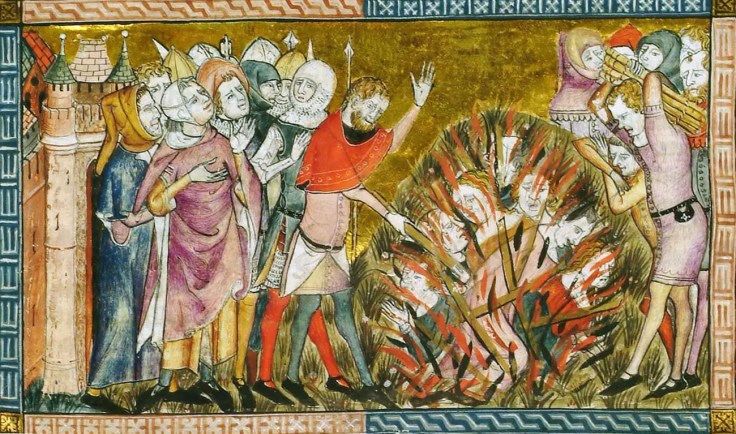
PUBLIC DOMAIN
The tragedy in Mainz wasn’t an isolated incident. The seeds of such violent outbreaks were rooted in deep-seated antisemitic attitudes that had festered in Europe for centuries. Here are some factors that contributed to this:
1. The medieval Christian world often accused Jews of deicide — the killing of Jesus Christ. This view, however flawed, painted the Jews as eternal sinners, leading to mistrust and hatred.
2. Jews in medieval Europe were frequently involved in money lending. Church prohibitions on Christians charging interest meant that Jews filled an essential economic role. However, this also made them targets of envy and resentment.
3. Jewish communities largely lived in segregated quarters, known as ghettos. This physical separation exacerbated misunderstandings, mistrust, and perpetuated stereotypes.
4. Outrageous myths like the ‘blood libel’ emerged in medieval Europe, accusing Jews of using the blood of Christian children for ritualistic purposes. Such myths further dehumanized the Jewish community in the eyes of their Christian neighbors.
5. Whenever calamities struck — be it famine, economic downturns, or diseases like the Black Death — Jews were convenient scapegoats. Accusations against Jews, such as poisoning wells during the Black Death, can be seen in this light.
History is replete with moments of immense hardship and persecution. But understanding these tragedies, contextualizing them, and learning from them is essential. By recognizing the patterns of prejudice, bigotry, and dehumanization, we can better arm ourselves against future instances of hate and stand in solidarity with others who face persecution.
Let us remember the lives lost at Mainz, not just as victims of a senseless pogrom, but as testaments to the resilience of the Jewish spirit. Our continued existence, growth, and contributions to the world honor their memory. And in our quest for a brighter future, let us always strive for understanding, unity, and peace among all of humanity.



 DAVE DOES HISTORY
Leave a comment