
August 21, 1945, stands as a stark reminder of the perils associated with the dawn of the atomic age. It was on this day that physicist Harry Daghlian experienced a fatal accident with what would later become notoriously known as the “Demon Core” at the Los Alamos Laboratory in New Mexico. Let’s unfold the events of that day and understand the broader implications of this tragedy.
Public Domain
Just weeks after the devastating bombings of Hiroshima and Nagasaki, scientists at Los Alamos were fervently conducting experiments with plutonium cores, intended for a third bomb named “Fat Man”. Among these scientists was 24-year-old Harry Daghlian, a talented physicist from a promising background.
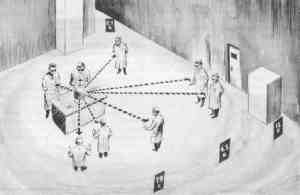
On that fateful evening, Daghlian was working alone at the laboratory, conducting a series of neutron reflection experiments. These experiments involved placing tungsten carbide bricks around a plutonium core to reflect the neutrons emitted by the core back into itself. The goal was to bring the core closer to its criticality point without it actually going critical.
Unfortunately, while placing one of the bricks, Daghlian accidentally dropped it onto the core. This mistake caused the assembly to go supercritical, initiating a self-sustaining nuclear chain reaction. Realizing the grave error, Daghlian quickly moved to disassemble the bricks and halt the reaction. Although he managed to stop the reaction within seconds, he had already been exposed to a lethal dose of neutron radiation.
Daghlian’s exposure was so severe that he was hospitalized immediately. His symptoms worsened rapidly, showcasing the horrifying effects of acute radiation syndrome. Just 25 days after the accident, on September 15, 1945, Harry Daghlian succumbed to the injuries, making him the first known fatality caused by a criticality accident.
The core that took Daghlian’s life did not stop there. Less than a year later, in 1946, it claimed another victim, physicist Louis Slotin, in a separate but equally tragic incident. Following these incidents, the core was dubbed the “Demon Core.”
Daghlian’s accident and the subsequent one involving Slotin underscored the dire need for enhanced safety protocols in handling radioactive materials. As a result, remote-controlled machinery started being used for such experiments, minimizing direct human contact.
These incidents brought forth the inherent dangers associated with nuclear research and weaponry. It showcased that the risks were not just on the battleground but also in labs where scientists worked to harness the power of the atom.
While the incidents were tragic, they served as important lessons for future generations. They highlighted the importance of rigorous training, safety measures, and a deep respect for the forces being dealt with.
In conclusion, the story of Harry Daghlian and the Demon Core is not just an account of a tragic accident but a somber lesson about the awesome and terrifying power of nuclear energy. It reminds us of the sacrifice made by early nuclear scientists and the perils they faced in their quest to unlock the secrets of the atom. As we reflect upon these events, we recognize the importance of diligence, safety, and the profound respect required when dealing with forces that have the power to both create and destroy.





 DAVE DOES HISTORY
Leave a comment