
August 17, 1942: In the vast theater of World War II, amidst well-documented epic battles, there was a raid that showcased American innovation, bravery, and tactical genius. This was the Raid on Makin Island, where U.S. Marines and submarines combined forces in an audacious assault on Japanese positions. kin Island, a part of the Gilbert Islands in the Pacific, was occupied by the Japanese and was deemed of strategic value to the Allied forces. While not a major base, intelligence indicated it was a seaplane base and radio station, serving as a forward outpost for the Japanese. The U.S. military sought not just to disrupt its operations but also to test amphibious raid tactics and boost American morale after the attack on Pearl Harbor.
Public Domain
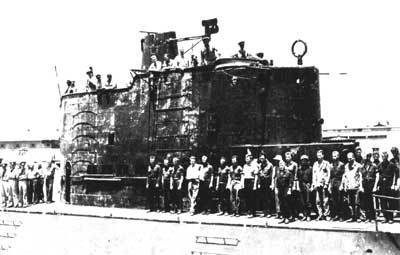
Two submarines, the USS Nautilus and USS Argonaut, played pivotal roles in the Makin Island raid. These weren’t merely support vessels; they were central to the raid’s execution. Both were large, fleet-class submarines, with the Argonaut being the largest non-nuclear submarine ever operated by the U.S. Navy.
The Marine Raiders, an elite unit, were chosen for the raid. 221 men, led by Lt. Colonel Evans Carlson and his second-in-command, Major James Roosevelt (son of President Franklin D. Roosevelt), embarked on the submarines. Using small rubber boats with outboard motors, the Marines were deployed near the island. The submarines’ capability to approach enemy territories stealthily, deploy combatants, and extract them after the operation made them invaluable for such covert operations.
Public domain
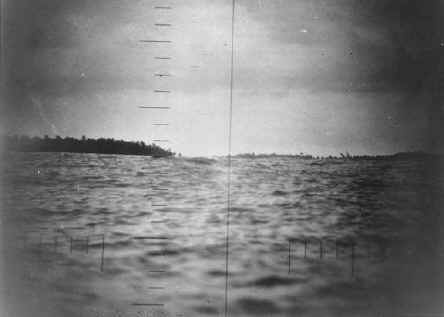
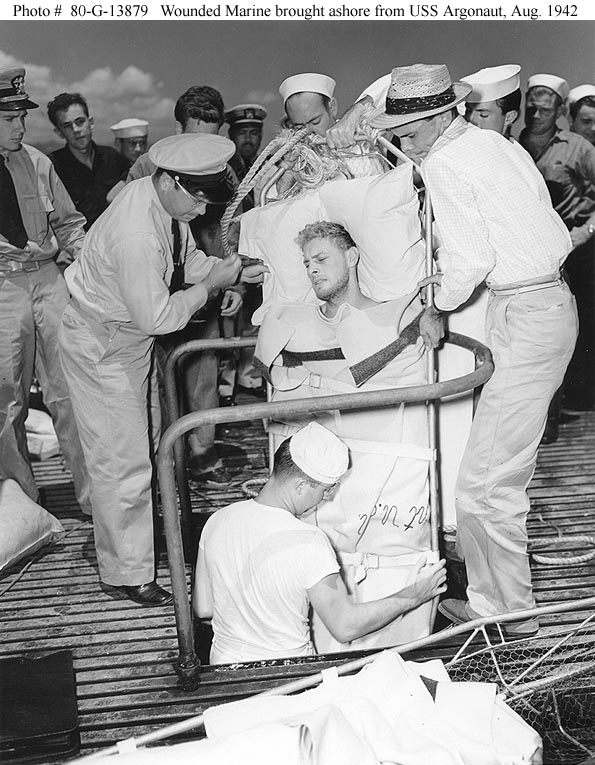
The actual raid was set to last two days, August 17 and 18. Unfortunately, from the start, the Raiders faced challenges. Strong tidal currents played havoc with their rubber boats, causing dispersion of forces. Some of the Raiders couldn’t make it to the designated landing site and had to be rescued by the submarines.
Once on the island, the Raiders engaged the Japanese forces, inflicting significant casualties and destroying installations. The element of surprise was initially on their side. However, as the operation continued, the Japanese started to organize more substantial resistance, complicating the mission.
Throughout the raid, the submarines provided support. When some of the Marines encountered a larger Japanese force, the USS Nautilus moved closer to shore, using its deck gun to provide fire support. This intervention was vital in keeping the Japanese forces at bay and ensuring the safety of the Marine Raiders.
Public Domain
After completing their mission, the Marines signaled the submarines for extraction. The extraction, much like the insertion, was not without its problems. Strong currents, Japanese resistance, and the scattered positioning of the Marine units made it a daunting task. While the majority of the Raiders were successfully evacuated, a number were left behind due to the confusion. These men had to fend for themselves, with some eventually being captured by Japanese forces.
In the raid’s immediate aftermath, the U.S. military had mixed feelings. The daring of the operation, combined with its partial success, was a morale booster. However, operational issues, particularly the problems faced during insertion and extraction, offered lessons in amphibious raids’ complexity.
The role of the submarines was seen as a game-changer. Their ability to approach enemy territories, deploy and support combatants, and extract them afterward would influence U.S. military tactics in the Pacific theater.
The raid had significant ramifications. On a tactical level, it provided the U.S. military with insights into amphibious assaults, leading to improved strategies in subsequent operations.
On a strategic level, the Japanese, alarmed by the raid’s audacity, fortified their island defenses across the Pacific, diverting resources that might have been used elsewhere. This overstretching, to defend even remote locations, would cost them later in the war.
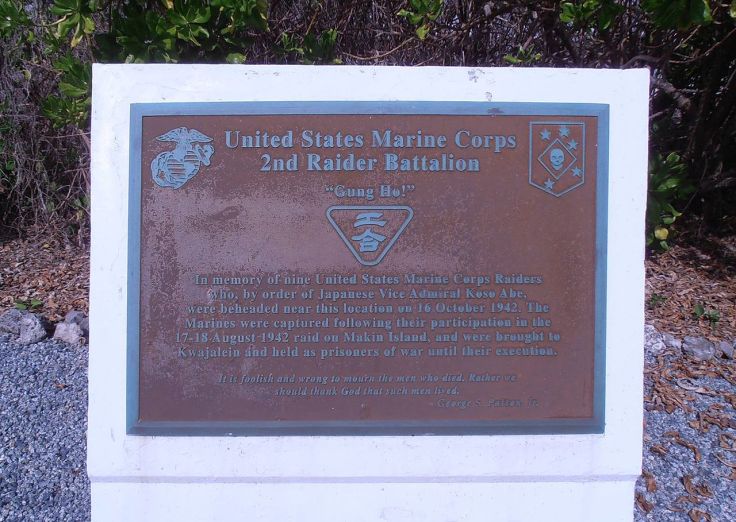
From a human perspective, the fate of the Marines left behind on Makin Island was a tragic chapter. Captured by the Japanese, they were shipped to another island, Kwajalein, and executed. Their remains were only recovered many decades after the war.
The Raid on Makin Island, while a small operation in World War II’s vast scope, holds a special place in U.S. military history. It was a testament to the bravery of the Marine Raiders and the innovative tactics the U.S. was willing to employ. The crucial involvement of submarines, acting not just as carriers but also as active participants in the combat, showcased the flexibility and potential of these vessels in modern warfare.




 DAVE DOES HISTORY
Leave a comment