
Every day as I drive home, I drive on Bennington Ave, named for the battle fought in New York on August 16, 1777.
In the summer of 1777, the Revolutionary War’s Northern Campaign saw British forces under the command of General John Burgoyne devising an ambitious plan: a southward push from Canada through New York with the goal of severing the rebellious New England colonies from their southern counterparts. This initiative, known as the Saratoga Campaign, was based on the strategic belief that isolating New England would cripple the larger war effort of the American colonies.
To support this march, General Burgoyne required a consistent supply line. By mid-summer, however, these supplies dwindled, and word reached Burgoyne of a sizable cache of provisions and war materials stored by the Americans in Bennington, Vermont. Recognizing the strategic significance of these supplies, Burgoyne dispatched a detachment to seize them.
Under the leadership of Lt. Col. Friedrich Baum, a force mainly comprised of German mercenaries known as Hessians, set forth towards Bennington. Unbeknownst to Baum, the Americans were well-prepared for the impending clash.
At the helm of the American defense was General John Stark. He commanded a group of New Hampshire militia and was soon joined by other militias from Massachusetts and Vermont. Their numbers swelled, forming a robust defense against the approaching British force.
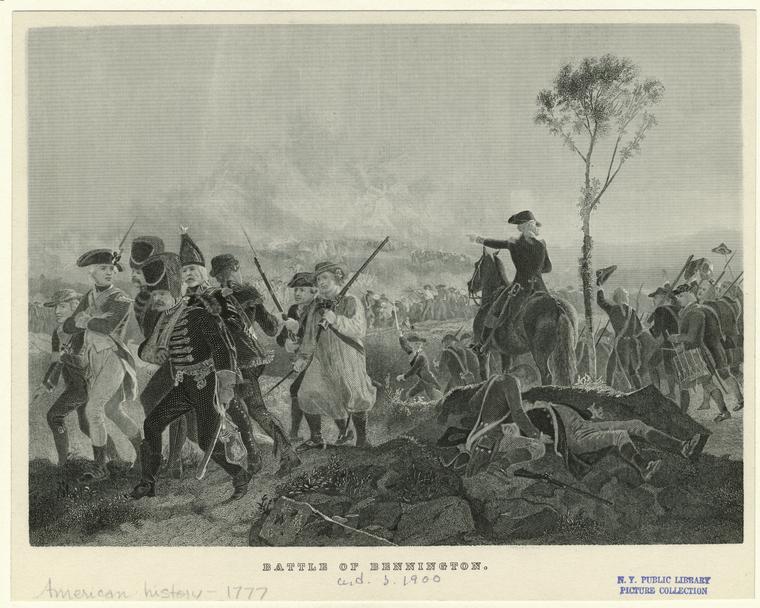
Public Domain
On August 16, 1777, under the looming threat of a thunderstorm, Stark’s forces launched their assault on Baum’s detachment. The American militia’s tactics, combined with the advantageous terrain, allowed them to encircle and overpower the Hessians. As the battle raged, Lt. Col. Baum sustained a mortal wound and his troops faced significant casualties and captures.
However, the day’s events were not yet complete. A reinforcement column for the British, led by Lt. Col. Heinrich von Breymann, arrived on the scene. The American forces, energized by their earlier success and reinforced by Seth Warner’s Green Mountain Boys, clashed once more with the Germans and again emerged victorious.
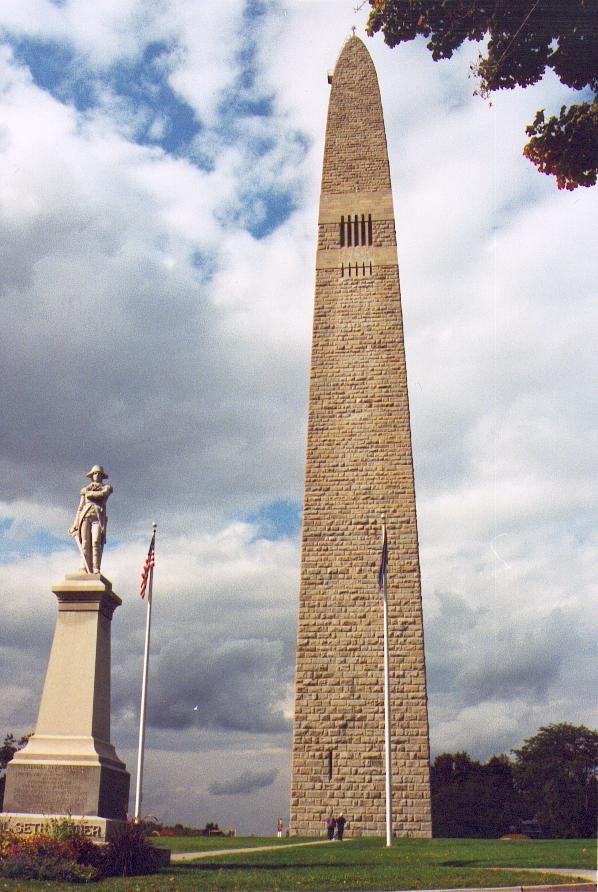
Public Domain
The immediate aftermath of the Battle of Bennington was a profound American victory, both tactically and in terms of morale. Of Burgoyne’s dispatched forces, approximately 700 were captured, killed, or wounded. The American losses were comparatively minimal.
However, the repercussions of Bennington reverberated far beyond the immediate battlefield:
1. Morale: At a time when the American Revolution was fraught with challenges, Bennington served as a beacon of hope, bolstering the resolve of the Continental Army and the American public. It demonstrated that the colonial militia, often maligned as disorganized and ineffective, could hold its ground against the feared European professional soldiers.
2. Burgoyne’s Campaign: The defeat at Bennington critically weakened Burgoyne’s army, depriving it of needed reinforcements and supplies. This failure was instrumental in Burgoyne’s eventual surrender at Saratoga in October 1777, marking a significant turning point in the war.
3. Franco-American Alliance: The American victories at Bennington and subsequently Saratoga played a vital role in convincing France to enter the war as an American ally in 1778. This alliance brought essential military and financial support to the American cause.
In the annals of the American Revolutionary War, the Battle of Bennington stands not merely as a testament to tactical prowess but as a symbol of the burgeoning resilience and determination of a fledgling nation striving for independence.




 DAVE DOES HISTORY
Leave a comment