
NOTE: The recent fires on Maui have been devastating. If you would like to support the efforts to help those in need, please click here to get the latest and to donate
The annexation of Hawaii by the United States, on August 12, 1898 was the culmination of social, economic, and political forces that had been building for decades.
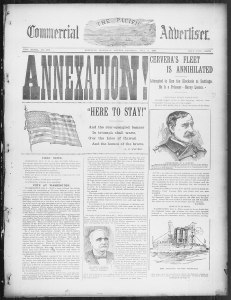 By the late 19th century, Hawaii had become a key supplier of sugar to the United States. The Reciprocity Treaty of 1875 allowed Hawaiian sugar to enter the U.S. market duty-free, which provided an economic boon to American plantation owners in Hawaii. However, with the potential end of this treaty and the McKinley Tariff of 1890 (which raised import duties on foreign sugar), it became economically advantageous for American sugar planters in Hawaii to push for annexation to maintain their competitive edge in the U.S. market.
The U.S. saw Hawaii as a valuable strategic location in the Pacific. With the rise of naval powers and global competition among them, control of the Hawaiian Islands would give the U.S. a strategic advantage. The U.S. had already established a presence with the construction of Pearl Harbor as a naval base.
Many Americans, especially those involved in the lucrative sugar industry, had settled in Hawaii. They held significant economic and political power on the islands. These settlers and businessmen, many of whom were of European descent, often had more in common with American interests than with the native Hawaiian populace. Over time, they sought closer ties with the U.S., both for economic reasons and because of cultural affinity.
In 1893, American and European businessmen, backed by U.S. Marines, overthrew Queen Liliuokalani, the last reigning monarch of Hawaii. This coup was driven in part by the queen’s attempt to draft a new constitution that would restore power to the monarchy and reduce foreign influence. Following the overthrow, the provisional government initially sought annexation by the U.S., but President Cleveland opposed it. It wasn’t until the administration of President McKinley that annexation became official policy.
The late 19th century was a time of American expansionism. Many in the U.S. believed in the idea of “Manifest Destiny” – the notion that Americans were destined to expand their territory and influence. This belief wasn’t limited to the North American continent; it extended to other areas, including the Pacific islands. The annexation of Hawaii can be seen in the broader context of American imperialism during this period, which also included the acquisition of territories like the Philippines, Guam, and Puerto Rico following the Spanish-American War.
While these factors played significant roles, it’s worth noting that the annexation was controversial. Native Hawaiians and other groups opposed it. There was considerable debate in the U.S. about the merits and morality of annexing the islands. However, the combined weight of economic, military, and political factors ultimately led to Hawaii’s annexation.




 DAVE DOES HISTORY
Leave a comment