
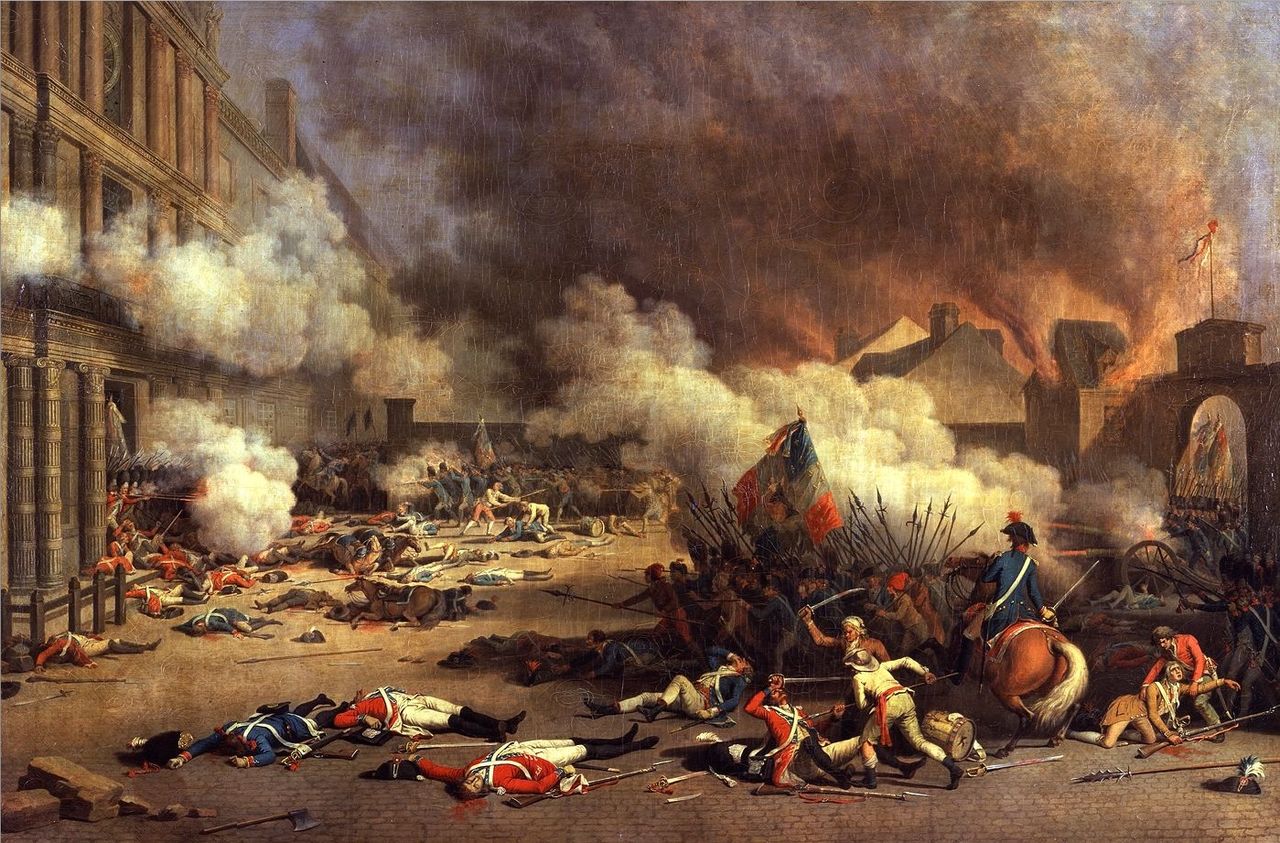
The events at the Tuileries Palace on August 10, 1792, marked a pivotal moment in the French Revolution and led to the fall of the French monarchy. On that day, a large and angry mob of revolutionary insurgents stormed the Tuileries Palace in Paris, where King Louis XVI and his family were residing, and overthrew the monarchy. This event is commonly referred to as the “Storming of the Tuileries.”
By 1792, France was in a state of political turmoil and social unrest. The radicalization of the revolution had intensified, with various factions vying for power and advocating for significant societal changes. King Louis XVI’s perceived attempts to resist the revolution and external threats from other European monarchies contributed to the growing tension.
On August 10, a massive crowd of sans-culottes (radical working-class revolutionaries) and National Guard units, along with members of various revolutionary factions, converged on the Tuileries Palace. Their demands included the removal of King Louis XVI and the establishment of a more radical republican government.
Facing this overwhelming force, the palace guards were unable to hold back the mob. The royal family, including Louis XVI, Queen Marie Antoinette, and their children, took refuge within the palace. However, the mob breached the defenses and entered the palace, leading to violent clashes between the revolutionaries and the royal guards.
Public Domain
Amid the chaos and bloodshed, King Louis XVI decided to take shelter with the National Assembly, hoping to avoid further violence and bloodshed. This decision effectively ended the Bourbon monarchy, as the National Assembly declared that Louis XVI would be temporarily suspended from his role as king. The monarchy was subsequently abolished altogether, and France was declared a republic.
The storming of the Tuileries had profound consequences for the course of the French Revolution. It marked a shift towards more radical political forces and contributed to the rise of the Jacobins, a radical political club that played a significant role in subsequent revolutionary events. The events of August 10 further polarized the revolution and deepened the divide between moderate and radical factions.
In the wake of the fall of the monarchy, a series of political trials and purges followed, leading to the arrest, trial, and eventual execution of King Louis XVI and Queen Marie Antoinette. The revolutionary fervor that characterized this period would continue to shape the course of French history and have far-reaching implications for both France and Europe as a whole.




 DAVE DOES HISTORY
Leave a comment