
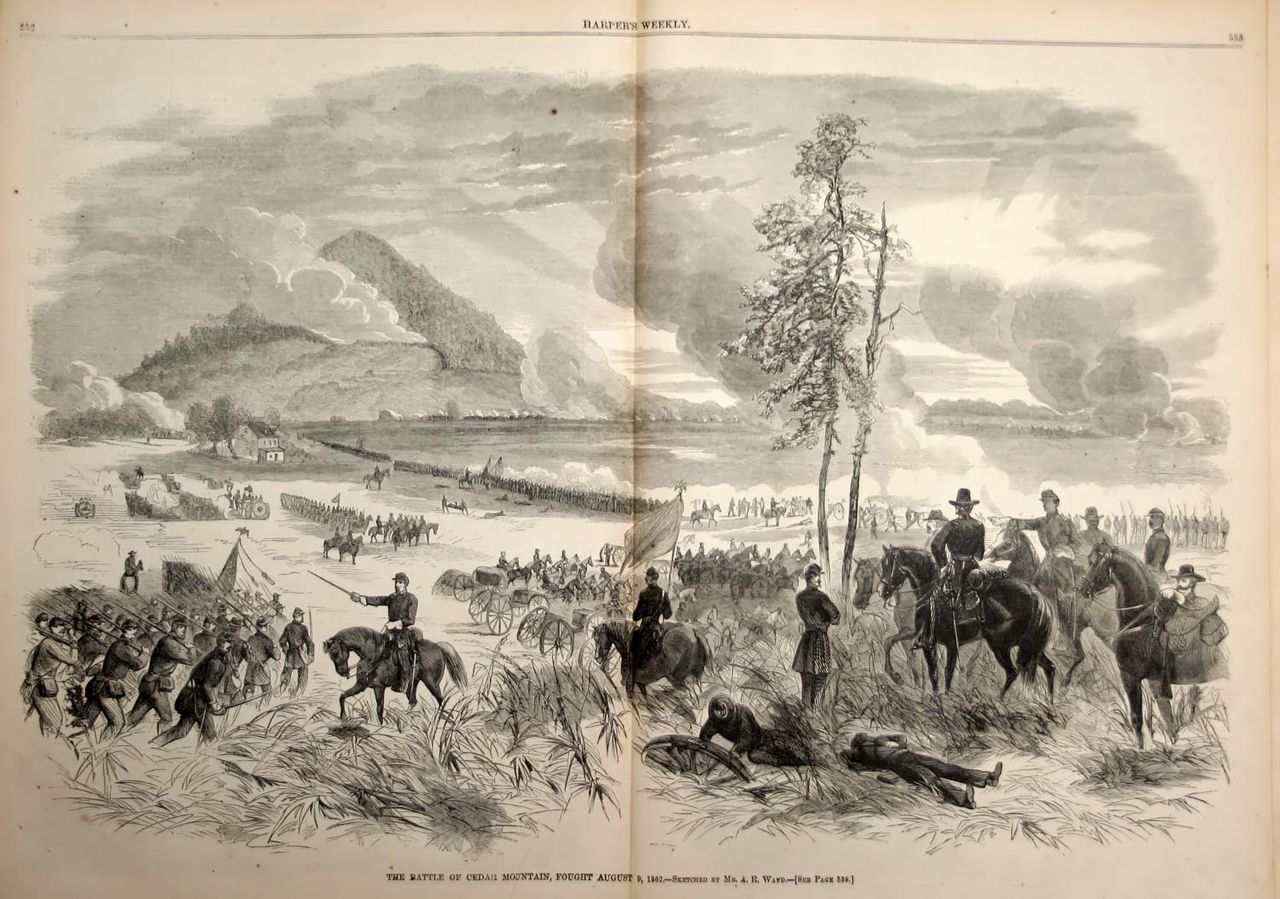
The Battle of Cedar Mountain, fought on August 9, 1862, during the American Civil War, was a significant engagement in Northern Virginia between Confederate forces commanded by General Thomas “Stonewall” Jackson and Union forces led by Major General Nathaniel Banks. This battle marked a clash between two skilled commanders and provided insights into the evolving tactics and strategies of the Civil War.
In the summer of 1862, General Robert E. Lee, the commander of the Confederate Army of Northern Virginia, sought to exploit Union divisions by launching a series of offensives. One of his strategies was to send General Stonewall Jackson to confront the Union forces under General Banks in the Shenandoah Valley.
General Jackson’s Confederate forces, numbering around 16,000, were positioned along Cedar Mountain near Culpeper, Virginia. On the Union side, General Banks commanded an army of approximately 12,000 troops.
The battle began with skirmishes on August 9, as both sides tested each other’s positions and intentions. The Confederate forces were well-entrenched on the slopes of Cedar Mountain, while the Union forces prepared for an assault.
Sensing the Union forces’ preparations, General Jackson launched a preemptive counterattack against the advancing Union troops. The Confederate assault was fierce, catching the Union forces off guard. Jackson’s aggressive move put pressure on the Union lines, leading to initial setbacks for the Northern troops.
As the Union lines began to falter, General Banks ordered reinforcements to stabilize the situation. Union brigades under the command of Generals Christopher C. Augur and John W. Geary arrived on the battlefield to bolster the Union position.
The battle intensified as both sides fought fiercely for control of the field. The Confederate assaults faced determined resistance from the Union forces, particularly in the woods and rugged terrain. The fighting was intense and characterized by close-quarters combat and artillery exchanges.
Despite the initial Confederate successes, Jackson decided to withdraw his forces from the battlefield in the evening. His decision was influenced by concerns about potential Union reinforcements and the need to conserve his forces for the larger Confederate campaign in the region.
(Public Domain)
The Battle of Cedar Mountain resulted in a Confederate tactical victory, as Jackson’s forces had managed to repel the Union assault. However, the battle also showcased the Union forces’ resilience and ability to hold their ground, preventing a complete Confederate rout. The Confederate victory did not lead to significant strategic gains, and the battle had relatively high casualties on both sides.
The Battle of Cedar Mountain demonstrated the evolving nature of tactics and strategies in the American Civil War. It highlighted the importance of strong defensive positions and the effectiveness of well-entrenched troops in countering assaults. The battle also provided insights into the leadership abilities of General Jackson and the determination of Union forces under General Banks.
In the broader context of the war, the Battle of Cedar Mountain was a precursor to the larger battles and campaigns that would follow, shaping the course of the conflict and the fate of the nation.




 DAVE DOES HISTORY
Leave a comment