
As a qualified submariner myself, I have a long fascination with the CSS Hunley. The innovation that the boat displayed – and that is still being discovered – is absolutely amazing. After killing it’s crew time and again, one has to wonder just how the last crew was convinced to get aboard? It’s like the scene in The Hunt for Red October, but in reverse… “How do you make a crew want to get ON a submarine?”
By all accounts, once they had worked out the kinks that caused the first two accidents, the Hunley was quite a masterpiece of naval technology. There are contemporary reports of her putting on demonstrations in the river that convinced the CSA Navy that she was ready for combat.
It’s hard for me to imagine how they climbed in there and set off on that final voyage. Like so many submariners through history, they never came back. But nobody ever really forgot them. When she was found, I followed the story with great interest. When she was raised, I was thrilled. And now that she has been studied and analyzed, I am amazed at the genius of the men who designed and built her.
What frustrated me was that I went all the way to Charleston to see her in May. But you cannot just walk in, buy an admission and see her. She is only open for viewing on certain days, none of which were ones that I was in the area.
So I headed off to Hamburg, SC, instead… but that’s a story for another day…
The story of the Confederate submarine CSS Hunley is one of perseverance, innovation, and historical significance. Its discovery and subsequent recovery have shed light on a pivotal moment in naval warfare during the American Civil War, offering insights into the technology, challenges, and human dedication of that era.
The CSS Hunley, named after its inventor Horace Lawson Hunley, was a pioneering submarine commissioned by the Confederate States of America in the midst of the Civil War. Launched in 1863, the Hunley was a daring attempt to change the course of naval warfare by introducing a stealthy underwater vessel capable of delivering explosive payloads to enemy ships. Despite its potential, the Hunley faced several operational challenges, including the tragic loss of two crews during testing due to accidents and sinking.
The most famous episode in the Hunley’s history took place on the night of February 17, 1864, when it successfully carried out a mission against the Union blockade ship USS Housatonic off the coast of Charleston, South Carolina. The Hunley attached a torpedo to the hull of the Housatonic and then retreated to a safe distance. However, moments after the torpedo detonated, both the Housatonic and the Hunley disappeared beneath the waves, leaving historians puzzled about the submarine’s fate for over a century.
After decades of speculation and research, the Hunley’s resting place was finally discovered off the coast of Charleston in 1995 by a team of underwater archaeologists led by Dr. E. Lee Spence. The remarkable find sparked global interest in uncovering the submarine’s secrets and understanding the circumstances surrounding its tragic disappearance.
Recovering the Hunley was a complex and challenging endeavor. The submarine lay buried beneath layers of sediment and marine debris for over a century, preserving it but also making its retrieval a delicate process. The first step involved creating a conservation basin to surround the Hunley and prevent its exposure to the air, which could lead to rapid deterioration. The actual recovery took place in 2000, with a specially designed truss lifting the Hunley from the seabed and transporting it to a conservation lab.
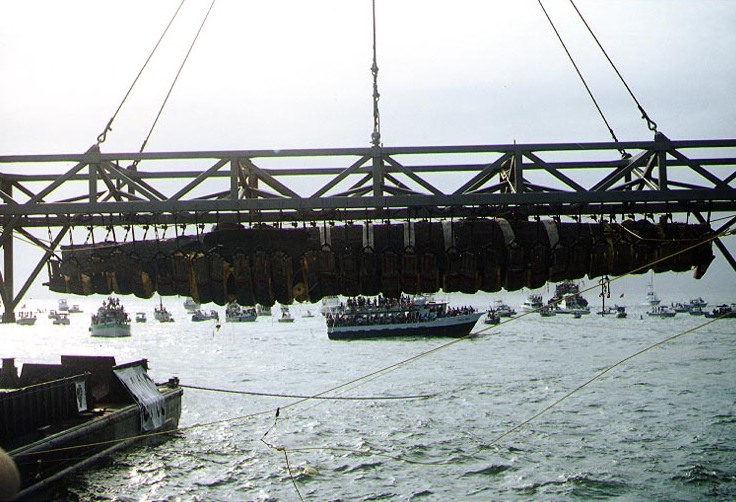
(Public Domain)
The recovery of the Hunley was a significant milestone in underwater archaeology. The submarine’s preservation provided researchers with an unparalleled opportunity to study 19th-century naval technology, design, and engineering. Additionally, the artifacts found within the Hunley, including personal belongings of the crew, have provided insights into the daily lives of Civil War submariners.
The meticulous analysis of the Hunley’s remains, combined with historical records and contemporary accounts, has provided valuable insights into the submarine’s operation, crew composition, and its ill-fated final mission. Researchers discovered that the Hunley had struck the Housatonic’s hull directly with the torpedo, causing the explosion that sank both vessels.
The story of the CSS Hunley is a testament to human ingenuity and determination in the face of technological challenges. While its mission was a tragic failure, the Hunley’s contribution to naval warfare cannot be underestimated. It paved the way for subsequent advancements in submarine technology that would eventually shape modern naval operations.
In conclusion, the discovery and recovery of the Confederate submarine CSS Hunley have offered us a glimpse into a daring and revolutionary attempt to alter the course of naval warfare during the American Civil War. This historical episode serves as a reminder of the sacrifices made by those who sought to push the boundaries of technology and warfare, as well as the dedication of modern researchers in uncovering the past and preserving its lessons for future generations.
At last resurfacing on August 8, 2000, the Hunley kept the most import rule in submarines: Make sure that the number of surfaces equals the number of dives…




 DAVE DOES HISTORY
Leave a comment