
The Whiskey Rebellion was a significant event in the early history of the United States that occurred between 1791 and 1794. It was a protest and uprising against a federal excise tax on whiskey imposed by the newly established federal government under President George Washington’s administration.
In the aftermath of the American Revolutionary War, the young United States faced significant financial challenges. To address this, Secretary of the Treasury Alexander Hamilton proposed various economic measures, one of which was the imposition of an excise tax on distilled spirits, including whiskey. This tax aimed to generate revenue for the federal government and help repay the war debt.
The tax on whiskey was particularly controversial in certain regions of the country, such as western Pennsylvania, where many farmers distilled surplus grain into whiskey as a way to transport and store their crops. Whiskey had become a form of currency and a means of trade in these areas. The tax was seen as disproportionately affecting these small farmers and frontiersmen, who often lacked access to traditional forms of currency.
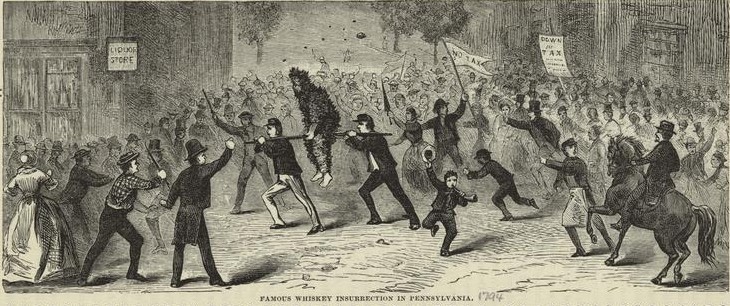
As the federal government began to enforce the tax, resistance grew among the affected communities. In 1791, incidents of defiance and violence against tax collectors and federal officials began to occur. The tension escalated, and in 1794, the situation came to a head when a U.S. marshal arrived in western Pennsylvania to serve writs on individuals who had not paid the taxes.
The rebellion turned into a more organized and confrontational movement. A group of rebels, estimated to be around 7,000 strong, took control of the region, obstructing the execution of the tax laws and intimidating federal officials. The situation alarmed President Washington, who feared that allowing the rebellion to persist could set a dangerous precedent for the young nation’s ability to enforce its laws.
President Washington and his administration were determined to assert federal authority and maintain the rule of law. In response to the rebellion, on August 7, 1794, Washington issued a proclamation calling for the insurgents to disperse and abide by the law. He also dispatched a militia force of around 13,000 troops, led by himself and other prominent figures like Alexander Hamilton and Henry “Light-Horse Harry” Lee, to suppress the rebellion.
The military force arrived in western Pennsylvania, and their presence, coupled with negotiations, gradually defused the situation. The rebels dispersed without major violence, and many of the leaders fled the region. The federal government demonstrated its ability to enforce its laws and assert its authority over states and localities.
The Whiskey Rebellion was a pivotal moment in the early years of the United States. It established the federal government’s capability to respond to challenges to its authority, and it emphasized the importance of maintaining the rule of law. The episode also reinforced the principle that disputes should be resolved through peaceful means rather than through armed resistance.
Furthermore, the rebellion contributed to the ongoing debate over the extent of federal power and the rights of individual states. It highlighted the tension between federal taxation authority and the interests of local communities. The incident played a role in shaping discussions about the balance of power between the federal government and state governments, a debate that continues to influence American politics to this day.


 DAVE DOES HISTORY
Leave a comment