
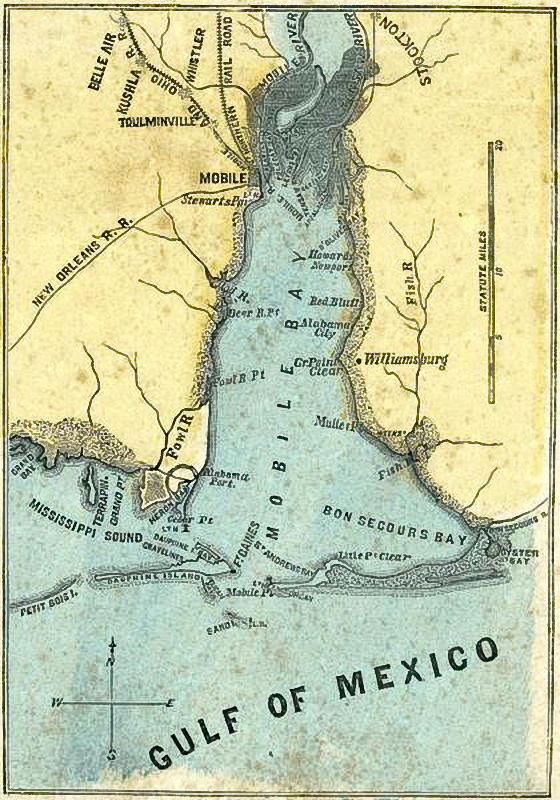
The Battle of Mobile Bay took place on August 5, 1864, during the American Civil War and was a significant naval engagement between the Union Navy, led by Rear Admiral David G. Farragut, and the Confederate forces under Admiral Franklin Buchanan.
Public Domain
Mobile Bay, located in Alabama, was a strategically important port city for the Confederacy. It served as a major naval base and was one of the last remaining ports through which the Confederacy could import essential supplies and export cotton to Europe. The Union had been trying to block and capture the port for some time, as it was vital to strangling the Confederate economy and supply lines.
The Confederate defenses at Mobile Bay included two forts – Fort Morgan on the eastern side and Fort Gaines on the western side of the bay, along with an array of underwater mines (known as torpedoes at that time) to deter enemy ships.
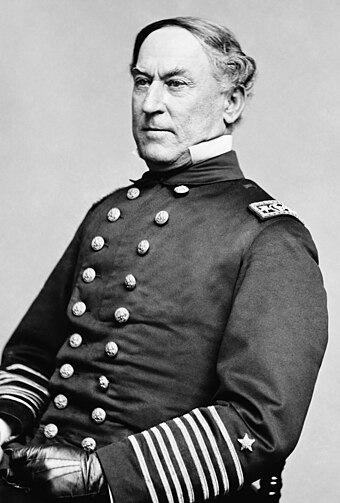
Admiral Farragut, commanding a fleet of 14 wooden warships and four ironclad monitors, led the Union naval forces into Mobile Bay. As the Union fleet entered the bay, they encountered a minefield, and the lead ship, USS Tecumseh, struck a mine and sank, causing a momentary halt in the advance.
Public Domain
Farragut famously issued the order, “Damn the torpedoes, full speed ahead!” to push the fleet forward. The remaining Union ships navigated through the minefield under heavy fire from the Confederate forts.
During the battle, the Confederate ironclad CSS Tennessee, commanded by Admiral Buchanan, engaged the Union fleet, attempting to break through the blockade. It put up a fierce resistance, taking on multiple Union ships at once.
The Union’s superior numbers and firepower gradually overpowered the Confederate defenses. Farragut’s fleet managed to disable the CSS Tennessee and forced its surrender. With the Confederate naval threat neutralized, Fort Gaines soon surrendered to Union forces.
Following the Union victory at Mobile Bay, Fort Morgan was also captured, and the port of Mobile was effectively closed to Confederate ships. This was a significant blow to the Confederacy, cutting off one of their last vital supply lines.
The Battle of Mobile Bay was a resounding Union success and secured another important naval victory for the North. Farragut’s bravery and determination earned him lasting fame and recognition as one of the most prominent naval figures in American history.
Overall, the fall of Mobile Bay played a role in hastening the eventual defeat of the Confederacy, contributing to the Union’s success in the Civil War.




 DAVE DOES HISTORY
Leave a comment