
Louis Armstrong, also known as “Satchmo” and “Pops,” was a pioneering jazz musician and one of the most influential figures in the history of American music. Born on August 4, 1900, in New Orleans, Louisiana, he rose from a challenging upbringing to become a virtuoso trumpeter, singer, and bandleader. Armstrong’s innovative style, unique vocal talents, and charismatic stage presence not only shaped the development of jazz but also made him a global icon of the 20th century.
Louis Daniel Armstrong was born into poverty in the poorest section of New Orleans known as “Storyville.” Raised by his grandmother, he had a difficult childhood, and at the age of five, he was placed in the Colored Waif’s Home for Boys, where he discovered his love for music. It was at the home that Armstrong learned to play the cornet under the guidance of Peter Davis, who recognized his musical talent.
At the age of 14, Armstrong was released from the home and began performing in local brass bands, dance halls, and on riverboats. His early exposure to various musical styles, including blues, gospel, and ragtime, heavily influenced his development as a musician.
In 1922, Armstrong received an invitation to join King Oliver’s Creole Jazz Band in Chicago, which marked a significant turning point in his career. His exceptional talent on the cornet and his ability to improvise captivated audiences and fellow musicians alike. During his time with Oliver’s band, Armstrong honed his improvisational skills and became known for his innovative solos.
In the late 1920s, Armstrong moved to New York City, where he joined the Fletcher Henderson Orchestra as the lead trumpet player. He continued to refine his playing and began recording with various bands, establishing himself as one of the most influential musicians of the era.
Louis Armstrong’s impact on jazz cannot be overstated. He played a crucial role in transforming jazz from a collective improvisational art form into one featuring virtuosic soloists. His extraordinary talent for improvisation and his use of scat singing, a style of vocalizing using improvised, nonsensical syllables, set new standards for jazz musicians.
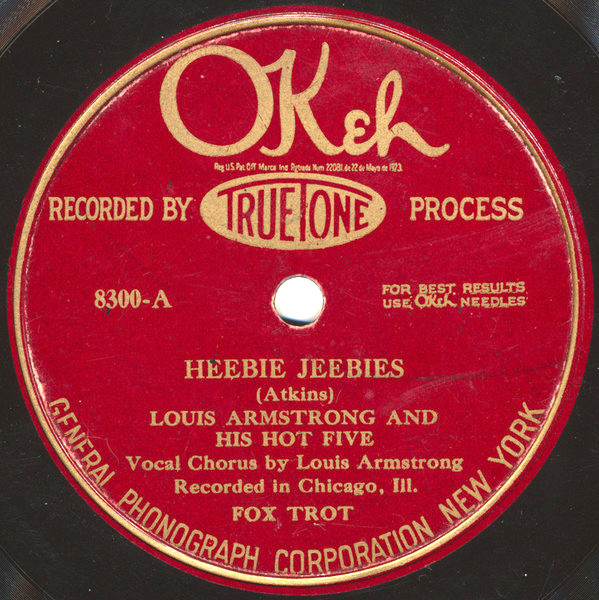
By Okeh Records – https://www.discogs.com/release/1658659-Louis-Armstrong-And-His-Hot-Five-Heebie-Jeebies-Muskrat-Ramble/image/SW1hZ2U6MzU2Njc4MDU=, Public Domain,
Armstrong’s recordings with his Hot Five and Hot Seven bands, made during the late 1920s, are considered some of the most important and influential in jazz history. Tracks like “West End Blues,” “Potato Head Blues,” and “Struttin’ with Some Barbecue” showcase his incredible technical skills, emotional expressiveness, and creativity.
As Louis Armstrong’s fame grew, he embarked on extensive international tours, becoming one of the first truly global jazz ambassadors. His collaborations with other prominent artists, including Ella Fitzgerald and Duke Ellington, further cemented his status as a jazz legend.
Throughout his career, Armstrong remained a beloved figure, renowned for his warm and engaging personality both on and off the stage. His wide smile and gravelly voice became iconic, and he exuded an infectious sense of joy through his performances.
Louis Armstrong’s contributions to jazz and American music earned him numerous accolades, including the Presidential Medal of Freedom. Beyond his musical accomplishments, he also played a significant role in breaking down racial barriers in the entertainment industry and using his fame to advocate for civil rights.
Louis Armstrong passed away on July 6, 1971, but his musical legacy continues to influence and inspire generations of musicians worldwide. His impact on jazz and popular music remains immeasurable, making him one of the most celebrated and beloved figures in the history of American culture.


 DAVE DOES HISTORY
Leave a comment