
The 1936 Olympic 100m dash, won by American athlete Jesse Owens, remains one of the most iconic moments in the history of the Olympic Games and a significant milestone in the fight against racism and discrimination. The event took place in Berlin, Germany, on August 3, 1936, during the politically charged atmosphere of the 1936 Summer Olympics, which were used by Adolf Hitler’s Nazi regime as a propaganda tool to showcase Aryan supremacy. Jesse Owens’s triumph in the 100m dash shattered the Nazi propaganda and stood as a symbol of athletic excellence and racial equality.
The 1936 Summer Olympics, officially known as the Games of the XI Olympiad, were awarded to Berlin before the Nazi Party rose to power in Germany. Adolf Hitler and his propaganda minister, Joseph Goebbels, saw the Olympics as an opportunity to showcase Nazi Germany’s supposed superiority, particularly in athletics, and promote their racist ideologies.
The Olympics were held at the newly built Olympic Stadium in Berlin, an impressive structure that served as a stage for Hitler’s grandiose vision of Aryan supremacy. The Nazi regime invested heavily in the Games to ensure a spectacular show of German strength and efficiency.
Jesse Owens, an African-American track and field athlete, arrived in Berlin as one of the standout performers from the United States. On August 3, 1936, he competed in the 100m dash, a highly anticipated event. Despite the intimidating presence of the Nazi regime, Owens remained focused on his athletic abilities and determined to demonstrate his talent on the world stage.
In the final race, Owens faced stiff competition from the German sprinters, particularly Ralph Metcalfe. However, he exploded off the blocks with remarkable speed, quickly gaining the lead. With powerful strides and incredible form, Owens surged ahead, crossing the finish line in just 10.3 seconds, a new Olympic record.
Owens’s victory in the 100m dash was not only a triumph for himself but also a repudiation of the Nazi ideology that promoted Aryan racial superiority. It demonstrated that athletic excellence knows no racial boundaries and that talent and hard work are not confined by race or ethnicity.
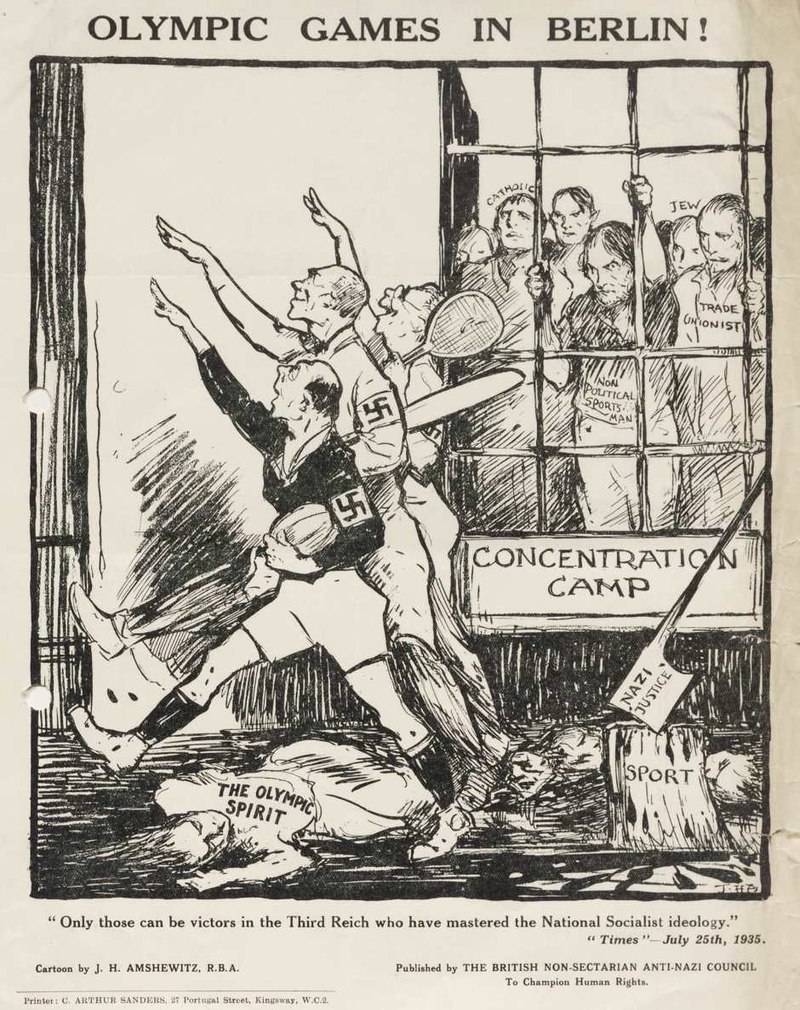
By John Henry Amshewitz(Life time: 1882-1942) – Original publication: Poster published by British Non-Sectarian Anti-Nazi Council in 1935Immediate source: https://warwick.ac.uk/services/library/mrc/archives_online/exhibitions/olympics
(Public Domain)
Jesse Owens’s triumph in the 100m dash was a powerful statement against racism and discrimination. His success at the 1936 Berlin Olympics shattered Hitler’s claims of Aryan supremacy, undermining the Nazi propaganda and challenging the world’s perceptions of race and athletics.
Owens would go on to win three more gold medals in the long jump, 200m dash, and 4x100m relay events at the 1936 Olympics, making him the most successful athlete of the Games. His extraordinary achievements on the Olympic stage earned him worldwide recognition and admiration.
Beyond the Olympics, Jesse Owens’s legacy transcended sports. He became a symbol of courage, resilience, and the fight for racial equality. He used his platform to advocate for civil rights and became a vocal advocate for African-American athletes.
Jesse Owens’s victory in the 1936 Olympic 100m dash was more than just a sporting triumph; it was a resounding victory against racism and intolerance. Despite competing in a politically charged environment, Owens proved that true greatness knows no color and that athletic talent can transcend barriers of discrimination. His remarkable achievements at the 1936 Berlin Olympics remain an enduring symbol of courage, excellence, and the universal power of sport to inspire and unite people around the world.




 DAVE DOES HISTORY
Leave a comment