
Several factors contributed to Columbus’s departure on this specific date, and understanding these reasons sheds light on the significance of his voyage and its historical impact. In this essay, we will explore the key reasons that led Columbus to embark on his journey to the Americas on August 3, 1492.
1. Quest for a New Route to Asia:
One of the primary motivations behind Columbus’s voyage was his ambition to find a new trade route to Asia. During the 15th century, the Silk Road, the traditional overland trade route between Europe and Asia, was fraught with challenges and dangers, including wars and territorial disputes. Columbus believed that by sailing westward, he could reach the lucrative markets of the Far East, primarily India and China, and bypass the dangerous land route. This notion was based on the belief that the Earth was round, contrary to the prevailing misconception that it was flat.
2. Support from the Spanish Monarchs:
Columbus’s ambitious plan faced numerous rejections from several European monarchs before he eventually secured the support of Ferdinand II of Aragon and Isabella I of Castile, the Catholic Monarchs of Spain. After years of negotiations and attempts to gain financial backing, Columbus finally obtained the necessary funding for his expedition from the Spanish monarchy. On April 17, 1492, the Catholic Monarchs signed the Capitulations of Santa Fe, granting Columbus the titles of Admiral of the Ocean Sea and Viceroy of the newly discovered lands. The signing of this agreement set the stage for his historic voyage.
3. Departure from Palos de la Frontera:
After securing the necessary funding and royal approval, Columbus departed from the port of Palos de la Frontera in southwestern Spain. The departure date of August 3, 1492, was significant because it coincided with the expulsion of the Jews from Spain. On the same day, the Catholic Monarchs issued the Alhambra Decree, which ordered the expulsion of all Jews who refused to convert to Christianity from Spain. This decree forced many Jewish families to leave their homes and seek refuge elsewhere, and some historians speculate that Columbus’s timing for his voyage was intended to distract from the tragic events of the day.
4. The Santa Maria, the Pinta, and the Niña:
Columbus’s expedition was comprised of three ships: the Santa Maria, the Pinta, and the Niña. The flagship, the Santa Maria, was the largest of the three ships and was captained by Columbus himself. The Pinta and the Niña were smaller caravels commanded by Martín Alonso Pinzón and Vicente Yáñez Pinzón, respectively. The small fleet set sail from Palos de la Frontera and made a brief stop at the Canary Islands to resupply before heading into the unknown waters of the Atlantic Ocean.
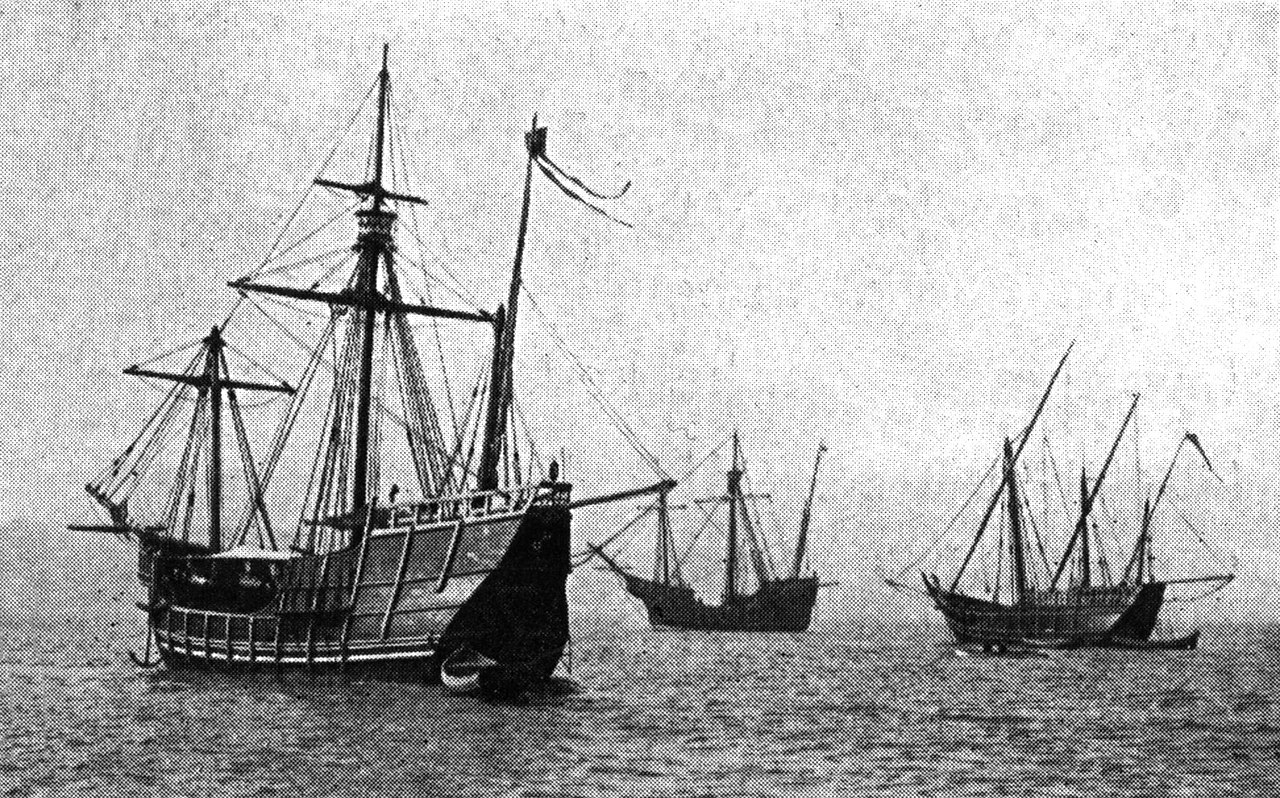
By E. Benjamin Andrews – Andrews, E. Benjamin.
History of the United States, volume V. Charles Scribner’s Sons, New York. 1912
(Public Domain)
The departure of Christopher Columbus from Spain on August 3, 1492, marked the beginning of one of the most significant voyages in history. Driven by the quest for a new route to Asia and the support of the Spanish Monarchs, Columbus’s expedition would go on to make a transformative impact on the world, leading to the discovery of the Americas and the subsequent colonization and exchange of cultures between the Old World and the New World. His historic journey opened up a new chapter in human history, reshaping the global landscape and forever changing the course of exploration, trade, and geopolitics.




 DAVE DOES HISTORY
Leave a comment