
On July 28, 1914, Austria-Hungary declared war on Serbia. The events leading up to this declaration and the outbreak of the war were complex and involved a series of diplomatic and political crises.
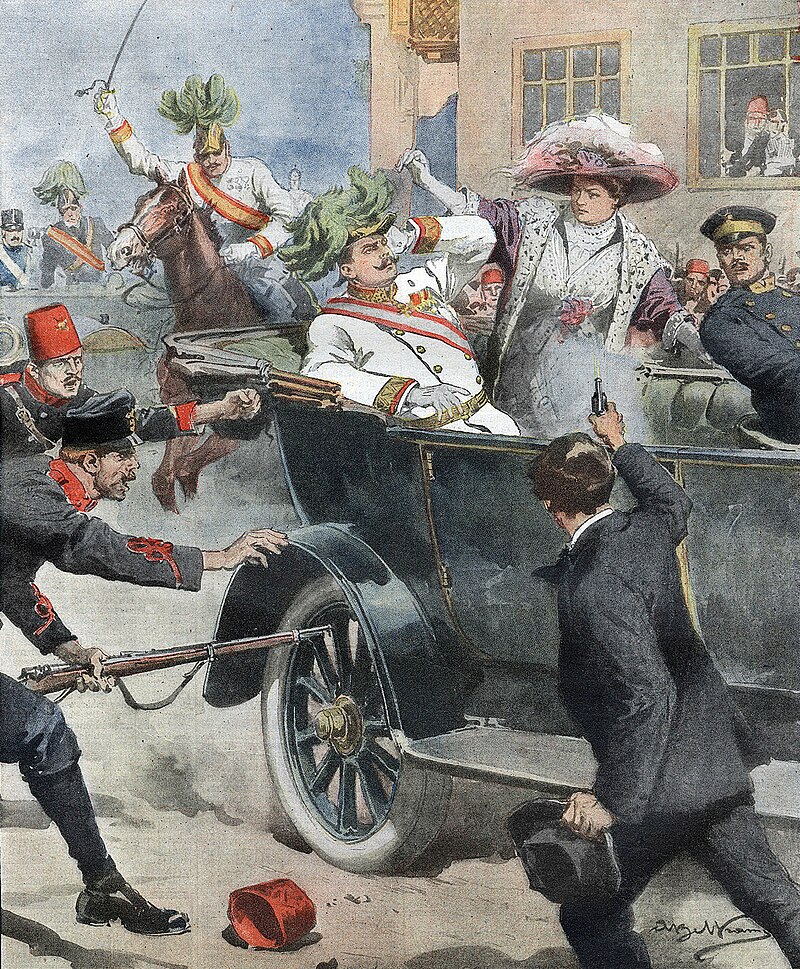
Assassination of Franz Ferdinand, 1863-1914 Archduke of Austria, and his wife Sophie, in Sarajevo, Bosnia, 28 June 1914,
©Bianchetti/Leemage
The immediate trigger for the war was the assassination of Archduke Franz Ferdinand of Austria-Hungary and his wife, Sophie, on June 28, 1914, in Sarajevo, Bosnia. The assassination was carried out by Gavrilo Princip, a young Bosnian Serb nationalist. Austria-Hungary saw the assassination as an opportunity to deal with the perceived threat of Serbian nationalism in the Balkans.
Here is a brief sequence of events that led to the war:
1. Assassination of Archduke Franz Ferdinand: The assassination in Sarajevo set off a chain reaction of events that culminated in the outbreak of war. Austria-Hungary blamed Serbia for supporting and encouraging the assassins.
2. Austro-Hungarian Ultimatum to Serbia: On July 23, 1914, Austria-Hungary issued an ultimatum to Serbia, demanding an investigation into the assassination, the suppression of anti-Austrian organizations in Serbia, and other measures that would significantly compromise Serbia’s sovereignty. The ultimatum was intentionally made difficult for Serbia to accept.
3. Partial Serbian Acceptance: Serbia accepted most of the demands but rejected a few that would have infringed on its sovereignty. Austria-Hungary viewed this as a refusal and an opportunity for military action against Serbia.
4. Austro-Hungarian Declaration of War: On July 28, 1914, Austria-Hungary declared war on Serbia, starting the hostilities. This move began the process of drawing in other countries due to their alliances and commitments.

(CC BY-SA 4.0)
5. Chain Reaction of Alliances: Austria-Hungary’s declaration of war against Serbia set off a series of alliances and commitments between European powers. Russia, Serbia’s ally, began mobilizing its forces, and Germany, Austria-Hungary’s ally, declared war on Russia on August 1, 1914. Germany then declared war on Russia’s ally, France, on August 3, 1914.
6. The United Kingdom’s Entry: On August 4, 1914, Germany’s invasion of neutral Belgium led the United Kingdom to declare war on Germany, as Britain had commitments to protect Belgian neutrality.
The combination of longstanding tensions, alliance systems, and the interconnectedness of European nations ultimately turned the initial conflict between Austria-Hungary and Serbia into a global war involving many countries, which we now know as World War I.



 DAVE DOES HISTORY
Leave a comment