
The Korean Armistice Agreement was signed on July 27, 1953, and it effectively ended the hostilities of the Korean War, which had been raging since June 25, 1950. The armistice was not a peace treaty but rather a temporary ceasefire agreement between the two warring sides. Here are the events that led to the Korean Armistice:
1. Outbreak of the Korean War (1950): The Korean War began when North Korean forces, backed by the Soviet Union and China, invaded South Korea. The United Nations, with the United States taking the lead, intervened to support South Korea, and a multinational force was formed to aid the South.
2. UN Counterattack and Chinese Intervention: The UN forces, led by General Douglas MacArthur, pushed North Korean forces back to the northern border of the Korean peninsula. However, China intervened in late 1950, deploying large numbers of troops to support North Korea, leading to a stalemate along the 38th parallel, the original dividing line between the North and the South.
3. Leadership Change in the United States: In April 1951, President Harry S. Truman relieved General MacArthur of his command due to disagreements over war strategy and public statements made by MacArthur that contradicted Truman’s policies. General Matthew Ridgway replaced MacArthur as commander of the UN forces in Korea.
4. Stalemate and Ceasefire Talks: After intense fighting, both sides reached a stalemate around the 38th parallel, with neither able to decisively defeat the other. Ceasefire talks began in July 1951 in the village of Kaesong, but negotiations were often difficult and protracted.
5. Shifting Political Landscape: Over time, the political situation changed on both sides. The death of Joseph Stalin in March 1953 and the subsequent change in leadership in the Soviet Union had an impact on North Korea. In the United States, President Truman’s successor, Dwight D. Eisenhower, took office in January 1953.
6. Agreement on POWs: One of the significant obstacles during the negotiations was the issue of prisoners of war (POWs). Both sides struggled to reach an agreement on the repatriation of POWs. Eventually, an agreement known as “Operation Little Switch” allowed for the exchange of sick and wounded prisoners, which opened the way for further negotiations.
7. Panmunjom Agreement and Armistice Signing: After intense negotiations, a draft armistice agreement was reached on July 27, 1953, in the Joint Security Area (JSA) at Panmunjom. This agreement established a Military Armistice Commission to oversee the ceasefire. The armistice was signed by representatives of the United Nations Command, North Korea, and China.
8. Implementation and Aftermath: The armistice came into effect on July 27, 1953, leading to a cessation of hostilities. However, a formal peace treaty was never signed, and the Korean War technically continues to this day. The Demilitarized Zone (DMZ), a buffer zone separating North and South Korea, was established along the 38th parallel to prevent future conflicts.
The Korean Armistice Agreement remains in place, but tensions between North and South Korea persist, and efforts to negotiate a lasting peace or reunification have faced significant challenges.
Events of the Korean Armistice on July 27, 1953:
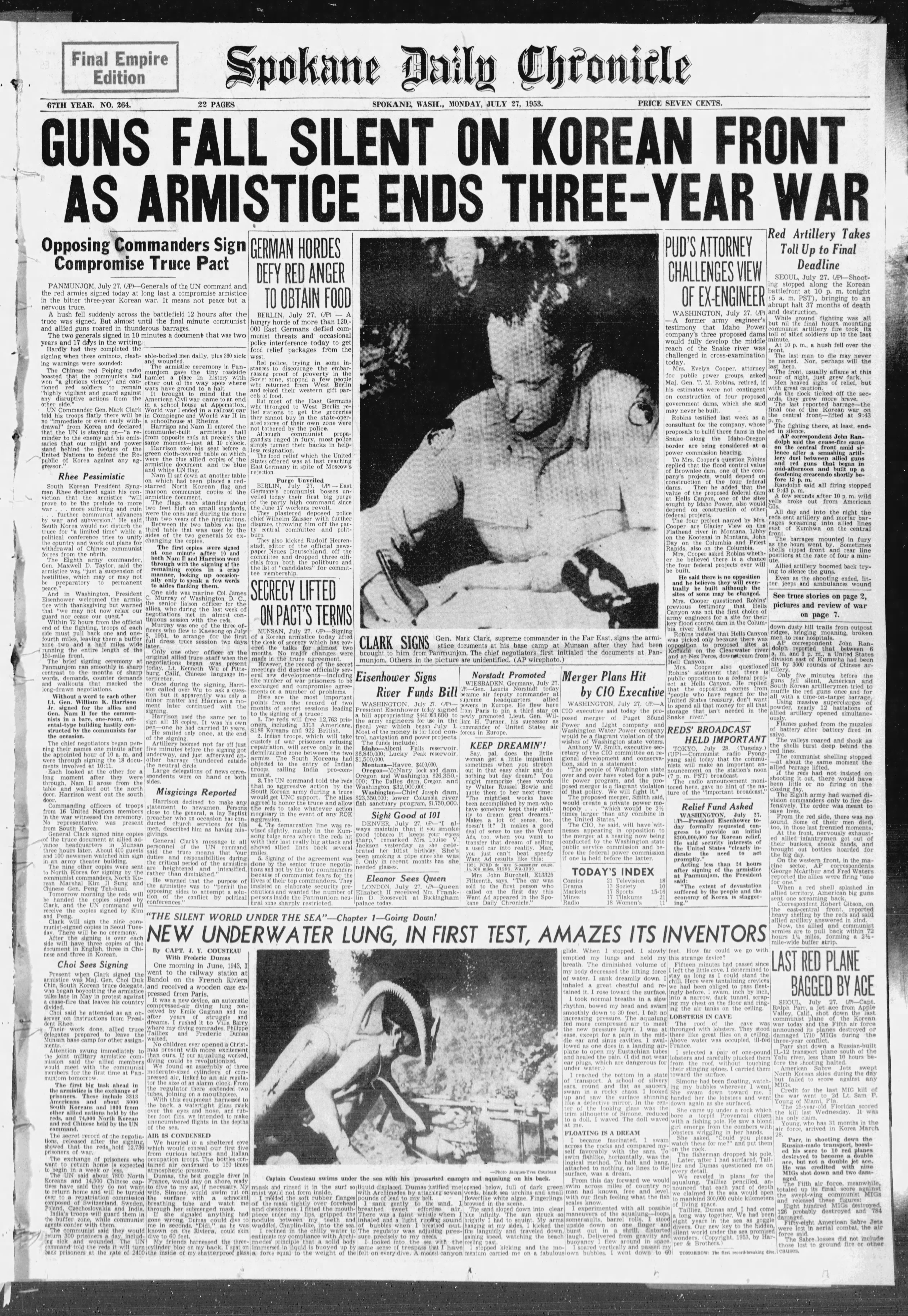
- At 10:00 AM, the Korean Armistice Agreement was signed at Panmunjom by representatives of the United Nations Command (UNC), the North Korean People’s Army (KPA), and the Chinese People’s Volunteer Army (CPVA).
- The agreement called for a ceasefire and the withdrawal of all forces to positions along the 38th parallel.
- It also established the Military Armistice Commission (MAC), which was tasked with overseeing the implementation of the agreement and resolving any disputes.
- The armistice did not officially end the Korean War, but it did bring an end to the active fighting. North and South Korea remain technically at war to this day.
Here is a table summarizing the key events of the Korean Armistice:
| Date | Event |
|---|---|
| July 27, 1953 | The Korean Armistice Agreement is signed. |
| July 28, 1953 | The MAC begins its work. |
| August 1, 1953 | All forces begin withdrawing to positions along the 38th parallel. |
| October 25, 1953 | The withdrawal of forces is complete. |
The Korean Armistice Agreement was a significant step towards peace on the Korean Peninsula. However, it did not resolve the underlying conflict between North and South Korea. The two countries remain divided and there is still a risk of renewed hostilities.




 DAVE DOES HISTORY
Leave a comment