
George Clinton (July 26, 1739 – April 20, 1812) was an American soldier, statesman, and politician who played a pivotal role in the early history of the United States. He was born in Little Britain, New York, into a prominent and politically active family. His father, Charles Clinton, was a wealthy landowner, and his uncle, George Clinton Sr., served as the colonial governor of New York.
Early Life and Military Career:
George Clinton received a classical education and briefly attended King’s College (now Columbia University). However, his interest in politics and the growing tensions with Britain diverted his focus from academics. In 1755, at the age of 16, he joined the New York militia and participated in the French and Indian War. His military service allowed him to hone his leadership skills and gain valuable experience that would serve him well in the years to come.
Political Career and the American Revolution:
During the early stages of the American Revolution, George Clinton emerged as a vocal advocate for colonial rights and independence. He attended the Continental Congress in 1775 and 1776, where he was one of the signatories of the Declaration of Independence. He also served as a brigadier general in the Continental Army and played a crucial role in defending the Hudson River Valley from British forces.
In 1777, Clinton was elected as the first Governor of New York under the newly adopted state constitution. He would serve seven non-consecutive terms as Governor, making him one of the longest-serving governors in U.S. history. During his tenure, Clinton worked to strengthen the state’s military defenses, promote agriculture, and support the war effort.
George Clinton’s political philosophy was deeply rooted in his belief in states’ rights and individual liberties. At the Constitutional Convention of 1787, he expressed strong reservations about the proposed Constitution, fearing it might erode states’ sovereignty and fail to protect individual rights. He ultimately did not sign the Constitution, as he believed it needed a Bill of Rights to safeguard the people’s freedoms.
Several key reasons contributed to George Clinton’s anti-Federalist views:
1. States’ Rights: George Clinton strongly believed in the sovereignty of individual states and their right to govern themselves to a large extent. He feared that the Constitution would grant too much power to the federal government, potentially leading to an erosion of states’ rights and undermining the authority of state governments.
2. Centralization of Power: Clinton was concerned that the Constitution, as written, would create a strong central government that could become tyrannical and distant from the concerns of the people. He worried that a centralized government would be more prone to abuse of power and less responsive to the needs and interests of individual states and citizens.
3. Absence of a Bill of Rights: One of Clinton’s significant objections to the Constitution was the absence of a Bill of Rights. He believed that a clear enumeration of individual rights and liberties was essential to protect citizens from potential abuses by the federal government. Without these explicit protections, Clinton worried that the federal government might infringe on basic freedoms.
4. Fear of Standing Army: George Clinton, like many anti-Federalists, was wary of the creation of a standing army under federal control. He feared that such a force could be used by the central government to suppress dissent and threaten the liberties of the people.
5. Strong Executive Branch: Clinton was apprehensive about the powers vested in the presidency under the proposed Constitution. He believed that the executive branch could become too powerful, potentially leading to a form of executive tyranny.
Despite his objections and concerns, the Constitution was ultimately ratified by the required number of states, and the federal government was established. However, Clinton’s anti-Federalist views played a crucial role in shaping the early political landscape of the United States. As a result of the anti-Federalists’ advocacy, the Bill of Rights was added to the Constitution in 1791, providing specific protections for individual freedoms and addressing some of the anti-Federalists’ concerns.
In 1804, George Clinton was elected as the fourth Vice President of the United States under Presidents Thomas Jefferson and James Madison. He served two terms as Vice President until his death in 1812. During his vice presidency, he continued to be a strong advocate for states’ rights and worked to uphold the principles of the Democratic-Republican Party.
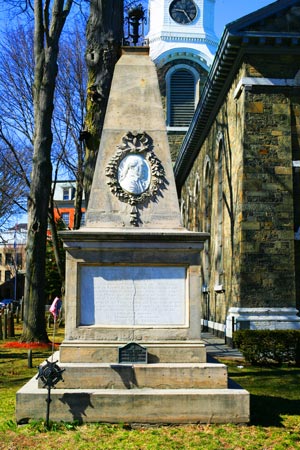
(Pauljoffe at English Wikipedia)
Tragically, George Clinton passed away on April 20, 1812, in Washington, D.C., at the age of 72. He was still serving as Vice President at the time of his death. Clinton’s contributions to American politics and his unwavering dedication to the principles of states’ rights and individual liberties left a lasting impact on the nation’s understanding of federalism and the balance of power between the federal government and the states.
Today, George Clinton is remembered as a founding father, a key figure in the American Revolution, and a champion of democratic principles. His legacy endures as a testament to his commitment to public service and his invaluable contributions to the formation and early development of the United States of America.




 DAVE DOES HISTORY
Leave a comment