
On July 26, 1936, Nazi Germany and Fascist Italy decided to intervene in the Spanish Civil War on the side of Franco’s Nationalists.
The Spanish Civil War which lasted from 1936 to 1939, was a proving ground for many of the new German weapons and tactics.
The Republicans were the democratically elected government of Spain. They were supported by a wide range of groups, including liberals, socialists, communists, and anarchists. The Nationalists were a group of right-wing rebels who opposed the Republican government. They were supported by the Spanish army, the Catholic Church, and the wealthy landowners.
There were a number of causes of the Spanish Civil War. Some of the most important causes include:
-
The rise of fascism in Europe. The Spanish Civil War was one of the first major conflicts of the 20th century, and it was fought against the backdrop of the rise of fascism in Europe. Fascist regimes, such as those of Adolf Hitler in Germany and Benito Mussolini in Italy, were opposed to democracy and supported the use of violence to achieve their goals.
-
The weakness of the Spanish government. The Spanish government was weak and divided. It was unable to address the economic and social problems that were facing the country, and it was unable to prevent the rise of fascism.
-
The polarization of Spanish society. Spanish society was deeply divided between right-wing and left-wing groups. This polarization made it difficult to find a peaceful solution to the country’s problems, and it made it more likely that the conflict would lead to civil war.
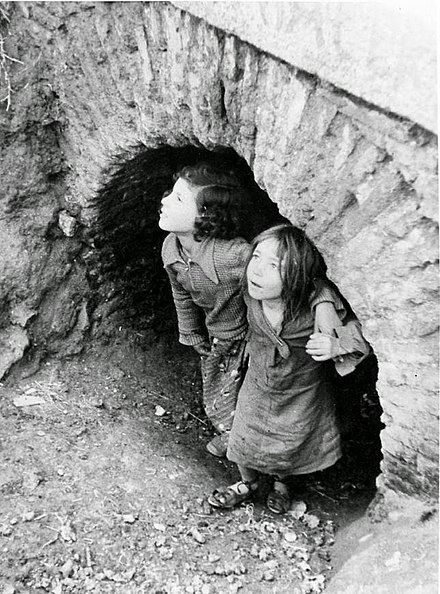
(Public Domain)
The Spanish Civil War was a bloody and destructive conflict. It is estimated that over 500,000 people died in the war, and many more were injured. The war also had a significant impact on the Spanish economy and society. It left the country devastated and divided, and it took decades for Spain to recover from the war.
Germany intervened in the Spanish Civil War for a number of reasons.
-
To support the fascist rebels. Germany was sympathetic to the fascist rebels, who were led by General Francisco Franco. Germany saw the Spanish Civil War as an opportunity to test new weapons and military tactics, and to gain experience in the use of air power. Germany also hoped that a victory by the rebels would help to spread fascism in Europe.
-
To weaken France and Britain. Germany also saw the Spanish Civil War as an opportunity to weaken France and Britain. Both France and Britain had declared their neutrality in the war, but Germany hoped that by supporting the rebels, it could force France and Britain to intervene militarily. This would have distracted France and Britain from their own rearmament programs, and it would have weakened their resolve to oppose Germany.
-
To test the Non-Intervention Agreement. In August 1936, a number of countries, including France, Britain, Germany, and Italy, signed the Non-Intervention Agreement, which prohibited the shipment of arms to Spain. Germany, however, violated the agreement by sending arms and military personnel to the rebels. Germany wanted to test the resolve of the other signatories to the agreement, and to see if they would be willing to enforce it.
The German intervention in the Spanish Civil War had a significant impact on the outcome of the war. The rebels were able to purchase more and better weapons than the Republicans, and they were able to receive more military training from German advisors. As a result, the rebels were able to win the war in 1939.
The German intervention in the Spanish Civil War also had a significant impact on the Second World War. The experience gained by German military personnel in Spain helped to prepare them for the war that followed. The German intervention also helped to strengthen the alliance between Germany and Italy, which would become a key factor in the outbreak of World War II.



 DAVE DOES HISTORY
Leave a comment