
The Kitchen Debate was a famous and impromptu exchange that took place between then-Vice President Richard Nixon of the United States and Soviet Premier Nikita Khrushchev at the American National Exhibition in Moscow on July 24, 1959. The event occurred during the height of the Cold War and became a symbol of the ideological and political differences between the United States and the Soviet Union.
The American National Exhibition was an attempt to showcase American technological advancements and consumer goods to the Soviet people, highlighting the superiority of the capitalist system. As part of the exhibition, a model American suburban house was constructed, complete with a modern kitchen filled with the latest American appliances.
As Nixon and Khrushchev toured the exhibition, they stopped at the model house’s kitchen, where the debate ensued. The encounter was not formally planned but turned into a highly publicized event when journalists and photographers from both nations were present.
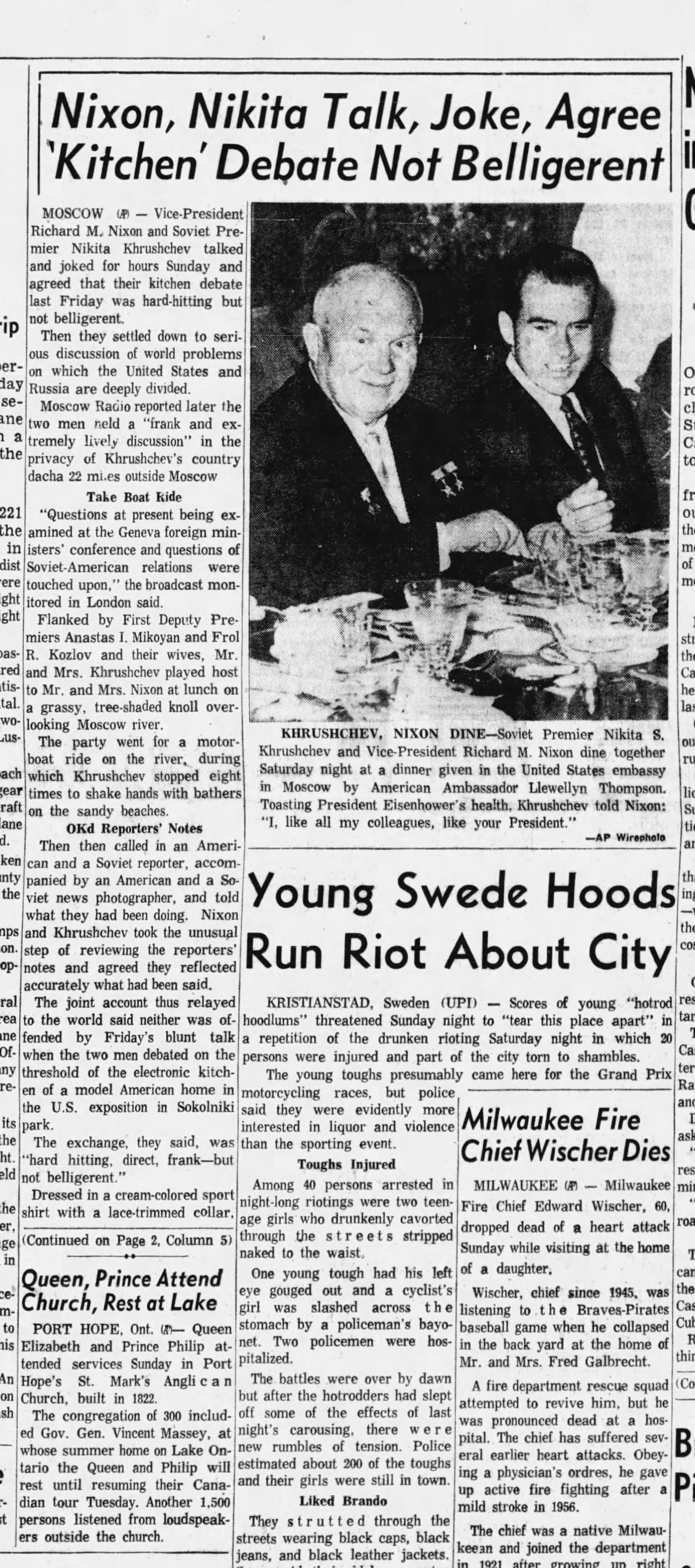 During the debate, Khrushchev argued that the Soviet Union was catching up to the United States in terms of technological advancements and accused Nixon of having a biased view of the Soviet system. He claimed that the Soviet Union’s economic and political model was superior and that communism would eventually surpass capitalism.
In response, Nixon defended the American way of life and emphasized the benefits of capitalism, free markets, and individual freedoms. He showcased the modern appliances in the kitchen as examples of the American standard of living and argued that the prosperity and freedom in the United States were superior to the restrictive Soviet system.
The debate covered various topics, including living standards, economics, political systems, and technological achievements. Despite the heated arguments and ideological clashes, the debate remained civil and did not escalate into a full-blown confrontation.
The Kitchen Debate became a significant moment in Cold War history, representing the broader tensions between the United States and the Soviet Union. It also highlighted the ongoing competition for global influence and the contrasting ideologies of the two superpowers. The event underscored the importance of public diplomacy during the Cold War era and became an iconic symbol of the ideological divide between East and West.




 DAVE DOES HISTORY
Leave a comment