
The Temple of Artemis, also known as the Temple of Diana, was one of the most renowned ancient Greek temples and counted among the Seven Wonders of the Ancient World. Dedicated to the Greek goddess Artemis, the temple stood as a testament to the ingenuity and grandeur of ancient architecture. Its history is a tale of destruction and resurrection, reflecting the prominence of the cult of Artemis and the influence of different civilizations in the region.
The site was originally occupied by a simple shrine dedicated to Artemis, the Greek goddess of the hunt, wilderness, and childbirth. The worship of Artemis dates back to the Bronze Age, making it one of the most ancient cults in the Greek world.
The construction of the grand temple began around 550 BCE during the reign of King Croesus of Lydia. It was designed by the Greek architect Chersiphron, and his son Metagenes, and took approximately 120 years to complete. The temple was raised on a marshy area near the Cayster River, chosen to provide a stable foundation for the massive structure.
By the 4th century BCE, the Temple of Artemis underwent significant expansion under the rule of Alexander the Great. Alexander admired the temple and, in recognition of his military victories, offered to finance the temple’s enlargement. However, the Ephesians politely declined the offer, stating that it would be inappropriate for one deity to build a temple for another.
Despite this refusal, the temple was indeed expanded during the Hellenistic period, with additional columns and lavish decorations added to the existing structure. The Temple of Artemis became a center of religious devotion, attracting worshippers and visitors from various parts of the ancient world.
The temple’s grandeur and fame also made it a target for destruction. In 356 BCE, a man named Herostratus set fire to the temple in a notorious act of arson, reportedly seeking fame for himself. The fire caused significant damage, destroying the wooden roof and many of the temple’s ornaments.
Following the destruction, the Ephesians embarked on a reconstruction effort to restore the Temple of Artemis to its former glory. Funded by contributions from various Greek city-states, the rebuilt temple featured more lavish embellishments and was even more impressive than before.
The Temple of Artemis continued to be a significant religious and cultural center during the Roman era. The Romans revered the goddess Artemis as the equivalent of their goddess Diana and further enhanced the temple’s splendor. However, with the rise of Christianity, the temple’s significance gradually declined.
In 262 CE, the Temple of Artemis suffered its final blow when it was severely damaged by the invasion of the Goths. The once majestic structure was left in ruins, and over time, the remains were scavenged for building materials, contributing to its eventual disappearance.
Although the Temple of Artemis no longer stands, its legacy endures in the annals of history and literature. Ancient writers, such as Strabo and Pliny the Elder, provided detailed accounts of the temple’s architectural marvel and its importance in the ancient world.
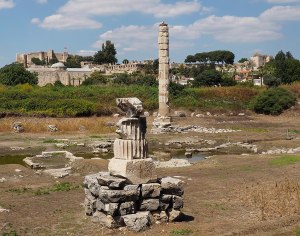
Archaeological excavations have uncovered fragments of the temple’s foundations, columns, and sculptures, shedding light on the temple’s design and scale. Some of these remnants are on display in the Ephesus Archaeological Museum in Turkey.
In conclusion, the history of the Temple of Artemis is a tale of resilience and reverence. It rose from humble origins as a simple shrine to become a grandiose structure celebrated as one of the Seven Wonders of the Ancient World. Despite facing destruction and decline, the temple’s allure and cultural significance continue to captivate the imagination and curiosity of people around the globe. The Temple of Artemis stands as a testament to the skill of ancient craftsmen, the strength of religious devotion, and the enduring legacy of human achievement in the ancient world.




 DAVE DOES HISTORY
Leave a comment