
Today is the Feast of Esther, a day when Jews around the globe fasted to support her efforts to thwart the plans of the evil Jew hater, Haman.
It’s no coincidence that on this day in 1933, the Nazi Party announced it’s “Coordination” plan, from bringing all of Germany under it’s ideology, even without having a majority in the Reichstag.
Hitler was never elected, and the Nazi’s NEVER held a majority in the legislature. They achieved their power through the use of violence and “emergencies” to forces their plans into effect.
This article comes from the Holocaust Museum:
The Nazi Party came to power in 1933 and quickly began trying to control all aspects of society. This internal consolidation of power to remake Germany as a Nazi state was known as Gleichschaltung. The term is a German word that means “coordination” or “synchronization.” Under Gleichschaltung, German political, social, and cultural life were rearranged to serve Nazi goals.
Background
Gleichschaltung is the German term applied to the Nazification of German society following the Nazi seizure of power in 1933. Once Hitler became chancellor, he and the Nazi Party sought to “coordinate” all political, social, and cultural institutions with the Nazi state. This “coordination” was done in the name of national unity. However, it allowed the Nazi Party to extend its power by creating a single party state. Everything was subject to coordination: local government, professional organizations, social clubs, leisure activities—even those for children.
The state enforced coordination from the top-down. At the same time, many Germans responded with a bottom-up coordination of their own. This was known as Selbstgleichschaltung. Even Hitler was surprised with the speed and ease of remaking Germany. He noted “everything is going much faster than we ever dared to hope.”1
Creating a Single Party State
One of the primary goals of coordination was the creation of a single party state entirely under Nazi control. In January 1933, Hitler became chancellor. At the time, Germany was still a multi-party state. The country was led by a popularly elected representative government. The following month, the Reichstag (German parliament building) burned down by arson. The Nazis seized the chance to act. They blamed the Communist Party. On February 28, 1933, they issued the Reichstag Fire Decree. The measure suspended the protections for civil rights, free speech, and due process in the German Constitution.2
On March 24, 1933, Hitler succeeded in passing the Enabling Act. The act gave the Reich Chancellor (Hitler) the ability to pass laws without consulting the Reichstag. He was able to do so even if those laws conflicted with the German Constitution. This effort effectively ended parliamentary democracy in Germany.3
Hitler had succeeded in securing control of the national government. He passed two additional laws to reconstitute state-level governments under Nazi control. These laws dissolved existing state governments. The law also appointed a Reichsstatthalter (Reich governor) for each state. The Reichsstatthalter reported directly to Wilhelm Frick, the Reich Minister of the Interior. Each was responsible for implementing Nazi policy within their state.
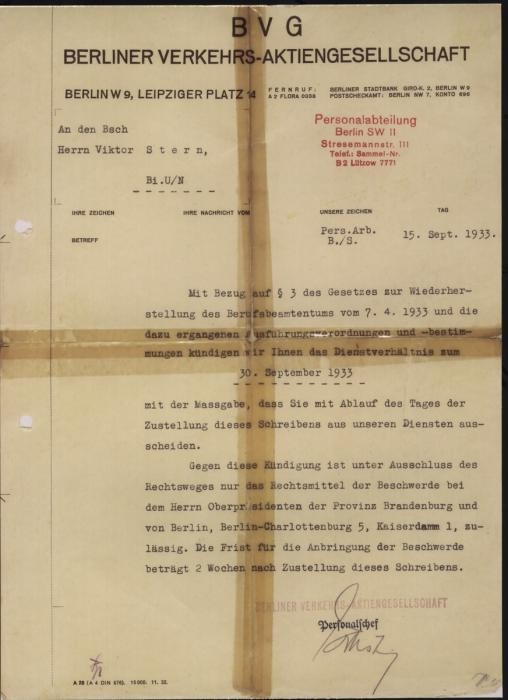
The next target in this process was the civil service. Hitler issued the Law for the Restoration of the Professional Civil Service on April 7, 1933. The measure dismissed all Jews and political opponents of Nazis from the civil service. It covered every employee at every level of government administration. Further, it applied to numerous other positions not considered part of the civil service in many countries. For example, it covered judges, teachers, university professors, and lawyers. Many people, especially Jews and Communists, lost their jobs and retirement benefits. Many other people rushed to join the Nazi Party in order to protect their jobs in a time of high unemployment. All those who joined were not necessarily doing so from political conviction.
Hitler had gained control of the national and local governments. He had also secured a government workforce purged of all potential opposition. The Nazi Party could now declare Germany a single party state. On July 14, 1933, the party issued The Law Against the Founding of New Parties. It declared, “The National Socialist German Workers Party is the only political party in Germany.”4 Membership in other political parties, such as the Social Democratic Party or the Communist Party, became illegal. Members of these parties were targeted by the Nazis. Some fled the country or went underground. Within six months, Hitler and the Nazi Party had managed to gain complete control over the German state. They had eliminated all formal political opposition.
Coordinating Economic, Social, and Cultural Life
Absolute political power was not enough. The Nazi Party sought complete control over economic, social, and cultural life in Germany as well. All labor unions were abolished in May 1933, replaced by the Deutsche Arbeitsfront (DAF, or German Labor Front). The DAF created a single overarching labor union. Essentially all German workers and employees in every economic sector belonged to the DAF. For example, farmers were coordinated into the Reich Food Estate. While traditional unions prioritized workers’ rights, the DAF emphasized national economic goals above personal well-being.
![At a rally, members of the Hitler Youth parade in the formation of a swastika to honor the Unknown Soldier. [LCID: 85513]](https://encyclopedia.ushmm.org/images/large/956e5aa2-ed98-4292-8ce1-22ebd3d8dd5b.jpg)
In September 1933, Nazi Propaganda Minister Joseph Goebbels created the Reich Culture Chamber. It coordinated literature, music, theater, radio, film, fine arts, and the press. Only artists and writers belonging to its affiliated bodies could continue in their professions. Groups that were previously organized under political parties or labor unions—such as sports teams, music groups, and craft associations—were disbanded. The ones that remained were organized under the Nazi Party. Scouting organizations for children were also Nazified. A 1934 law made the Hitler Youth the only legal youth group in Germany.5 In 1939, participation became mandatory. All German children became exposed to Nazi ideology from an early age.
Even leisure time was coordinated according to Nazi principles in the Strength through Joy (Kraft durch Freude) program. The program was a division of the German Labor Front. Strength through Joy offered subsidized tourism packages, music lessons, art classes, fitness opportunities, and sponsored theater and concert tickets.
Conclusion
Gleichschaltung was a process of coordination. It was designed to bring all aspects of German life under Nazi control. From the single party state to the German Labor Front to the Nazi-approved leisure activities offered by Strength through Joy, almost no part of German life remained untouched by Nazism.



 DAVE DOES HISTORY
Leave a comment