
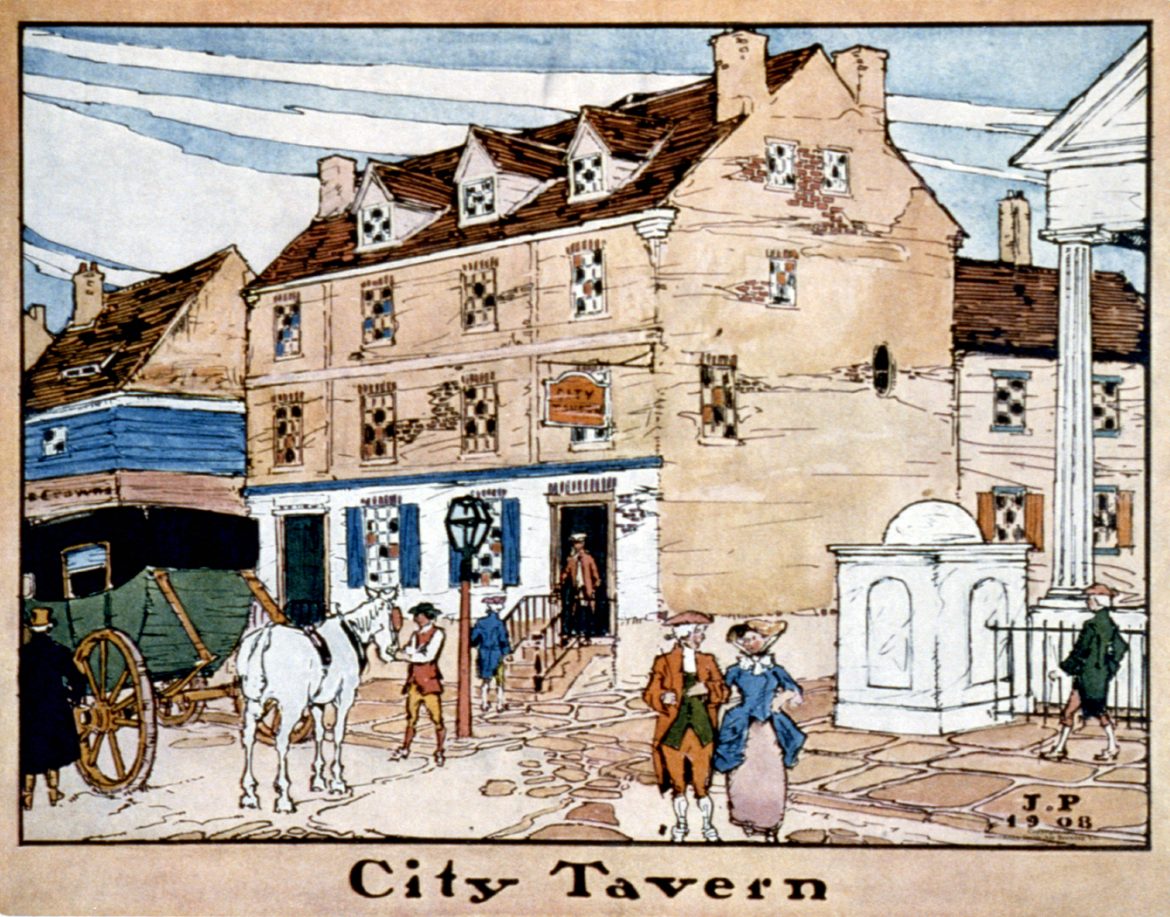
ity Tavern in Philadelphia is a reconstruction of the famous eighteenth century tavern where countless patriots—both political and military—met throughout the American Revolution, and later, during the Constitutional Convention in 1787. It recently closed due to the impact of Covid-19 on their business. This sad ending occurred despite the fact the owner/executive chef has been a celebrity on television and has published several cookbooks.
So it got this author thinking, what taverns from the era of the American Revolution and the Founding generation remain open—either as restaurants/inns or as museums? I compiled a list, in no particular order, of ten taverns, several of which have operated as inns as well. They are spread up and down the east coast of the United States. Sadly, the ravages of time and the Civil War leave none that I am aware of in the southeastern region, North Carolina, South Carolina or Georgia. My goal was to select taverns from as wide a geographic scope as possible and break ties for recognition by favoring those taverns with significant connections to Revolutionary War or United States Constitutional history. Consideration was given to either well known figures from history who may have frequented the tavern or architectural details of interest readers may enjoy.
Taverns were, and in some cases still are, intersections for not just drinking and dining, but also lodging, receiving postal mail, and hosting various kinds of community or social meetings. Perhaps the most famous tavern long out of existence was the Tun Tavern in Philadelphia, which served as the site of the creation of the United States Marine Corps on November 10, 1775.
Fraunces Tavern in lower Manhattan. Depending on where one draws the line for restoration versus reconstruction, Fraunces Tavern is arguably a reconstruction done in colonial revival style by the New York Society of the Sons of the Revolution (SRNY) in 1906. They hired architect William Mersereau, who was likely a descendant of the Mersereaus who operated a spy ring between Staten Island and adjacent Perth Amboy, New Jersey. The building was originally built back in 1719. The SRNY hosted a grand, 300th-anniversary gala event in 2019 which this author enjoyed attending. It was bought by Samuel Fraunces in 1761, who opened it for business as the Queen’s Head Tavern. It was a regular meeting place of the New York Sons of Liberty in the 1760s and 1770s. This tavern famously hosted General George Washington’s farewell dinner to his officers in December of 1783. The event was recorded by the young Maj. Benjamin Tallmadge in his memoirs decades later. Since 1906 it has operated as the headquarters of the SRNY, and as a popular New York City downtown restaurant in the financial district. It also features a public museum with a vibrant series of speaker presentations, tours and other special events.
Three years before the building that later became Fraunces Tavern was built, The Wayside Inn in Sudbury, Massachusetts opened its doors in 1716 as an inn that included the first-floor tavern room. It is, arguably, the oldest inn and tavern operating in the United States. The inn still has in its archives the original inn license granted to the first innkeeper, David Howe. His son, Ezekiel Howe, was the next innkeeper and fought in the American Revolution with the Sudbury Minutemen.[1] The inn is also known as “Longfellow’s Wayside Inn,” thanks to the famous poet Henry Wadsworth Longfellow and his book of poems, Tales of a Wayside Inn, published in 1863; Longfellow visited the inn in 1862. Henry Ford purchased the inn and an adjacent 3,000 acres in 1923 to preserve the building and its surroundings, including a chapel and a watermill. The building suffered a devastating fire in 1955 and was rebuilt with many original beams and other pieces the following year.
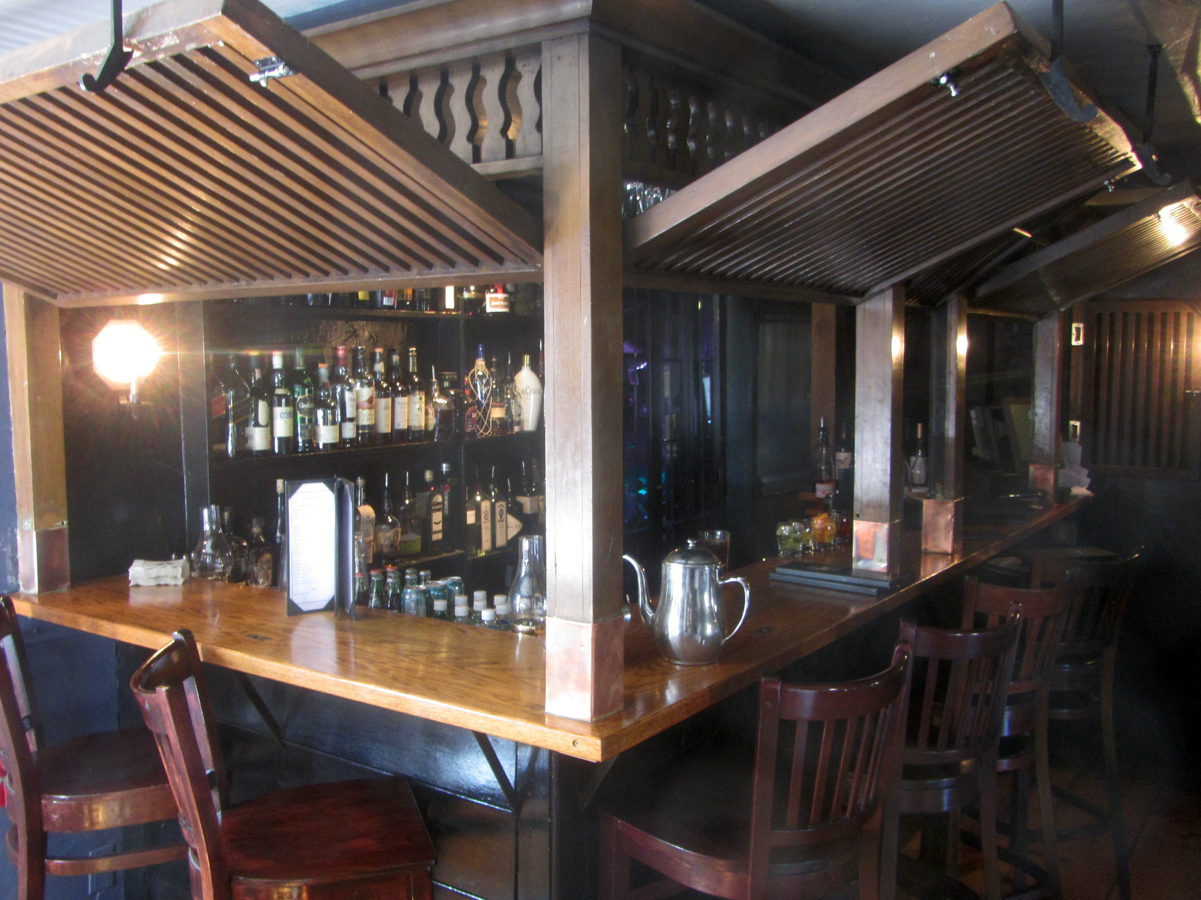
Rhode Island residents boast arguably the oldest restaurant/tavern in the United States, The White Horse Tavern tucked in the center of Newport. Built in 1675, it was first licensed as a tavern in 1687. The building became known as the White Horse Tavern in 1730 by owner Jonathan Nichols.[2] It was a boarding house for a number of decades in the nineteenth century and through 1952. Thanks to a restoration in the 1950s, the building is largely as it would have appeared in the 1770s with red wooden clapboards. The tavern quartered both Tory and British troops during the British occupation of Newport during the American Revolution, especially during the Battle of Rhode Island in the summer of 1778.
The oldest continuously operating inn in the United States is arguably The Griswold Inn in Essex, Connecticut, which has never closed its doors since it opened under the proprietorship of Sala Griswold in 1776. It remained open as well through the British raid during the War of 1812 which resulted in the burning of the wharfs nearby. The inn’s original, main building has been added onto over the centuries. More recently the expansion has continued with the twentieth-century purchase of other eighteenth-century buildings across the street. One serves as a conference room and the other as a gift shop with books, maps and many other items related to local history and the region’s beauty and abundant wildlife, including bald eagles.
The Raleigh Tavern, Williamsburg, Virginia, was completely reconstructed in 1930-31 thanks largely to the efforts of John D. Rockefeller. Though the building is of course not original, its appearance certainly is, including the interior, thanks to the drawing of the Apollo Room in the 1850s by Benson Lossing, famous for his Pictorial Field Book of the American Revolution. The Raleigh Tavern was the site where the members of the former House of Burgesses met following their dissolution by Virginia’s Governor Dunmore. It was also the place where the Phi Beta Kappa Society was founded on December 5, 1776. The room was the frequent rendezvous of Thomas Jefferson, Patrick Henry, and others.

In some ways The Leffingwell Inn, lately called the Leffingwell House Museum, is as old as The White Horse Tavern. Located just off Route 2 in historic Norwich, Connecticut, the oldest part of the inn was built by Stephen Backus in 1675, which included the first and second floor rooms on the southeast corner of the later, enlarged house. In 1701 Thomas Leffingwell was granted permission to operate an inn or “publique house of entertainment of strangers.”[3] Christopher Leffingwell inherited the house in 1756, and in April of 1776, he hosted George Washington during a part of his overnight stay in the nearby home of Gen. Jabez Huntington. The Leffingwell Inn is where Leffingwell also frequently hosted meetings of the Norwich Sons of Liberty between 1765 and 1775 that were led by Col. John Durkee with the help of Col. Jedediah Huntington. Despite the threat of demolition in 1956 by the State of Connecticut, local preservationists persevered and had the inn moved several hundred yards north, where it greets hundreds of drivers as they enter and exit Route 2 to and from Hartford.
The Keeler Tavern of western Connecticut in Ridgefield is almost at the opposite side of the small state of Connecticut from the Leffingwell in the east. Like the Leffingwell, the Keeler has operated for decades as a museum open to the public for tours, kitchen demonstrations and special events. The Keeler Tavern was built in 1713 for Benjamin Hoyt. HIs grandson, Timothy Keeler, converted the house into an inn in 1772. The building and the Hoyts witnessed the Battle of Ridgefield, a part of General Tryon’s raid on the patriot stores at nearby Danbury in April of 1777. In fact, the docents at Keeler Tavern enjoy pointing out the cannon ball still lodged in a post from that battle. The British fired on the tavern once they learned the basement was used for making musket balls. It served centuries later, in the early 1900s, as the summer home of the famous architect Cass Gilbert, who designed among many other buildings the Woolworth Building, the U.S. Supreme Court Building and several state capitols.
The Buckman Tavern in Lexington, Massachusetts, like the Keeler in Connecticut. also witnessed a well-known Revolutionary War battle—the very first one—the Battle of Lexington and Concord on April 19, 1775. Located on the town green, the large yellow house has also operated as a museum by the Lexington Historical Society. It was built around 1710 by Benjamin Muzzey. The owner in 1775, John Buckman, was married to a granddaughter of Muzzeys, and he served in the Lexington Train Band. Members often congregated at the tavern after training. It was early on the morning of April 19 that Capt. John Parker’s company of militia gathered at the Buckman before they re-congregated in two ranks on the green as the redcoat regulars arrived from Boston.
Turning towards the south, The Reynolds Tavern in downtown Annapolis, Maryland, was frequented by politicians and travelers from the eighteenth century and still is today. A Daughters of the American Revolution plaque from 1929 was placed on the front of the building by the Peggy Stewart Tea Party Chapter of the Maryland DAR. William Reynolds had the Georgian-style dwelling built around 1737 as a home and hat shop. He named his tavern and shop “The Beaver and the Lac’d Hat.” The fine interior wood paneling and arches in the Adams style date from about 1812 when alterations were made to the interior. It has operated as a restaurant and inn since the 1980s.
Likewise, Gadsby’s Tavern in downtown Alexandria, Virginia, is a handsome, red-brick building on a bustling, historic street. Much like Fraunces Tavern in Manhattan, Gadsby’s is actually a complex of several buildings. The first tavern building was built in 1785, added onto in 1792 and named the City Tavern. Later came a hotel addition in 1878. John Gadsby leased and operated the two tavern buildings from 1796 to 1808. In this way, the Revolutionary War-connected history ties in more with who visited just after the first tavern building opened in 1785. George Washington frequently visited the taverns, and twice attended the annual Birthnight Ball held in his honor each February 22. Other founders who visited there include John Adams, Thomas Jefferson, James Madison and James Monroe. The Marquis de Lafayette also visited City Tavern during his tour of the United States in 1824.
Honorable Mention: Middleton Tavern, Annapolis, Maryland (since one is already listed from Annapolis): Just down the hill from The Reynolds Tavern and towards the busting harbor, Middleton Tavern was built in the 1740s, and was operated beginning in the 1750s by Horatio Middleton as an “inn for seafaring men.” A later owner was John Randall, a patriot logistics officer who, prior to war, had partnered with the famous architect, William Buckland, designer of the Hammond-Harwood House in town. George Washington, Thomas Jefferson and Benjamin Franklin were also among the famous visitors.


 DAVE DOES HISTORY
Leave a comment