
History has a funny habit of hiding its sharpest knives in the quiet corners.
We tend to remember the American Revolution as a story of taxes, tea, and tempers. Stamp Act, Boston Harbor, redcoats and muskets. All true. All important. But every now and then you stumble across something that makes you stop, lean back, and say, “Wait a second… this is what actually scared them?”
This week’s episode of Dave Does History on Bill Mick Live takes you straight into one of those moments, a grievance buried in plain sight inside the Declaration of Independence. Not the loud ones that spark outrage, but the one that whispered something far more dangerous: Fear.
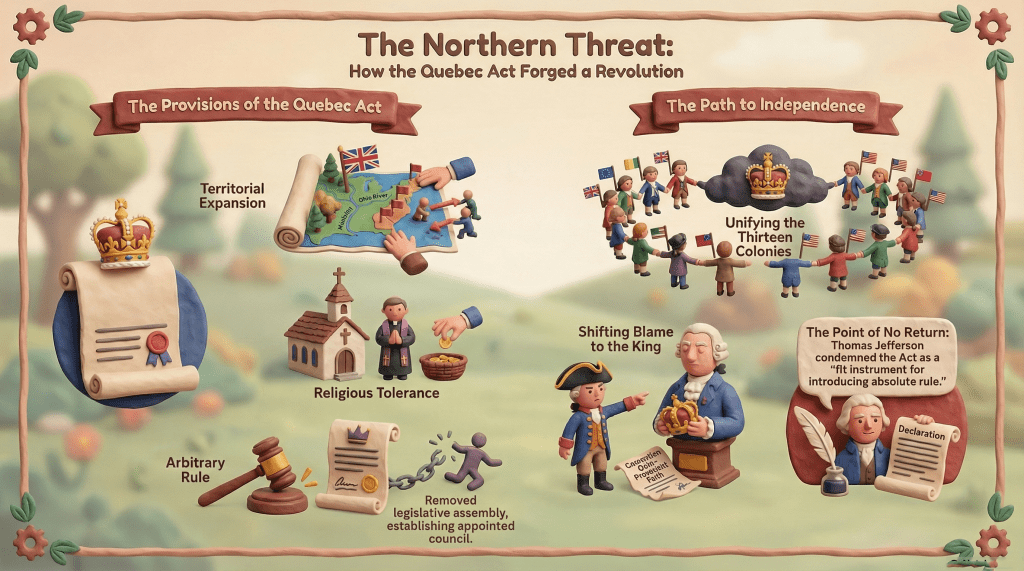
At the center of it all sits the Quebec Act of 1774, a piece of legislation most Americans today could not pick out of a lineup. And yet, in 1775, it hit the colonies like a thunderclap.
Why?
Because it did three things that, taken together, felt less like governance and more like a warning shot.
First, it handed vast western lands, territory colonists believed they had fought and bled for, over to Quebec. Second, it established a form of government there with no elected assembly, no juries, and authority resting squarely in the hands of a crown-appointed governor. And third, perhaps most unsettling of all, it restored and protected Roman Catholic institutions in the region, complete with the power to collect tithes.
Now pause for a moment and step out of the modern world. Religious differences today might spark arguments, maybe a cable news segment or two. In the 18th century, they sparked wars, executions, and deep, generational distrust.
To the colonists, this was not policy. It was a glimpse of a possible future.
A future where their land was gone, their legal protections stripped away, and their religious and political identity replaced by something they neither trusted nor understood.
As Dave lays out in the episode, this was not just irritating. It was existential.
And when fear takes hold, people start making decisions they might not otherwise consider.
Like sending emissaries north to convince Canada to join the colonial cause. When that failed, they tried something a bit more… direct. An invasion. One that ended, frankly, in disaster, but not without consequence. The campaign slowed British movements just enough to ripple forward into later successes, including the turning point at Saratoga.
There is a certain irony here. The colonies feared being surrounded by hostile powers, yet within a few years they would ally with one of them. The old proverb comes roaring back to life. The enemy of my enemy is my friend.
And beneath it all, something else begins to shift.
Anger, once directed at Parliament, starts to settle squarely on the shoulders of George III. Not just as a distant monarch, but as a man who, in their eyes, had broken his own sacred oath.
That is the kind of betrayal people do not forget.
This episode does not just revisit a neglected grievance. It pulls back the curtain on the emotional engine of the Revolution itself. Not outrage. Not idealism. But fear of what might come next if nothing was done.
And once you see it that way, the road to independence feels a lot less like a bold leap, and a lot more like a door slamming shut behind them.
 DAVE DOES HISTORY
Leave a comment