
There is a dangerous kind of man in history, and he is not the one sharpening a knife in the dark. He is the one sitting at a desk, convinced he is doing his duty.
That is where this episode of Dave Does History begins.
In Hour 3 of Bill Mick Live on March 24, 2026, the conversation does not ask whether King George III was a tyrant. That question has been answered, argued, and printed on parchment for 250 years. Instead, it asks something far more unsettling. What if he wasn’t, at least not in his own mind?
Because the idea of the “perfect villain” is not the cackling figure we grew up with. It is the man who believes he is right. Completely, unshakably right. The kind of man who can look at unrest, protest, even rebellion, and conclude not that he has failed, but that others have.
And when you place George III in that frame, the picture starts to shift.
From London, the empire did not look oppressive. It looked fragile. It looked expensive. It looked like something held together by thread, debt, and the quiet assumption that the colonies would play their part. And when they did not, when they resisted, argued, or outright defied, the king did not see a cry for liberty. He saw disorder. He saw ingratitude. He saw a system being challenged that, from his vantage point, was working exactly as it should.
That is the tension running through this episode.
Because on the other side of the Atlantic, the same system felt very different. What London called discipline, the colonies began to experience as control. What Parliament called authority, Americans started to question as overreach. And slowly, almost reluctantly at first, the argument began to change.
It was no longer about taxes. Not really. Cheap tea or expensive tea, that was never the heart of it. The real question was whether power had limits, and more importantly, who got to decide those limits.
That is a far more dangerous debate.
By the time we reach 1776, the colonies are not just complaining. They are building a case. A formal accusation. An itemized indictment. A public argument meant not only for themselves, but for the entire world to hear.
And like any good case, it needs a defendant.
Enter King George III.
Not because he passed every law or wrote every policy, but because he could be seen. He could be named. He could carry the weight of a system on his shoulders in a way that no abstract idea ever could. It is easier to oppose a man than a mechanism, easier to rally against a face than a framework.
So the king becomes the villain.
And here is the part that lingers.
He never agreed.
To his dying day, George III did not believe he had done anything wrong. He saw himself as preserving order, defending empire, fulfilling a duty placed upon him by birth and by God. The colonists, meanwhile, believed they were defending liberty, asserting rights that no king had the authority to deny.
Both sides made their case. Both sides believed it.
Only one side wrote the story that followed.
This episode walks straight into that tension, without flinching, and asks you to sit with it. Not as a neat morality play, but as a collision of ideas that still echoes today.
Because the most dangerous villains in history are rarely the ones who know they are villains.
They are the ones who never doubt they are right.
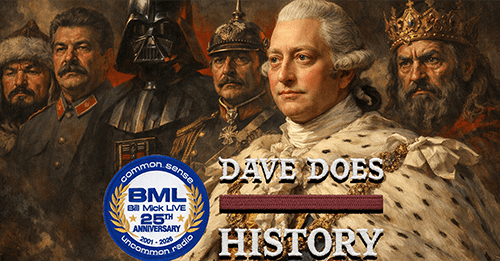



 DAVE DOES HISTORY
Leave a comment