
History rarely announces itself with trumpets. More often it slips in quietly, carrying a piece of paper, hoping someone important will read it. That is the thread running through this week’s Liberty 250 segment on Bill Mick Live, where Dave Bowman pulls listeners back to a cold December in 1640 and asks a deceptively simple question. Where did Americans learn to complain in writing?
The answer is not 1776. It is not Philadelphia. It is not even Jefferson’s desk. It is England, bruised and restless, stumbling toward civil war while insisting, at least at first, that it was only asking for reform. In this episode, Dave explores the Root and Branch Petition, a document that sounds foreign until you listen closely. Then it starts to feel uncomfortably familiar .

What The Frock – The Musical
The genius of this conversation is not the dates or the names, though those matter. It is the way Dave frames historical understanding itself. He opens with a deceptively personal analogy, the cultural gap between generations watching That 70s Show. What feels obvious and lived in to one generation is just background noise to another. That gap, Dave argues, is exactly what separates modern Americans from the world that shaped the Founders. They did not just know history. They lived inside its echoes.
From there, the episode moves into darker territory. Charles I rules without Parliament. Courts that once restrained power become instruments of enforcement. Taxes meant for emergencies become permanent habits. Religious uniformity is imposed not through persuasion but through punishment. Ears are cut off. Dissent is branded, literally. These are not colorful footnotes. They are warning signs. When grievances cannot be aired, governments stop feeling like something people participate in and start feeling like something that happens to them.
At the center of the discussion is what Dave calls Rule Three. When institutions stop working, people turn to personalities. The Root and Branch Petition is not a riot or a rebellion. It is citizens doing the last thing available to them within the system. They write. They list grievances. They demand structural change, not cosmetic fixes. That habit, Dave reminds us, did not originate with Americans. It was inherited.
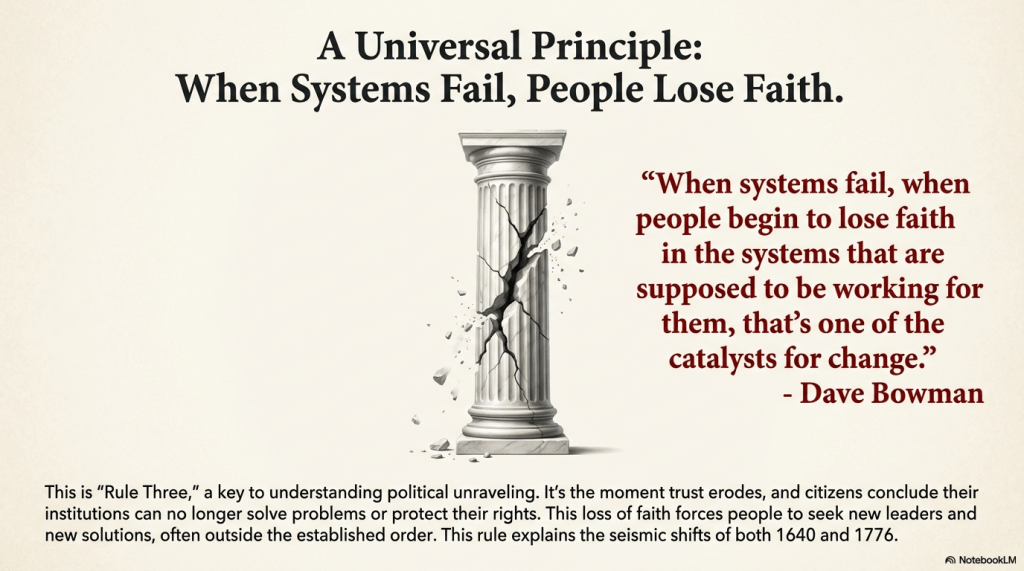
What makes this episode particularly sharp is its refusal to romanticize outcomes. England’s crisis produced Oliver Cromwell, a figure of immense ability and immense danger. America’s crisis produced Washington, a man powerful enough to hold things together and restrained enough to step away. That difference, Dave argues, was not inevitable. It was fragile. It depended on character, circumstance, and a public that still wanted institutions to survive.
This is not history as comfort food. It is history as a mirror, held up without flattery. The Root and Branch Petition did not ask for independence. It asked for legitimacy. When legitimacy collapses, confrontation follows whether anyone wants it or not. That pattern is old. Older than America. Older than 1776. And it is still with us.
This week’s Liberty 250 reminds us that the Declaration of Independence did not appear out of thin air. It belongs to a long tradition of people who believed that when systems fail, silence is not an option. They write. They sign their names. They risk consequences. And sometimes, history turns on a piece of paper that refuses to be ignored.



 DAVE DOES HISTORY
Leave a comment