
The story begins with a simple question that kept Spain awake at night. Since the world was round, and if the Portuguese had locked down the route to Asia by way of Africa, then where was the western route that logic insisted must exist? Spain felt fenced in, boxed out, and pushed to the sidelines of the spice trade. The Portuguese were sailing around Africa with a confidence that bordered on arrogance. Every shipload of cloves, nutmeg, and cinnamon sent Lisbon into louder celebration. Spain had sent Columbus west in the hope that he might stumble into the Indies. Instead he collided with two vast continents that forced every cartographer to sharpen his quills. The Portuguese were delighted, since this new mass of land improved their own leverage. The Spanish were less amused. If Asia could not be reached on a straight shot across the Atlantic, perhaps some hidden doorway existed where the continents ended. It was the kind of idea that kept kings hopeful and sailors nervous.
Ferdinand Magellan was a man who built a career on making other people nervous. He had given years of service to Portugal, had sailed to India, had fought in Morocco, and had managed to irritate enough powerful people that he eventually decided his future lay elsewhere. He believed the Moluccas, the coveted Spice Islands, were on the Spanish side of the world according to the fuzzy but politically convenient lines drawn in the Treaty of Tordesillas. Portugal disagreed and treated him as a nuisance. That insult was enough to send him into Spanish service, where King Charles I saw in him a man willing to gamble everything for the sake of the crown. Charles was seventeen years old and possessed the kind of youthful confidence that paired well with Magellan’s stubborn determination. Magellan presented his plan, and the king signed off. Spain would search for a western route, and Magellan would lead the expedition.
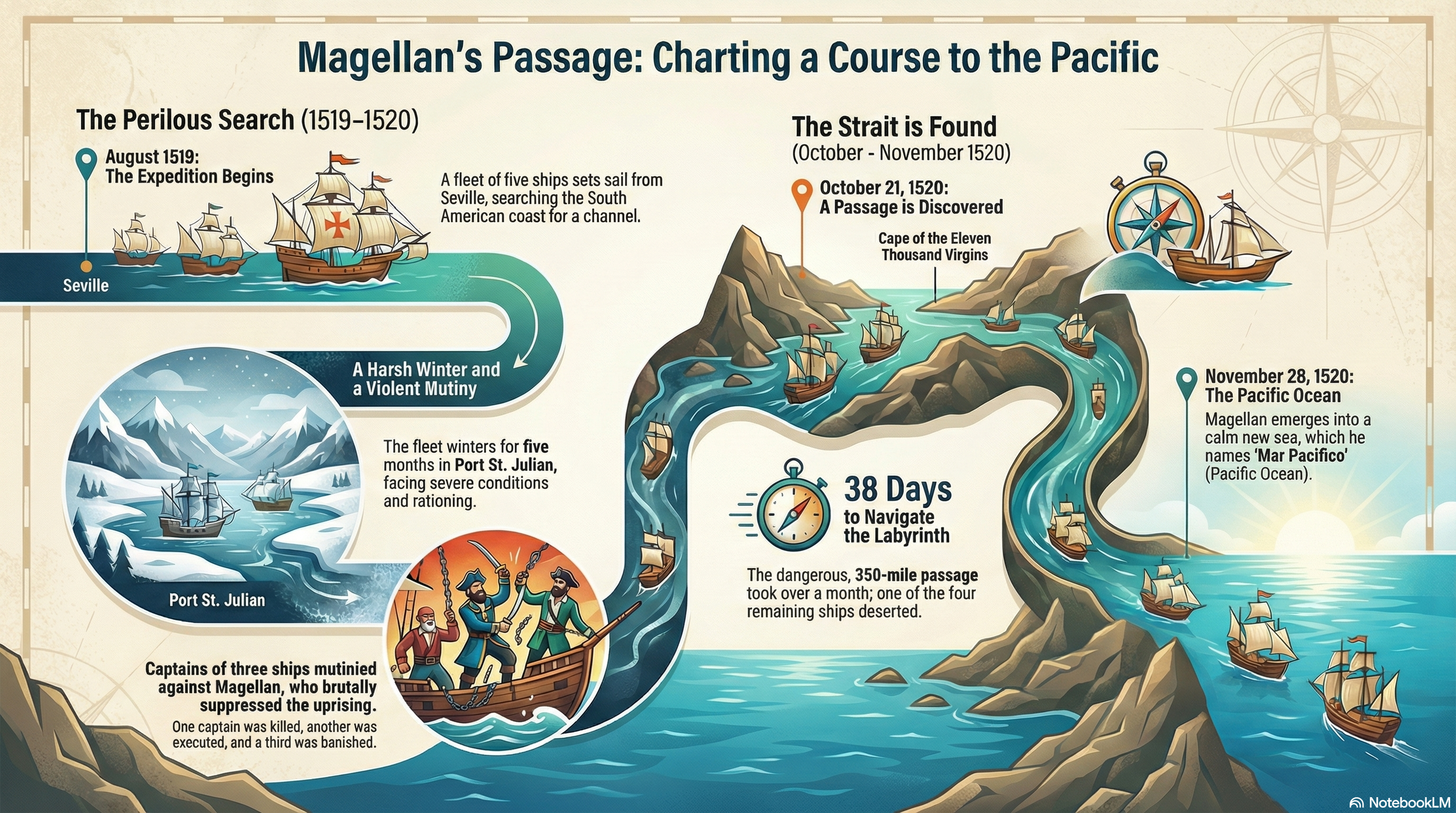
The fleet was an assortment of ambition held together by timber, rope, and faith. Five ships set out from Seville in August of 1519. There was the flagship Trinidad, proud and a little creaky. There was the San Antonio, the largest of the group. The Concepcion sat somewhere in the middle of the pack in quality and temperament. The Santiago was small, quick, and always in danger of drowning in a serious rainstorm. The Victoria was sturdy and unassuming. It would later become the only survivor. The fleet carried somewhere between 243 and 270 men, depending on whose account one believes. Magellan did not disclose every detail of the intended journey. Some secrets were kept back so the crew would not panic before the real hardships began.
They left Sanlucar de Barrameda in September, and within days the Atlantic reminded them of its usual talent for creating discomfort. The fleet reached the Canary Islands without too much trouble, then pushed southwest across the equator toward the coast of Africa. The conditions were miserable, the heat was oppressive, and the crew began to understand that Magellan was not just searching for a passage. He was chasing an idea that seemed to retreat the longer they followed it. By December they had crossed to Brazil, landing in the harbor of Rio de Janeiro. They found fresh food, friendly people, and a brief respite from the rising tension on the ships. They celebrated Christmas in a place that must have felt like the last outpost of comfort before they ventured into the unknown.
South America sprawled along the horizon like an unbroken wall. The coastline stretched on and on, endless in its patience. The Rio de la Plata tempted them with its broad mouth. Some believed it must be the long-sought passage. Magellan, clinging to hope but leaning toward doubt, ordered the ships to investigate. They sailed far enough to discover that the river was indeed a river. It ran inland rather than outward. Francisco Albo, one of the more technically minded chroniclers, recorded the error with a hint of restrained satisfaction. He never wrote with emotion, but even a dry logbook can speak volumes between the lines.

As the months piled up, the search dragged on. South America showed no signs of splitting open. The coastline grew harsher and more forbidding. Food dwindled. Morale sagged. Every day blended into the next, and Magellan’s authority eroded under the stress. When the fleet reached Port St. Julian in March of 1520, the cracks in discipline widened into a full mutiny. The Spanish captains resented Magellan’s Portuguese birth, his secrecy, and his stubborn refusal to turn back. Luis de Mendoça and Gaspar de Casada led the revolt. Juan de Cartagena, already a thorn in Magellan’s side, added his voice. It was not a small matter. It was a direct challenge to the man who held absolute command over their lives.
Magellan responded with calculated force. He suppressed the mutiny with a speed that surprised everyone. Mendoça was executed. Casada met the same fate. Cartagena was banished. Pigafetta, who admired Magellan with the enthusiasm of a devoted chronicler, portrayed him as merciful and heroic. Others suspected that Magellan simply removed the worst threats to his leadership. Whatever the truth, the crew had no choice but to follow him. Winter settled in. The men shivered through the miserable months in that lonely port while Magellan waited for the seas to calm and the conditions to improve. During this stay they encountered indigenous people who towered over them. Pigafetta described them as giants. Magellan captured two young Patagonian males, partly for curiosity and partly as insurance that the expedition would not leave empty-handed even if no passage was found.
The Santiago, sent out as a scout, was wrecked on a reef. By some miracle the crew survived and staggered back to report the loss. It was another blow to an already anxious expedition. When spring came, Magellan ordered the fleet onward. They left Port St. Julian in August and paused once more at the Santa Cruz River, waiting for the winter winds to relent. Then, in October, they sailed south along a coastline that seemed to stretch forever. No one knew what lay ahead. They only understood what lay behind them, and the prospect of turning back offered no comfort.
On October 21, 1520, the world changed. The fleet sighted a narrow opening in the coast at forty two degrees from the pole. The date happened to be the feast of the Eleven Thousand Virgins, which gave the cape its name. Cape Virgins marked the entrance to something that resembled a passage. The water narrowed, twisted, and vanished into the interior of the continent. It was the kind of sight that must have sent adrenaline surging through every sailor aboard. Magellan ordered the ships forward, convinced that they had finally found what they sought. The passage was given a temporary name, the Strait of All Saints, in honor of the calendar and the hope that it represented.

Hope can be an unreliable companion. The channel revealed itself to be a labyrinth of coves, inlets, and branches. Snow covered the peaks on both sides. The wind howled as if the land itself wanted them to turn back. Magellan convened his pilots and cosmographers. Andrés de San Martín urged caution. He pointed to the weather, the dwindling supplies, and the possibility that the strait might be a dead end. Magellan listened, then made his decision. They would proceed. The council might debate, but the authority belonged to him alone. He issued an Order of the Day insisting that each officer state his opinion, although everyone knew the outcome was predetermined.
Magellan sent the San Antonio and the Concepcion to explore side channels while the Trinidad and the Victoria held position. It was a reasonable plan until the San Antonio failed to return. The largest ship in the fleet, carrying a good portion of their remaining provisions, vanished into the gray distance. Captain Alvaro de Mesquita, Magellan’s cousin, had been overpowered. The pilot, Estevan Gomez, seized command and turned the San Antonio back toward Spain. It was a desertion that bordered on treason. Gomez later defended himself by claiming Magellan was leading the fleet to ruin. Spain accepted his explanation only because his ship was the only one in decent shape upon its return. It was an ugly episode, and it robbed the expedition of vital supplies at the worst possible moment.
The remaining ships pressed deeper into the strait. It stretched for hundreds of miles, narrow in some places and widening into vast inland seas in others. The men stared at mountains that rose like jagged teeth. The water beneath the hulls shifted unpredictably. Anchoring was often impossible because the bottom lay far below the reach of their weighted lines. Albo noted every hazard with precision, recording depths, shoals, and bearings as if scribbling down the anatomy of a beast. Pigafetta, more given to sentiment, declared that they were sailing through the most beautiful place on earth. He compared Magellan’s confidence to genius. He sketched maps that later helped Europe understand the shape of this new world.
The voyage through the strait took more than a month. A few times they believed they had reached a dead end. Then a new channel would appear. Each discovery brought temporary relief. Every turn presented the possibility of final disappointment. The winds battered them without mercy. The cold pierced every layer of clothing. The crew had long since lost any sense of luxury. They slept on damp boards, rationed water, and prayed that the passage would lead somewhere other than oblivion.
At last, on November 28, 1520, the ships emerged into open water. The ocean greeted them with a calmness that felt almost mocking after the torment of the strait. Magellan named it the Pacific because its surface appeared peaceful. He could not know how much misery those waters would inflict in the months to come. Behind them lay the twisting channel that forever altered the map of the world. Ahead lay an ocean so large that even the most optimistic navigator would have trouble believing it.
If the strait had been a trial by ice and wind, the Pacific would become a trial by hunger and disease. Magellan believed the crossing would be short. He guessed wrong. The ocean stretched on beyond any sane expectation. The voyage lasted three months and twenty days without fresh food or clean water. The men chewed powdered biscuit that crawled with worms. They drank water that smelled of rot. They softened rawhide ropes in seawater before cooking them over small fires. Scurvy tore through the crew. Gums swelled. Teeth loosened. Skin bruised at the slightest touch. Nineteen men died. The Patagonian giant, one of the two hostages, died as well. The other passed away shortly after. One wonders what those men thought of their captors and what fate they imagined awaited them.
Toward the end of the crossing the crew sighted two barren islands. They carried no food and no water. Pigafetta called them the Unfortunate Islands. They served as a grim reminder that salvation would not come from chance. Relief finally appeared in March of 1521, when the fleet reached the Mariana Islands. Here they found fresh supplies and a few days of peace. Their desperation must have seemed absurd to the islanders who watched these ragged strangers stagger ashore.
The expedition reached the Philippines soon after. These islands, labeled the Archipelago of St. Lazarus, offered the hope of rest and perhaps the beginning of the return trip. Magellan, however, became entangled in local politics. He allied with one chieftain and angered another. On April 27, 1521, he led a small force to the island of Mactan. Whether he believed his presence would intimidate the locals or whether he underestimated their ability to resist, the result was the same. He was struck down in the surf, surrounded and overwhelmed. The man who discovered the western route to the Pacific, who had bent the map to his will, never lived to see Spain reward his achievement.
The expedition limped onward without him. Juan Sebastián Elcano eventually took command of the Victoria and completed the first circumnavigation of the globe. Only eighteen men returned to Spain. They were the battered remnant of an idea so powerful that it had outlived nearly everyone who set out to pursue it.
The discovery of the Strait of Magellan was a blow struck against the limits of the known world. It connected the Atlantic and the Pacific, not in theory but in hard, navigated reality. It revealed the true scale of the planet. It showed Europe that the West held a doorway, narrow and treacherous, into the vastness of the Eastern world. Spain guarded the knowledge carefully, knowing that pirates and rival powers would seize any advantage. The strait was not used often, since it was dangerous and slow, yet the fact of its existence changed everything. It proved that the globe could be circled and that the old boundaries were only temporary obstacles.
Magellan never returned to Spain to receive the accolades he expected. Portugal refused to acknowledge his achievement, and many Spaniards never forgave him for his Portuguese birth. Yet history remembers him. Not because he was perfect. Not because he was a hero in the clean and simple sense. History remembers him because he was determined, flawed, visionary, and relentless. He believed a route existed, and he refused to surrender until the earth itself confirmed it.
The Strait of Magellan remains one of the most awe inspiring places on the planet. Anyone who sails it today understands the courage required to face those currents in fragile wooden ships. The world has changed since 1520, but the strait still whispers the same story to anyone willing to listen. It tells of men who risked everything to find a hidden path through a continent. It tells of the desire to push beyond fear. It tells of a journey that stretched human endurance past its breaking point and kept going. It tells of Magellan, who bet his life on a narrow ribbon of water, and won just enough for the world to be forever altered.
In the end the story is not about glory. It is about stubborn resolve and the willingness to look at the edge of a map and imagine a door where others saw only rock. Magellan did not conquer the world. He did not even survive the voyage that bears his name. But he proved that determination could bend history. He found a secret passage where logic suggested one must exist. He opened the Pacific to European exploration, for better or worse. He revealed the size of the world and, in doing so, reminded us that every bold idea demands a price.
History does not always reward the brave. Sometimes it kills them. But sometimes it leaves behind a story that reshapes how we see the earth, and that legacy is no small thing. The Strait of Magellan stands as a testament to the moment when the known world cracked open and the vast Pacific rolled into view. It is a harsh and beautiful monument to the courage, arrogance, desperation, and perseverance of a crew that refused to turn back. Their suffering carried the world into a new age, even if most of them never knew it.
And that, as the old chroniclers might put it, was worth the voyage.





 DAVE DOES HISTORY
Leave a comment