
John Adams walked into history as a man both proud and painfully aware of how history would judge him. He called himself obnoxious, suspected he was unpopular, and yet believed with the stubbornness of a Puritan that truth would outlive fashion. He became the second president of the United States, serving from 1797 to 1801, but long before that he had been the cranky conscience of a revolution. Where others blazed with charisma, Adams smoldered with intellect. He was brilliant, anxious, moral, and profoundly human. In an age of powdered wigs and perfect portraits, he was one of the few founders whose flaws were as visible as his virtues. He was neurotic, pompous, and impatient, yet unwavering in his devotion to liberty. His world revolved around two deep relationships that reveal almost everything about him. One was his marriage to Abigail Smith Adams, perhaps the most extraordinary partnership in early American political life. The other was his complicated friendship with Thomas Jefferson, which began in the heat of independence, burned through political rivalry, and rekindled into one of history’s most thoughtful correspondences. Adams lived and governed in what historians call the politics of disjunction, an era when his older vision of civic virtue and disinterested republicanism collided with a new world of populism and party warfare. He was a man whose ideals were forged in revolution but tested in the fire of politics. Though his presidency was scarred by conflict and division, his reputation has endured because his compass never wavered from principle. He left the world on the fiftieth anniversary of the Declaration of Independence, dying within hours of Jefferson, murmuring words that were said to be “Jefferson still lives.” They did not, in fact, live at that moment, but the sentiment captured something timeless: two founders bound together, their lives echoing across the republic they built.
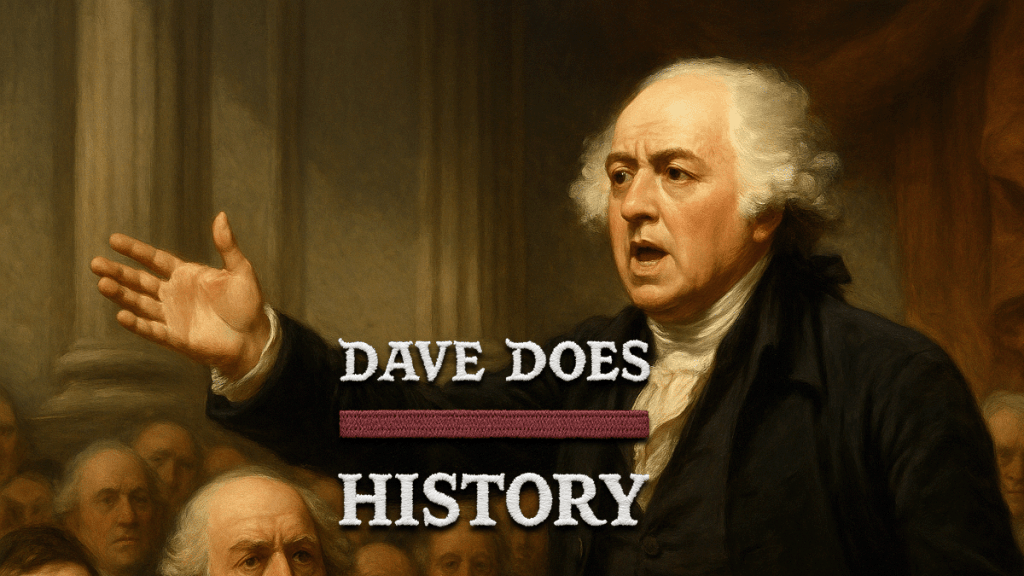
Adams’s road to independence began in the rocky soil of Braintree, Massachusetts, where he was born in 1735. His father was a farmer and deacon who wanted him to be a minister, but young John found more passion in argument than in sermon. He attended a Latin school, entered Harvard at sixteen, and left in 1755 with an education shaped by Cicero, Aristotle, and the stern logic of New England’s Calvinism. After teaching for a time, he chose the law, apprenticing under James Putnam and opening his own practice in 1759. He married Abigail Smith in 1764, his third cousin and his equal in intellect. Their letters over the next half-century would capture the intimacy of two minds joined by love, distance, and duty. They would raise six children, among them John Quincy Adams, whose own presidency would later fulfill the father’s ambition for family legacy. The young lawyer quickly made a name for himself with a sharp pen and sharper temper. When the British Parliament passed the Stamp Act in 1765, Adams anonymously published essays arguing that taxation without consent violated the rights of Englishmen. His words traveled through the colonies and brought him into the orbit of men like Samuel Adams and James Otis. Still, it was his defense of British soldiers after the Boston Massacre in 1770 that defined his sense of justice. In a city boiling with fury, he stood before a hostile jury and argued that even hated men deserved a fair trial. “Facts are stubborn things,” he said, and by those facts his clients were acquitted. The act cost him friends but earned him lasting respect. It showed the colonists that liberty required restraint as much as passion.
When Massachusetts sent Adams to the Continental Congress in 1774, he carried his legal mind and his Puritan conscience into a room filled with radicals and moderates. He soon emerged as one of the most forceful voices for independence. He argued that the colonies must prepare for war and pushed to nominate George Washington as commander of the Continental Army, recognizing the unity that a Virginian in charge of New England troops could provide. On the Marine Committee he helped create a Continental Navy and Marine Corps, believing that a nation seeking independence must be able to defend its commerce and coast. His fingerprints were on nearly every act of institution building that defined the early revolution. When the movement for independence reached its climax, Adams was appointed to a five-member committee to draft the Declaration. Knowing his reputation as blunt and unpopular, he insisted that Thomas Jefferson write the draft, saying Jefferson could write ten times better and that a Virginian’s words would carry more weight than those of a Massachusetts lawyer. Yet Adams fought in Congress to have the document adopted, speaking with fire and conviction when others hesitated. Jefferson later said that Adams “was the colossus of independence.” In that moment Adams found the purpose of his life: to shape a republic grounded in law, liberty, and virtue.
Diplomacy followed revolution. Adams was sent to Europe to negotiate alliances and loans, serving in France, Holland, and later Britain. In the Netherlands he secured vital credit that kept the infant republic alive. In 1783 he joined Benjamin Franklin and John Jay to negotiate the Treaty of Paris, ending the war and securing American independence. The work nearly broke his health, but he saw it through. In letters home he confided to Abigail his exhaustion and longing for peace, while she wrote back with humor and affection, keeping him tethered to home. His time abroad hardened his skepticism of monarchy and convinced him that self-government required education and virtue more than mere enthusiasm. Out of these reflections came his 1776 pamphlet “Thoughts on Government,” in which he wrote that “happiness is the end of government” and “consent the means.” He called the divine science of politics “the science of social happiness.” The best government, he wrote, is one that provides ease, comfort, and security to the greatest number. He declared that a republic must be an “empire of laws, and not of men.” He argued for a division of powers to prevent tyranny and proposed a bicameral legislature in which one house would mirror the people and another would refine their passions. The executive, chosen by both houses, would stand as guardian of stability. “Where annual elections end,” he warned, “there slavery begins.” The judiciary, he said, must be independent, its judges men of learning and virtue holding office during good behavior. These ideas became the scaffolding of the Massachusetts Constitution of 1780, which in turn influenced the federal Constitution seven years later. Adams saw government as a moral architecture, designed to keep human frailty from collapsing freedom.
The partnership of John and Abigail was more than domestic comfort; it was the emotional infrastructure of the revolution. Their letters—more than twelve hundred—record debates about virtue, education, and equality that were far ahead of their time. Abigail managed the family farm while John served abroad, handling finances and investments that helped preserve the family’s fortunes. She was witty, strong-willed, and politically aware. When she wrote in 1776 to “remember the ladies,” she wasn’t joking. She warned that if men failed to grant women representation, women would “foment a rebellion.” She opposed slavery as inconsistent with the new nation’s ideals and taught a free black youth in her home despite local criticism. Her faith and intellect made her an equal partner in her husband’s political life. During his presidency, her letters and private influence were so extensive that opponents mockingly called her “Mrs. President.” In truth, she was his conscience, and he trusted her judgment more than any man’s.
When the new government under the Constitution took shape, Adams became the nation’s first Vice President under George Washington. The job, as he said, was “the most insignificant office ever devised,” but he treated it seriously, presiding over the Senate and studying the mechanics of government. His personality and sense of decorum clashed with emerging party politics. Within his own Federalist ranks, he met a rival he could neither outtalk nor ignore: Alexander Hamilton. Hamilton and Adams despised one another. Adams saw Hamilton as manipulative and vain, a schemer who cared more for his own glory than the republic’s virtue. Hamilton saw Adams as arrogant, erratic, and unfit for command. Their feud divided the Federalists and poisoned Adams’s presidency before it began. Adams distrusted Hamilton’s vision of industrial power and financial consolidation, calling banks “more injurious to religion, morality, and prosperity than beneficial.” Hamilton, in turn, tried to maneuver the Federalist Party toward himself. The two men embodied opposing visions of what the United States should become: one moral and agrarian, the other commercial and centralized. When Adams sought re-election in 1800, Hamilton circulated a pamphlet savaging him, calling him unfit for office. Intended for private circulation, it leaked to the public and fractured the party beyond repair. Even after Hamilton’s death in 1804, Adams could not resist calling him “a little man” who had corrupted the spirit of government.
Adams’s presidency began in 1797 under a cloud of tension with France. French privateers were seizing American ships, convinced that the United States favored Britain. Congress revoked treaties with France, and an undeclared naval conflict began. Adams responded by expanding the Navy, ordering new frigates and creating a Marine Corps worthy of its name. The Navy’s victories—Constellation over L’Insurgente and La Vengeance—restored American pride. Adams called the Navy “the shield of our infant Republic” and was later honored as its father. Yet as Federalist hawks pushed for full war, Adams resisted. He believed peace was the nation’s true interest and sent envoys to negotiate. Their humiliation in the XYZ Affair, when French intermediaries demanded bribes, inflamed public anger, but Adams persisted. Against his own party’s wishes he reopened diplomacy and signed a new treaty in 1800 that ended hostilities. It was a decision that cost him politically but saved the country from a ruinous war. In private he called it his greatest service to America.
The same year saw the passage of the Alien and Sedition Acts. Passed by a Federalist Congress in the fever of foreign fear, the laws allowed deportation of non-citizens and criminalized criticism of the President or government. Adams signed them but never used them aggressively. Others did, and editors were jailed for dissent. The acts remain the darkest blot on his record, contradicting the very liberties he had once defended. He would later regret the political cost. His insistence on independence from party control alienated both Federalists and Jeffersonian Republicans. He governed with the old ideal that the executive should stand above factions, yet the nation had already entered the age of partisanship. His belief that democracy required restraint and that pure popular rule led to anarchy made him appear elitist in an era that celebrated equality. He believed in a natural aristocracy of talent and virtue, not birth, but the nuance was lost on voters. The election of 1800 became one of the ugliest in history. Adams faced not only Jefferson but his own divided party. The result ended his presidency and marked the collapse of the Federalists. In defeat, Adams refused to attend Jefferson’s inauguration. He left Washington before dawn, returning to Quincy with dignity wounded but conscience intact.
In retirement he returned to Peacefield, his farm in Quincy. The revolution was complete, and he had played nearly every role in it: lawyer, advocate, diplomat, vice president, president, and elder statesman. He wrote letters, tended his orchard, and doted on grandchildren. Time softened his public bitterness. His correspondence with Benjamin Rush reopened the path to reconciliation with Jefferson. Rush had told him that Jefferson still cherished their friendship, and Adams, ever the letter writer, took the bait. In 1812 he wrote Jefferson, and the old fire reignited—not in anger but reflection. Over fourteen years they exchanged hundreds of letters. They debated politics, philosophy, science, and the meaning of the revolution. Jefferson called the letters a conversation between two old men who had “grown gray in honest zeal for the good of mankind.” When Abigail died in 1818, Jefferson wrote a tender letter of condolence, and Adams replied with gratitude. Their renewed friendship became a monument of its own. On July 4, 1826, Adams lay dying in his Quincy home, unaware that Jefferson had died hours earlier in Virginia. His last words, depending on the source, were either “Jefferson still lives” or “It is a great day.” Both fit. The day marked fifty years since the Declaration of Independence. The nation had survived its first half-century, and Adams could die believing it endured.
History’s judgment of Adams has shifted over two centuries. His presidency remains controversial, too independent for party men, too prickly for popularity, but his principles have aged well. He believed government must rest on law and virtue, that peace is a greater achievement than conquest, and that liberty without order dissolves into chaos. His Massachusetts Constitution, with its separation of powers and independent judiciary, became a model for state governments and a clear influence on the federal frame. His writings in “Thoughts on Government” still echo in classrooms and courtrooms. He scorned the self-promotion that later defined politics, preferring reason over rhetoric. If Jefferson wrote the poetry of democracy, Adams wrote its grammar. He remains a moralist in politics, stubborn but sincere. Even his failures reveal the growing pains of a new nation learning how to govern itself.
Abigail’s place in history stands beside his. She was no passive partner but an active intellect shaping the private heart of the republic. Her voice on women’s education, property rights, and moral equality influenced generations. Historians regularly rank her among the greatest of first ladies. She embodied the same virtue her husband preached, without the temper that so often undermined him. Together they gave the nation an ideal of marriage rooted in respect and conversation. If the Revolution had saints, they were its domestic pair.
In death Adams’s influence spread through his son, John Quincy, who inherited his discipline and moral resolve. The Adams line produced diplomats, historians, and reformers who carried the family creed of duty. Monuments mark his memory from Massachusetts hills to Washington, D.C., where a proposed Adams Memorial awaits completion. A cairn stands on Penn Hill where John and Abigail watched the Battle of Bunker Hill burn. His words survive in granite and paper alike, carved into the nation’s conscience. He once feared that he and his generation would be forgotten, that the farmers and philosophers who fought for liberty would vanish under the weight of prosperity. He was wrong. Time has given him what popularity never could: the respect due a man who placed principle above ambition.
Adams remains one of the most recognizably human of the founders. He quarreled, he fretted, he doubted, but he never surrendered his faith in the republic. He believed that honor mattered more than success, that truth endured even when misunderstood. His life captures the paradox of a nation born in ideals and bound by imperfection. He was a thinker out of step with his time, yet indispensable to it. When he predicted that history might forget him, he underestimated how deeply his fingerprints were set into the American experiment. Two and a half centuries later, his voice still carries, sharp and stubborn, reminding us that freedom is a discipline, not a luxury, and that republics depend less on charisma than on conscience. He may have failed to master the politics of popularity, but he mastered something greater. He lived and died believing that reason, law, and virtue could outlast passion, and in that belief he was proven right.




 DAVE DOES HISTORY
Leave a reply to 41 Cold War Sentinels – USS John Adams SSBN-620 – Patrol Reports Cancel reply