
They called him “Rabbit” when he was a boy. Not because he was cute or timid, but because he could run errands across Chicago’s South Side faster than anyone else. He didn’t stroll. He sprinted. Ralph Metcalfe didn’t just grow up fast. He was fast. And on August 3, 1936, under the cold eyes of Adolf Hitler in a stadium built to glorify Aryan supremacy, Metcalfe ran what many still call the most famous race in Olympic history. He lost.
But not really.
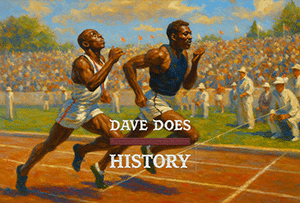
Born in Atlanta in 1910, Ralph Harold Metcalfe moved with his family to Chicago when he was seven. His father worked stockyards. His mother sewed for a living. Ralph, from an early age, ran. At Tilden Technical High School, his track coach didn’t sugarcoat the truth. If Metcalfe wanted to win as a Black man, he had to leave daylight between himself and everyone else. So he did. He trained until his legs burned and his lungs turned to gravel. It worked. By the time he was nineteen, he was the National Sprint Champion.
That would’ve been enough for most. But Metcalfe kept going. At a track meet in Chicago’s Soldier Field, he caught the eye of Marquette University’s athletic director. A scholarship offer followed. Metcalfe worried about the cost of college, but his mother wouldn’t let him say no. So he packed his bags and became a Milwaukee man. He excelled in the classroom and crushed it on the track. By 1932, he’d tied or broken multiple world records. At the Los Angeles Olympics that summer, Metcalfe raced to what should have been a photo-finish tie in the 100 meters. The judges gave gold to Eddie Tolan, who may have beaten Metcalfe by an inch or two, depending on who you ask. Metcalfe never fully bought it. Then came the 200 meters. His lane was improperly measured, starting him behind the others. He still earned bronze.
He could have been bitter. Instead, he focused on his studies and helped mentor younger athletes, one of whom was a young Ohio State star named Jesse Owens. Between 1932 and 1936, Metcalfe didn’t lose a race. People started calling him the World’s Fastest Human. It was more than a nickname. It was earned.
Then came Berlin.
Nazi Germany wanted the 1936 Olympics to be a stage for propaganda. Hitler had a stadium built to seat 100,000. Swastikas draped the entrances. The regime did everything it could to project dominance, even down to manipulating lane assignments. But the track didn’t lie.
The U.S. team, 400 strong, included 18 Black athletes. Among them were Jesse Owens, Mack Robinson, John Woodruff, and Ralph Metcalfe. They sailed together aboard the SS Manhattan and trained side by side. Before their first events, Metcalfe gathered them together. The tension in Berlin was heavy. Nazi soldiers watched from the stands. Journalists circled like vultures. Metcalfe, calm and collected, reminded the team they weren’t there to carry the weight of politics or history. They were there to compete for their country.
In the 100-meter final, Owens edged out Metcalfe by a tenth of a second. It was close, but decisive. Hitler watched silently as two African Americans stood on the podium in the middle of his engineered fantasy of racial superiority. And then, in a quiet moment away from the cameras, Owens insisted Metcalfe stand on the top step. Owens had won gold, but Metcalfe, he said, had led the team. The gesture said everything.
Later, the two men joined Foy Draper and Frank Wykoff in the 4×100 meter relay. There was controversy before the race. Two Jewish runners, Sam Stoller and Marty Glickman, had been pulled at the last moment. The official reason was strategy, but many believed the move was meant to appease Nazi officials. Metcalfe and Owens hadn’t practiced handoffs with the team. Even so, they outran everyone, shattered the world record, and won gold.
After Berlin, Metcalfe walked away from competition. He returned to the States, earned his master’s degree, and began teaching at Xavier University in New Orleans. He coached track and mentored young men. Then came the war. Metcalfe joined the Army and rose to First Lieutenant. He developed a training program nicknamed the Metcalfe Olympics, and the Army adopted it across multiple bases. He also coached the Camp Plauche Pirates baseball team, who only lost once during their season against the New York Cubans, a Negro League powerhouse.
Once the war ended, Metcalfe kept serving. He entered politics, first as a Chicago alderman, then as a Congressman. He helped found the Congressional Black Caucus and fought police brutality, even when it meant going against the powerful Mayor Daley machine. He never stopped fighting for fairness, even when it cost him politically.
He died in 1978 while running for re-election. Heart attack. He was sixty-eight. Gone too soon, but not forgotten.
It’s easy to remember the man who won gold. But it’s just as important to remember the man who stood next to him, who lifted others up, who served when the lights dimmed. Ralph Metcalfe didn’t need a gold medal to prove he was great. He proved it with every stride, every word, every choice he made. Second place on the track. First in a life well run.

 DAVE DOES HISTORY
Leave a comment